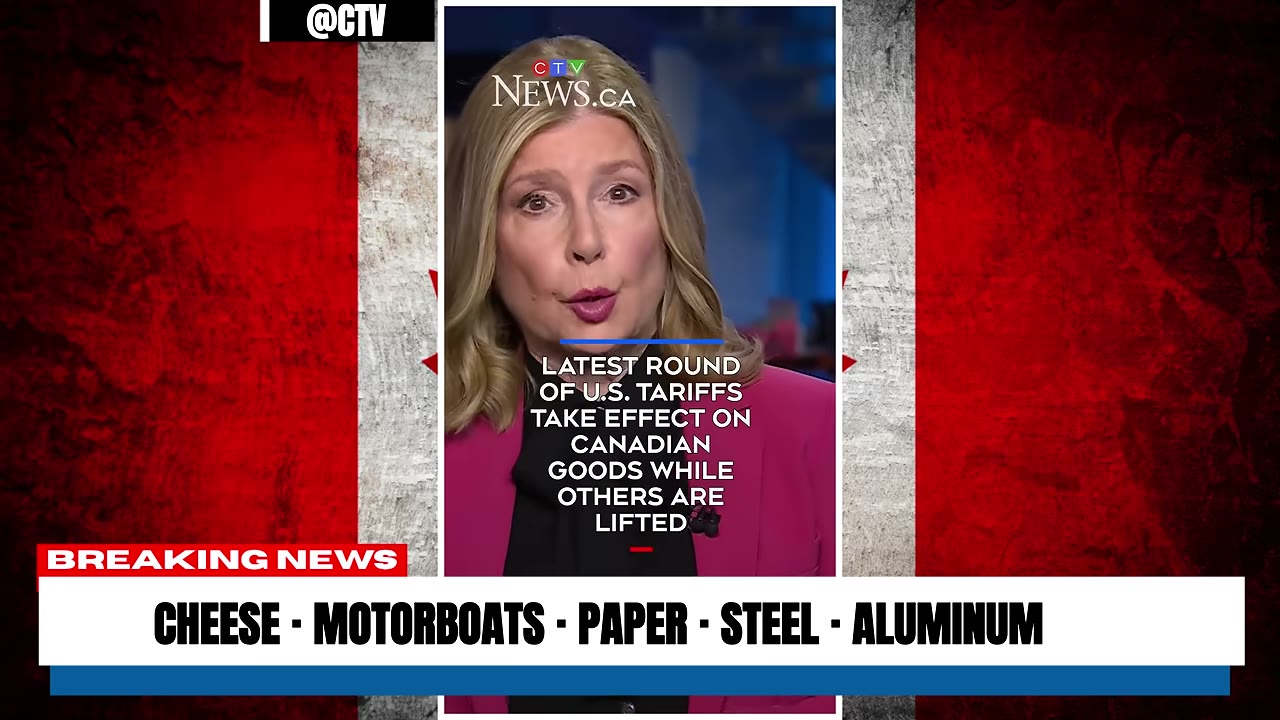
The US has imposed a new 50% tariff on 110 Canadian products including cheese, steel and motorboats, while removing levies on 10 items such as salt and toilet paper. Canada's counter-tariffs hit US dairy, and a Vermont cheese maker describes exports falling to zero.
1US slaps 50% tariffs on 110 Canadian goods as economists warn of disruption
The United States has imposed a new 50% tariff on 110 Canadian items. Economists are warning the levies will cause some regional disruptions as businesses adapt to their new reality.
The move is part of a wider push to ease the burden on US commerce, according to the broadcast.
The list of affected goods runs long. The tariffs land on products ranging from cheese and ATVs to furniture, hitting Canadian exporters across several sectors at once.
Economists quoted in the report say the disruption will not be uniform — some regions and industries will feel it more than others as companies adjust.
What happens next depends on how businesses adapt and whether Canada responds with counter-measures of its own.
2Same broadcast pairs 50% tariffs with 10 tariff removals
On the same day the US imposed 50% tariffs on 110 Canadian items, it also removed tariffs on 10 others. The two opposite lists came from the same office.
The new 50% tariffs apply to products including cheese, ATVs and furniture.
At the same time, the United States removed tariffs on 10 items including salt, cement and toilet paper. The White House says it is removing those levies to ease the burden on US commerce.
The twin moves leave Canadian exporters facing steep new costs on some goods while others get relief — a split picture from a single day of trade policy.
3Toilet paper prices could rise as US depends on Canadian pulp
Toilet paper may be the next grocery item to get more expensive. The US makes its own toilet paper, but American companies depend on pulp from trees in Canada.
The tariff fight between the US and Canada is the latest tug-of-war between the two countries, and it could soon cost shoppers more.
Three weeks before the order, a station in Ohio had already reported that the price of toilet paper was expected to rise as the trade war escalated.
The concern runs through the supply chain: even with US manufacturing, the raw pulp comes from north of the border. If that input gets more expensive, the shelf price can follow.
4Logistics expert warns of rising prices and possible layoffs
A logistics expert says the tariff fight could hit more than your grocery bill. Professor Kelly Crockson warns that if Canada charges the US more for trees, the impact will reach beyond store prices.
"If they continue to escalate, I think that's going to be the effect on the economy," she said.
Crockson said consumers could see rising prices directly, and that layoffs are also possible.
Her warning ties the trade dispute to jobs, not just shelves — a sign the fallout could spread through the wider economy if both sides keep raising costs on each other.
5Expert urges consumers not to stockpile toilet paper
A logistics expert is telling consumers not to rush out and stockpile toilet paper. Professor Kelly Crockson warned that panic-buying would create a whole new problem.
"I wouldn't rush out and load up on on toilet paper," she said.
Crockson said she worries wholesalers or consumers will read the news of rising prices and decide to load up, which then creates a fresh problem on top of the tariff fight.
Her message to viewers: wait and see how this plays out. The caution comes as the trade dispute between the US and Canada continues to escalate.
6Canada's counter-tariffs hit US cheese and dairy exports
Canada's counter-tariffs now include a 25% duty on US cheese and a 50% charge on certain milk, cream and whey products. For Northeast dairy farmers, Canada is a critical market.
Mateo Keeler co-founded Jasper Hill Farm with his brother Andy. They started the business milking cows and making farmstead cheese 23 years ago in Greensboro, Vermont, in the Northeast Kingdom right on the Canadian border.
The duties could reduce demand for US dairy products, causing a surplus of supply that would force American producers and processors to seek alternative markets.
For farms built on cross-border trade, the mirror measures land directly on their order books.
7Vermont cheese maker's exports fall from record to zero
Purchase orders at one Vermont cheese maker went from gangbusters to zero cases. Mateo Keeler says the collapse came in February of last year, when the first round of tariffs was announced.
"Our purchase orders went from absolute gangbusters after an incredible holiday season to zero," he said. "Like zero cases of cheese ordered."
Exports represent about 7 to 8% of the business historically, Keeler said. This year, he said, it's a big old donut.
Keeler co-founded Jasper Hill Farm with his brother Andy 23 years ago in Greensboro, Vermont, near the Canadian border. The order book shows what the trade fight looks like at ground level.
8Vermont farm pivots to US sales amid inflation and Canadian packaging tariffs
A 200-cow Vermont dairy farm is absorbing tariffed Canadian packaging while inflation drives up its input costs. Mateo Keeler says Jasper Hill Farm has pivoted to build US sales.
"Last year was the worst year we've ever had," he said. "This year's turning out to be okay," but he added the farm faces a crazy amount of inflation on the input side.
The farm milks 200 cows. Diesel and fertilizer prices are up, and much of the corrugate packaging comes from Canada — raw materials produced there that are now being tariffed.
Keeler said the underlying costs of doing what they do day in and day out are just escalating.
9Trump administration defends tariffs as leveling the field for farmers
The Trump administration touts the tariffs as the way to ensure a level playing field for the nation's farmers and protect American production. A Vermont farmer's verdict: "Just absolutely disastrous."
The official case, in one sentence, is that the tariffs level the field and shield US production.
Mateo Keeler, co-founder of Jasper Hill Farm, rejected that framing. He said the administration's policies have absolutely punished farmers up and down, regardless of what commodity they produce.
The gap between Washington's defense and the farm-level experience is the heart of the dispute: one side describes protection, the other describes punishment.
10Farmer calls tariffs disastrous and urges Republicans to push back
A cheese maker calls the tariffs "absolutely disastrous" and says there are no winners. He wants Republicans to act.
"We need uh Republicans to grow a spine and stand up to the insanity of the economic policies that we're all dealing with," he said.
The farmer said the issue goes beyond party lines. "These tariffs are affecting everybody," he said. "There's no winners here."
His warning lands as the tariffs stay in place. He says the pain is not limited to one side. He is asking Republicans to push back.
11Two lists from one office reveal the real tariff logic
Two lists came out of the same office on the same day: 110 things stayed expensive and 10 things were let go. The reason given for the 10 was not about Canada. It was about American commerce.
That makes the shorter list the useful one, because it shows where substitution did not exist.
An Ohio station had worked that out three weeks earlier without waiting for an announcement. A farm in Vermont shows the same rule running the other way: he cannot sell north and he pays more for what comes south.
He is not ruined and says so himself. The economist says do not panic and says so herself.