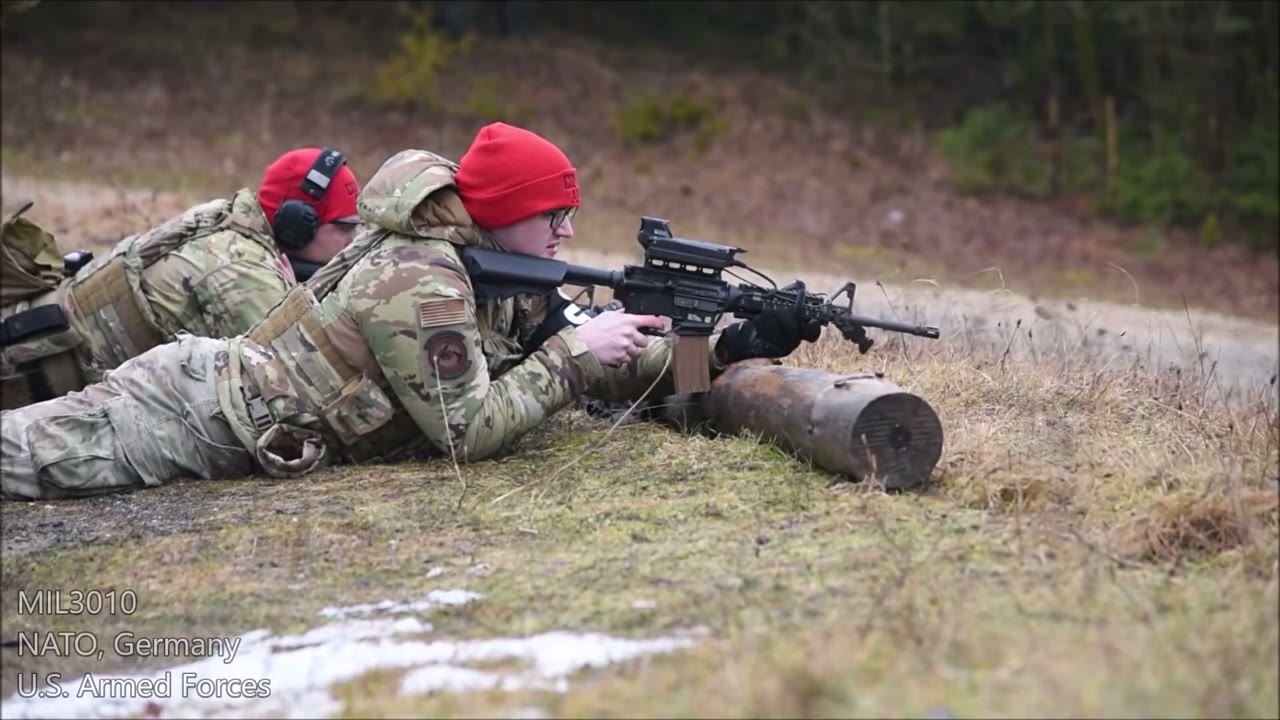
A US military training video shows soldiers in Germany using the SMASH 2000L smart scope, including counter-drone drills, range practice and squad operations. The footage captures live-fire targeting, radio procedures and unit movement planning during a NATO exercise.
1Soldiers Practice Zeroing and Firing SMASH 2000L Smart Scope
Soldiers running the SMASH 2000L smart scope in Germany spent their drill ironing out zero mode before they could fire, calling for the push-to-talk switch every time. One soldier asked a teammate for extra eye relief near the weapon, told he wasn't clear enough. The range commands followed: grounded, two, ready, then a count of "1 2 3 1." One soldier pushed back on a correction, insisting the scope was accurate. The drill kept returning to the same basics — releasing the trigger, lining up the spikes to fire, and keying the radio correctly. Getting those steps right is what makes the smart optic's targeting work in live fire.
2Troops Struggle With Scope Settings and Night Targeting
Nighttime visibility with the SMASH 2000L drew a blunt verdict from one soldier: "I can see currently this is bad for me. This is bad at night." The troops worked through zero mode settings, opening the cover only after leaving zero mode, and checked the display for drone detection — told there should be no drone at the bottom of the screen. Then came the target plan at the 100-meter mark: three targets, starting right, then middle, back to the right, then three and back to one — "1 2 right. Yeah. So it'll be right middle." At least one soldier was still trying to work out what kind of target he was looking at.
3Squad Briefs Plan to Occupy and Start Up RDU ADS Systems
Two squads will mount vehicles, cross the line of departure and roll south along the MSRS toward two RDU ADS sites, with vehicle one heading to RDU ADS 2 and vehicle two to RDU ADS 1. The order came in sequence: RDU ADS 2 shuts down first and is secured, then the full squad moves to the A do, and the squad occupying RDU ADS 1 begins its own shutdown once the consolidation is complete. After that, the full squad moves to occupation of RDU ADS 1 and 2 with 360 security established. At each container, a team of four designated operators starts the system while the other fire team of four gets its first patrol order and prepares to leave. Once a system is up, the squad calls "eagle eye" over the platoon net — "Eagle eye operational is just going to signify to the talk here that we're operational."
4Soldiers Discuss RDU ADS Use and Master Gunner Training
One soldier put the question plainly: does the unit actually run these air defense systems for its battalion, or for someone else? The answer opened a problem — "So we're we're starting to major problem right here." The exchange then turned to master gunner training, with a soldier asking how he could become one and being told he'd be shown how to get there once he arrived. The back-and-forth stayed short and unresolved, leaving the battalion question hanging over the systems the squads had just been ordered to occupy.
5Commander Describes Training Area Terrain and Cover
The training area is a mix of everything — wooded tree lines, rolling hills, open areas with multiple avenues of approach, and railroad tracks. For friendly forces, that means easy line of sight across the open ground, while the tree lines offer some concealment but not much cover. The commander's read matters for how squads move and where they can be seen. The same stretch of ground then fed into a fire mission: a target programmed at 04477, five clicks to the west.
6Fire Mission Reported Five Clicks West of Operations
A fire mission five clicks to the west was passed along with a clear bottom line: it does not affect our operations. Alpha 1 checked with Broadsword 3 for a grid coordinate and got a negative — none available. The mission was relayed for situational awareness only, not as a tasking. "And it's not affect your battle space. Just for your SA," came the reply, met with a good copy. The call stayed short: know it's out there, keep working.
7Soldiers Track Drone Release and Mitigation During Exercise
Charlie released a drone, and the question became whether to use mitigation as it moved. One soldier set a clear trigger: "If he crosses this green line, I'm taking him." The drone had been pushed down and away from the competition, though it wasn't clear whether it was missed. A call went out for Charlie 1 or Charlie 2 to signal if they would use mitigation on it. Then attention shifted to a portable ground radar — one was reported right below the unit's position.
8Portable Ground Surveillance Radar Spots Two Targets
A portable ground surveillance radar picked up two contacts right below the unit's position. "There's one right below," came the call, followed by confirmation of a second: "That's two as well. Yeah. Yeah, I got two." The count was quick and matter-of-fact. With the exercise winding down, the read was that it should be pretty quick from there.
9Exercise Wrap-Up and Family Support Anecdote
The drill was wrapping up with about 30 minutes to go, and the talk turned to family. One soldier recalled Marshall's wife, who loved the squad's drills and used to come out and record them. She was a familiar face around the unit, especially from the soldier's time on the best squad, when the families came out often. The exercise was nearly done; the memory was the last thing on the agenda.