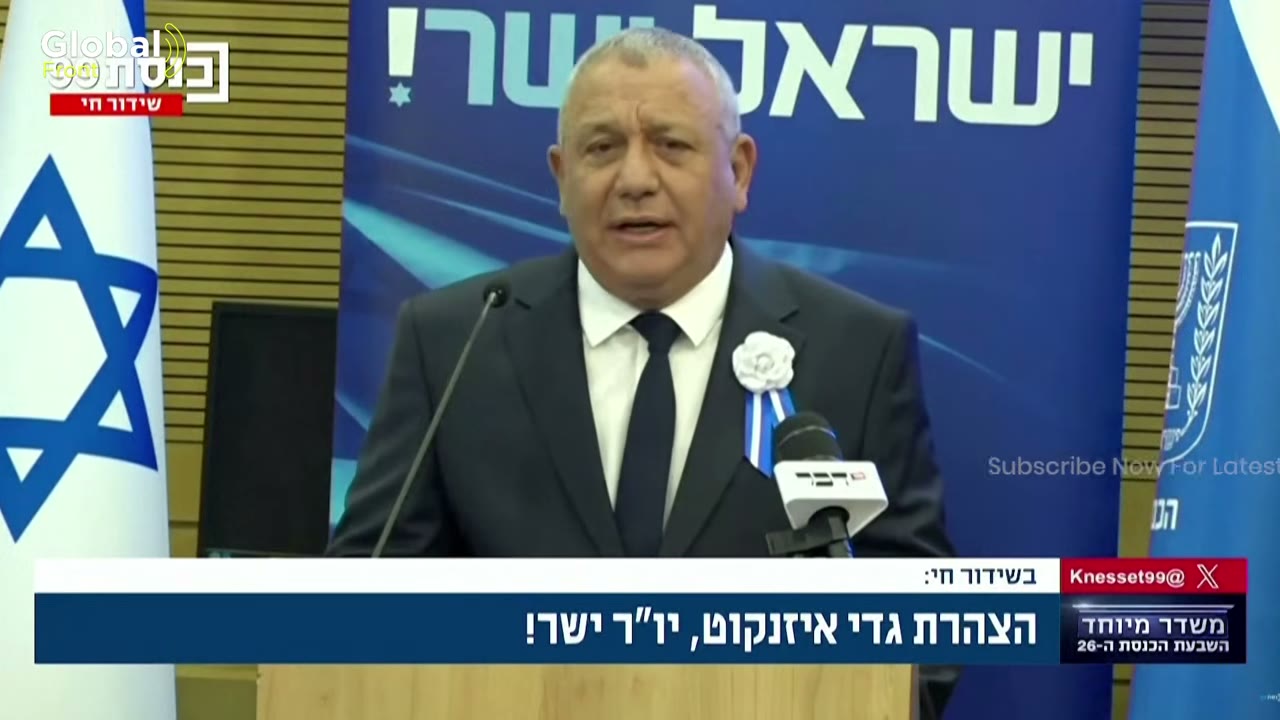
Israel's coalition talks remain unresolved more than a month after elections. Netanyahu has offered to let rival Gadi Eisenkot serve as prime minister first under a rotation deal, while Eisenkot holds the presidential mandate and faces a December 6 deadline to form a government.
1Netanyahu Offers Eisenkot First Turn in Prime Minister Rotation Deal
Israel's longest-serving prime minister has offered to let his rival take the top job first. On November 28, Benjamin Netanyahu suggested that opposition leader Gadi Eisenkot serve as prime minister first under a proposed leadership rotation agreement.
The concession came more than a month after Israel's parliamentary elections, with the fight for control of the premiership still unresolved. Netanyahu framed the move as a way to save his political future and stay in government.
The development marks a significant shift in Netanyahu's stance and raises new questions about whether he is willing to temporarily cede the country's top political post.
2Netanyahu and Eisenkot Meet Two Hours Without Final Deal
Two hours of talks between Israel's rival leaders ended with no coalition deal. On November 29, Benjamin Netanyahu and Gadi Eisenkot met at the Kirya Defense Headquarters in Tel Aviv to discuss forming a national unity government.
The meeting lasted approximately two hours, but no final coalition agreement was announced.
The talks come as Eisenkot's December 6 deadline for forming a government approaches.
3Eisenkot Faces December 6 Deadline as Netanyahu Lacks Majority
A December 6 deadline is closing in, and Israel's political parties are under pressure to compromise or face new elections. For Benjamin Netanyahu, the standoff is one of the most important political challenges of his career.
Despite leading Israel's largest parliamentary party, he no longer has the majority needed to form a government with his traditional allies.
For Gadi Eisenkot, the coming days could decide whether he becomes Israel's next prime minister or must reconsider his political strategy.
4October 27 Election Results Leave Knesset Deeply Divided
Israel's October 27 elections left the Knesset deeply divided, with no bloc reaching the 61 seats needed for a majority in the 120-member parliament.
Netanyahu's Likud became the largest single faction with 27 seats. Eisenkot's Yesh Atid won 21, Naftali Bennett's Yamina alliance took 12, Yair Golan's Democrats won eight, and Avigdor Lieberman's Yisrael Beiteinu won seven.
Neither of the two major blocs secured a majority.
5Herzog Hands Eisenkot Mandate After 67 Lawmakers Back Him
Sixty-seven lawmakers recommended Gadi Eisenkot to form Israel's next government. Forty-six backed Benjamin Netanyahu.
After consultations with members of parliament, Israeli President Yitzhak Herzog announced the count. On November 8, he officially handed Eisenkot the mandate.
"Gadi Eisenkot, I hereby entrust you with forming a government," Herzog said.
The decision was a serious political setback for Netanyahu and gave Eisenkot the chance to end his rival's leadership.
6Eisenkot Must Build Coalition Before Taking Office
The presidential mandate does not make Gadi Eisenkot prime minister. He must first build a coalition that can win parliament's confidence.
Until that process is completed, Benjamin Netanyahu continues to serve as prime minister.
Under Israeli procedures, Eisenkot initially has 28 days to finish negotiations, with President Herzog able to grant an extension of up to 14 days. If Eisenkot fails, Herzog may give another lawmaker the chance — possibly Netanyahu, though there is no guarantee the president would choose him.
7Netanyahu Drops Demand to Lead First, Accepts Deputy Role
Benjamin Netanyahu has offered to serve as deputy prime minister in the first phase of a unity government, dropping his demand to lead first.
Until recently, he insisted that Likud's status as the largest party justified his leadership, including the first turn under any rotation agreement. But as Eisenkot made progress in separate coalition talks, Netanyahu shifted.
He said he was ready to agree to Gadi Eisenkot leading the government first. A rotation deal, however, will require far more than an agreement between the two rivals.
8Eisenkot's Deals With Lieberman and Golan Reach 36 Seats
Gadi Eisenkot has already signed coalition agreements with Avigdor Lieberman's Israel Our Home party and Yair Golan's Democrats — together controlling 36 parliamentary seats with his own.
The deals strengthen his negotiating position and show he is still seeking alternatives to a partnership with Netanyahu.
Adding Naftali Bennett's Bezalel alliance would raise their combined strength to 48 seats, still short of a majority.
9Bennett Backs Unity Government if Eisenkot Leads First
Naftali Bennett backs a broad unity government — provided Gadi Eisenkot leads it first. The former Israeli prime minister has become a key figure in the negotiations.
His position differs from other opposition figures who do not want to enter an administration with Netanyahu.
For Eisenkot, partnering with Likud could create tensions inside the alliance that helped him win the presidential mandate. Several opposition leaders campaigned on replacing Netanyahu, and joining a coalition with him would require explaining a significant change.
10Ben-Gvir's Inclusion Divides Unity Government Talks
One of the most contentious questions in the unity talks is National Security Minister Itamar Ben-Gvir and his Otzma Yehudit party. Eisenkot's negotiating team reportedly opposed including Ben-Gvir's party in a proposed unity government.
Likud has not explicitly committed to abandoning its traditional coalition partners.
The differences reflect deeper contradictions over national security, internal governance, relations with the Palestinians and Israel's political course. For Netanyahu, a break with longtime allies could weaken ties that have helped sustain his leadership; for Eisenkot, accepting them could undermine his campaign commitments.
11Ultra-Orthodox Parties' 13 Seats and Draft Exemption Dispute
Israel's ultra-Orthodox parties, Shas and United Torah Judaism, hold 13 parliamentary seats — enough to give them significant influence over forming a government.
Negotiations with them could offer Gadi Eisenkot another path to a majority. But their positions on exempting religious students from military service remain a serious source of disagreement.
Eisenkot's allies support broader conscription and changes to long-standing exemption arrangements, while ultra-Orthodox representatives seek to protect religious education. A compromise could help Eisenkot gather support, but it could also provoke resistance from members of his own opposition alliance.
12Arab MPs' 19 Seats Could Decide Israel's Next Government
Israeli Arab parties could decide who forms the next government. The Joint List holds 11 parliamentary seats and Ra'am, led by Mansour Abbas, holds eight — 19 MPs in a parliament where no main bloc has a majority.
Their recommendations helped Gadi Eisenkot win the presidential mandate, but turning that support into an effective coalition has proved much harder.
Yair Golan supported exploring cooperation with Arab MPs, while other opposition figures expressed doubts about relying on them to maintain parliamentary confidence.
13Mansour Abbas Recognizes Hamas as Terrorist Organization
Mansour Abbas acknowledged on November 28 that Hamas is designated a terrorist organization, a significant shift made during a television interview.
The statement fulfilled one of Gadi Eisenkot's conditions for potential political cooperation with Arab parties and may improve prospects for negotiations involving Ra'am.
For Benjamin Netanyahu, it adds political pressure, since Eisenkot may have more opportunities to form a government without Likud. Disagreements between opposition parties over the role of Arab MPs remain, and no final decision has been made.
14Knesset Elects Mickey Levy Speaker With 66 Votes
Israel's opposition pulled off a parliamentary upset, electing Yesh Atid MK Mickey Levy as Knesset speaker with 66 votes against 52 for the opposing candidate on November 17. The result showed parties outside Benjamin Netanyahu's traditional alliance can cooperate on major parliamentary decisions without forming a formal coalition government.
After his election, Knesset Speaker Matan Kahane declared that the Knesset is a home for all citizens of Israel.
The win strengthened Eisenkot's political position and demonstrated Netanyahu's limited influence in the newly elected legislature. Despite the long stalemate, Eisenkot's alliance has already shown it can win important parliamentary victories — though a final decision on the government has not yet been made.
15Speaker Victory Does Not Equal a Stable Government
Winning the speaker's chair is not the same as forming a stable government. Running the administration requires long-term cooperation on legislation, economic policy, national security, ministerial appointments and Israel's broader diplomatic priorities.
The November 17 speaker vote, in which Mickey Levy won 66 to 52, proved rivals can unite on parliamentary decisions — but only for that vote.
Meanwhile, the differences between Netanyahu and Eisenkot went beyond domestic politics, the transcript says, pointing to a deeper split between the two leaders.
16Netanyahu and Eisenkot Clash Over Urgency of Iran Threat
Israel's two rival leaders split sharply on Iran during political meetings on November 23. Netanyahu stressed national unity, saying: "Our ability to ensure the existence of the state in the face of the great threats surrounding us depends on our unity."
He pitched a broad government as a way to address Israel's regional security concerns and keep political stability.
Eisenkot offered a different assessment the same day, stating that Israel does not face an imminent Iranian threat that would require military action before a new government is formed. The clash highlights their dispute over the urgency and timing of a potential security response.
17Eisenkot's Military Background Shapes Security Disagreement
Eisenkot's security disagreement with Netanyahu carries weight because of his record: he served as Chief of the General Staff of the Israel Defense Forces from 2015 to 2019 and sat in the emergency military cabinet set up after the events of October 2023.
That military experience gave him considerable knowledge of national security issues, making his break with Netanyahu particularly significant in the leadership struggle.
The question is not simply whether Israel should stay prepared to respond to regional challenges, but how those decisions should be made while the country's political leadership remains uncertain.
18India Watches Israeli Political Uncertainty Closely
India is watching Israel's political uncertainty closely, having expanded cooperation with Jerusalem under Prime Ministers Narendra Modi and Benjamin Netanyahu. Modi's state visit to Israel on February 25 strengthened bilateral engagement in defense, technology, agriculture, innovation and economic development.
Both countries also welcomed the signing of a memorandum on defense cooperation on November 4, 2025.
A leadership change in Israel could shift diplomatic priorities, but there is currently no confirmed evidence that Eisenkot intends to review the strategic partnership with India. Those ties go beyond the personal bond between Netanyahu and Modi, resting on established institutional cooperation and shared interests.
19Bank of Israel Holds Rate at 3.25% Amid Political Turmoil
The Bank of Israel held its base interest rate at 3.25% on November 23 amid domestic and global uncertainty, as political instability deepened concerns about the country's economic prospects.
The weakening Israeli shekel has added pressure on financial markets. Businesses and investors are watching whether coalition negotiations can produce a stable administration able to inspire confidence in future public policy.
A prolonged stalemate could complicate budget planning, economic reforms and public spending decisions.
20Four Scenarios for Ending Israel's Coalition Stalemate
Several paths remain open to end Israel's coalition stalemate. Eisenkot could accept Netanyahu's proposal for a rotation and build a broad unity government, letting both leaders serve as prime minister for different periods.
Alternatively, he could end negotiations with his current opposition partners and seek support from religious or Arab political parties — an arrangement that could potentially remove Netanyahu as prime minister without involving Likud.
If Eisenkot fails to gather enough support in parliament, Netanyahu may get another chance to form a government. If coalition-building still fails, Israel could eventually face another election.
21Netanyahu Concession Awaits Approval as Talks Stay Deadlocked
Netanyahu remains in office, but Eisenkot holds the presidential mandate and is still weighing numerous policy options. Netanyahu's willingness to let his rival lead the government first is a significant concession, but the proposal has not yet received the approval needed to form a cabinet.
The coming days could be decisive for both leaders. Netanyahu's challenge is to keep his political influence after losing his parliamentary majority. Eisenkot's is to turn growing political support into a stable administration without sacrificing the commitments that united his opposition alliance.
Whether Netanyahu stays part of Israel's leadership, Eisenkot becomes the next prime minister, or the two agree on power-sharing depends on negotiations that have not yet concluded.