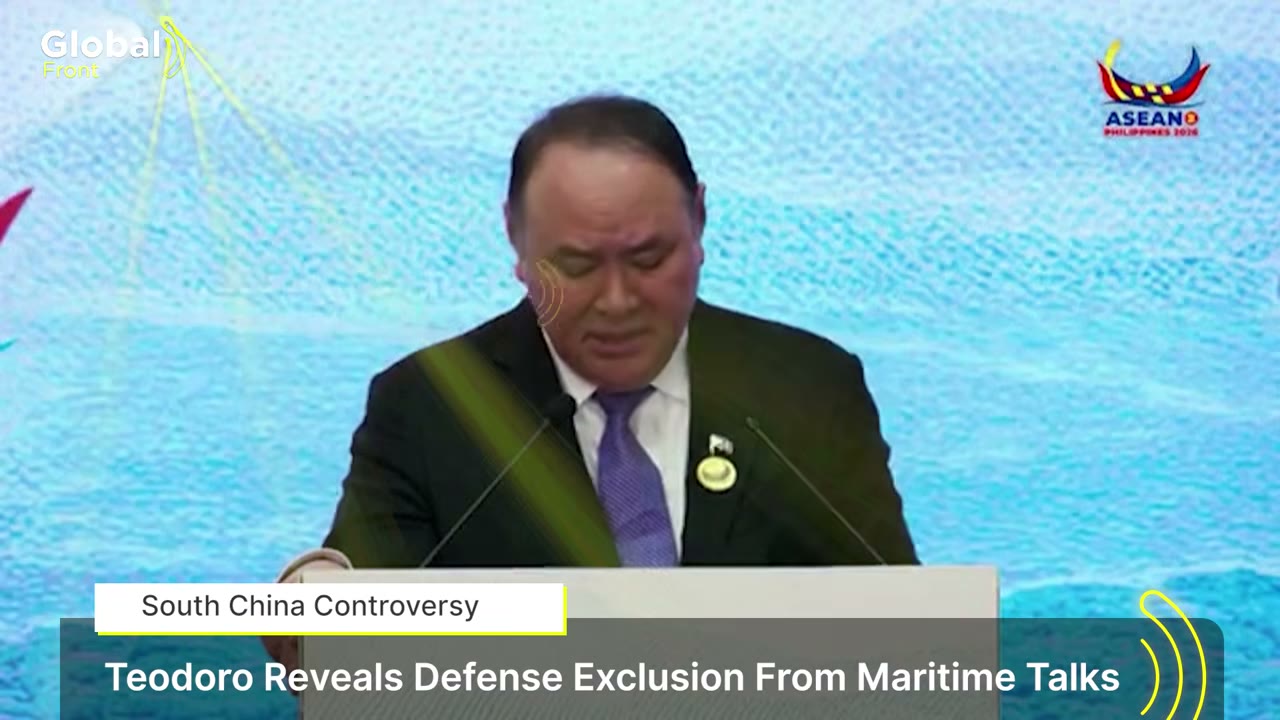
Defense Secretary Gilberto Teodoro Jr. says the Department of National Defense was not involved in drafting the South China Sea Code of Conduct and did not receive the negotiating text, raising coordination questions days after President Marcos claimed major progress. Manila hands an unfinished, roughly 80–90% complete draft to Singapore's 2027 ASEAN chairmanship.
1Teodoro Says Defense Department Not Involved in South China Sea Code Talks
The Philippines' defense department never received the negotiating text for the South China Sea code of conduct, Defense Secretary Gilberto Teodoro Jr. has said. His admission raises questions about how much the country's security officials know about an agreement meant to govern behavior in disputed waters.
Teodoro said the talks remain largely with the Ministry of Foreign Affairs. His department was not directly involved, he said, and did not get the draft for its own analysis. He pointed to President Ferdinand Marcos Jr. and Foreign Minister Maria Teresa Lazaro as the officials who can detail the status of the agreement.
The remarks came days after Marcos announced significant progress in the China-ASEAN negotiations.
The Philippines was not excluded from the talks. Manila remains an active participant in the ASEAN-led process. The question is whether defense officials have enough visibility into rules that touch maritime security, military planning, fishing communities and maritime rights.
2Marcos Claims 85–90% Progress as Lazaro Gives Cautious 80% Figure
President Ferdinand Marcos Jr. said 85% to 90% of the South China Sea code of conduct is done. Foreign Minister Maria Teresa Lazaro put the figure lower, at about 80%.
Speaking on November 17 at the ASEAN summit in Manila, Marcos said negotiators had resolved most issues and were working on the remaining provisions. He acknowledged the Philippines had hoped to announce completion during its 2026 ASEAN chairmanship, but that goal was not reached.
Lazaro said roughly 80% of the project has preliminary agreement, with several issues still unresolved and no final outcome yet.
Talks will continue in 2027, when Singapore takes over the ASEAN chairmanship. The Philippines hands over a substantially developed negotiating document, not a finalized agreement.
3Discrepancy in Progress Figures Raises Questions on Defense Role
Two different progress figures — 85–90% from the president, about 80% from the foreign minister — have drawn attention, but they do not necessarily signal a fundamental split.
The gap may reflect different views on agreed provisions, unresolved wording and how much work remains.
What sharpened the issue was Teodoro's inability to independently assess those numbers. His department was not part of the negotiations.
That raises a practical question: how closely should the defense ministry be involved in shaping rules that may affect how vessels behave in disputed waters?
The code is meant to reduce tensions, improve communication and prevent dangerous incidents among countries with competing maritime interests — China and ASEAN states including the Philippines, Vietnam, Malaysia and Brunei. Negotiations have run for decades.
4Philippines Accuses Chinese Vessels as Beijing Rejects Claims
The Philippines says it has repeatedly encountered Chinese vessels in areas it considers its exclusive economic zone, and accuses Chinese naval forces of dangerous maneuvers and obstruction of supply operations that threaten Filipino personnel and fishermen.
Beijing rejects that account. It maintains its maritime activities are legal and accuses Philippine vessels of entering areas claimed by China.
Those opposing positions have complicated efforts to write rules acceptable to all sides.
Defense Secretary Gilberto Teodoro Jr. has repeatedly voiced concern about relying on diplomatic assurances without verifying how commitments are carried out in practice.
5Teodoro Questions Whether China Can Be Trusted to Follow Code
Can China be trusted to follow a future South China Sea code? Defense Secretary Gilberto Teodoro Jr. would not say yes.
"I'll see—I'll believe, and as for trust, I'll refrain from commenting for now," he said in a November 16 speech.
His stance reflects wider concern that a written agreement means little if governments do not show willingness to respect it. It does not necessarily put him at odds with Manila's diplomatic strategy.
The foreign ministry runs negotiations and represents the Philippines internationally. The defense ministry handles national security, defense planning and preparing the armed forces for potential threats.
Both have South China Sea commitments, but their roles differ. Diplomats often negotiate while consulting other agencies through separate channels — so defense's absence from the table does not by itself mean Philippine maritime policy is uncoordinated.
6Unresolved Issues: Binding Force and Geographic Scope of Code
Two of the hardest questions in the South China Sea code remain open: whether it will be legally binding, and which waters it covers.
A binding agreement could create clearer legal obligations for participating governments, though its strength would still depend on specific provisions and enforcement mechanisms. A non-binding deal could guide behavior and encourage restraint without the same legal liability.
On geography, countries have not fully agreed on which marine areas fall under the rules. That matters because the treaty touches territorial disputes around islands, reefs, shoals and large maritime areas.
A seemingly technical provision could carry political weight if one government believes it indirectly recognizes another's territorial or maritime claims. Negotiators must separate practical rules of conduct from concessions on sovereignty or maritime rights.
7Philippines Insists Code Must Align With UNCLOS and 2016 Ruling
The Philippines insists any South China Sea code must comply with international law, particularly the UN Convention on the Law of the Sea, and it anchors that position in the 2016 arbitration ruling.
That tribunal rejected the legal basis for China's claims to historical rights beyond what the convention permits. Beijing rejected the decision and continues to adhere to its own position on maritime sovereignty and jurisdiction.
The code is not meant to decide ownership of disputed islands or settle all competing claims. Its main purpose is to manage behavior and reduce the risk of dangerous collisions while those disagreements remain unresolved.
That distinction matters for the Philippines, where maritime incidents can directly hit fisheries, supply missions and government operations.
8Fishermen and Patrols Would Feel Impact of Maritime Rules
For Filipino fishermen working near disputed areas, diplomatic progress becomes real when it means safer access to traditional fishing grounds.
For personnel on maritime patrols, effective rules could improve communication and cut the risk of misunderstandings during encounters with vessels from other countries.
For regional governments, an agreement that reduces confrontation could help stop relatively small maritime incidents from escalating into large-scale diplomatic or security crises.
9Analysts Warn Code of Conduct May Not Change China's Behavior
A code of conduct will not automatically change conditions in the South China Sea, analysts warn.
Political analyst Professor Aries Arugey questions whether a final agreement will change China's behavior, arguing that the growing imbalance in economic and security influence between Beijing and Southeast Asian countries makes expectations difficult.
Other experts say the hardest stages may remain even after most of the draft is provisionally adopted. Final provisions could decide whether the deal imposes meaningful restrictions on unsafe behavior, creates practical mechanisms to prevent incidents, or sets procedures for resolving disagreements.
That explains why a document described as about 80% or 90% complete may still require extensive diplomatic work.
10Nine Rounds of Talks Advance Code Tied to 2002 Declaration
Negotiators held nine rounds of talks and two high-level officials' meetings as the Philippines chaired ASEAN, pushing to finish the South China Sea code by the end of 2026.
Philippine diplomats say the faster pace advanced several key elements. One area of progress: the relationship between the future code and the 2002 Declaration on the Conduct of Parties in the South China Sea.
ASEAN and China have reached a preliminary agreement that the 2002 declaration will serve as the basis for a new code, with additional provisions to regulate conduct and encourage practical maritime cooperation.
The 2002 declaration remains a diplomatic landmark, but it has failed to prevent numerous confrontations over two decades. The challenge now is an agreement that goes beyond general pledges of peaceful conduct — for Singapore, which chairs ASEAN in 2027.
11Singapore Inherits Unfinished Code Talks as 2027 ASEAN Chair
Singapore will chair ASEAN in 2027 and inherit a South China Sea code that still isn't finished. The rest of the negotiations are expected to require significant diplomatic coordination. The new chairman picks up both the progress made under the Philippines' leadership and the unresolved differences that stopped the agreement being finalized this year.
Singapore must also weigh the gaps between ASEAN member states, whose economic relations with China and maritime security priorities do not always coincide.
For President Marcos, the unfinished agreement is both a diplomatic achievement and an unresolved political challenge.
12Marcos Left With Diplomatic Win but No Final Maritime Deal
The Philippines accelerated South China Sea code talks and still ended the year without a final agreement. President Marcos' government pushed negotiations forward, helped advance the project development process and backed the Philippines' participation in regional discussions.
But no deal means the administration cannot yet show how the proposed rules would change the maritime situation.
That leaves Marcos with a diplomatic achievement on one side and an unresolved political challenge on the other.