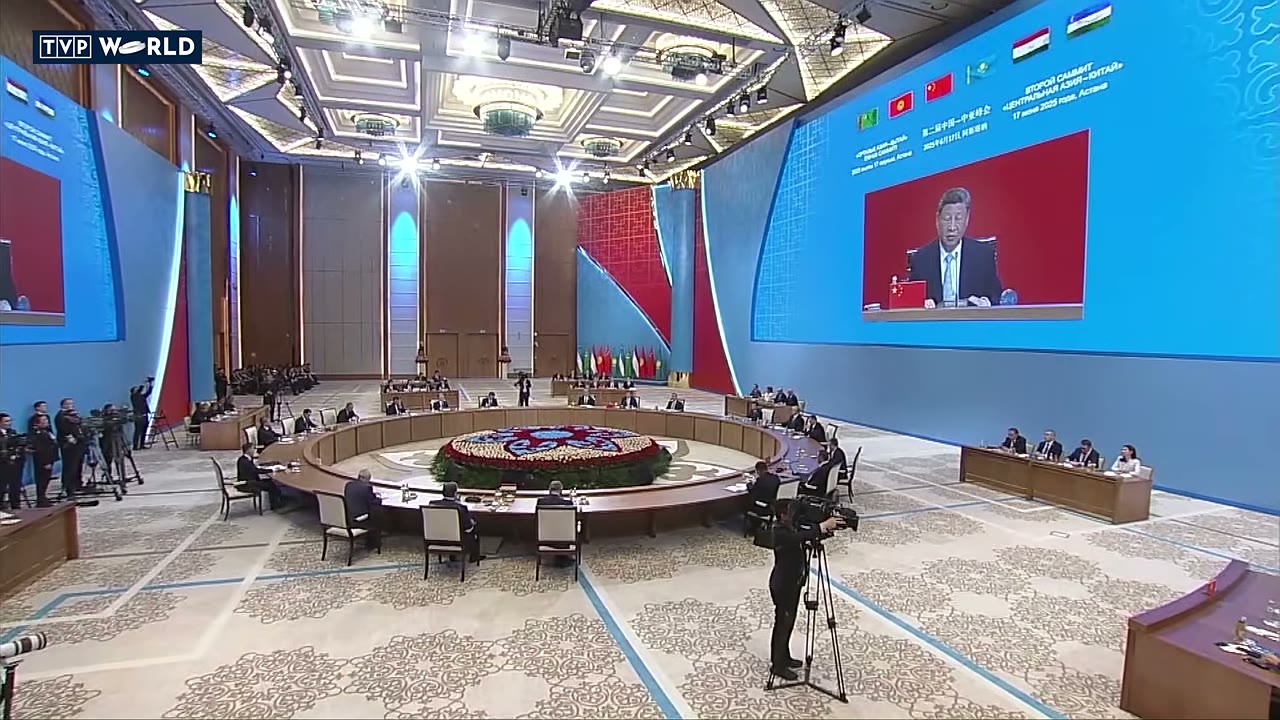
China's trade with Central Asia hit a record $106 billion in 2025, eroding Russia's influence. Bruce Pannier explains how Chinese loans to Kyrgyzstan and Tajikistan create leverage over critical minerals and the $4.7 billion China-Kyrgyzstan-Uzbekistan railway.
1China expands Central Asian influence, challenging Russia with record $106B trade
China's trade with the five Central Asian republics hit a record $106 billion in 2025 — roughly double the region's trade with Russia, at about $51 billion.
A new report from the Institute for Foreign Policy Studies says Beijing is building trade networks, industrial partnerships and infrastructure that are reducing the region's dependence on Moscow.
Kazakhstan remains China's largest regional partner. Chinese investment is growing fast in Uzbekistan, particularly in manufacturing and industry.
Beijing is also strengthening its position in critical minerals. Chinese companies have acquired stakes in copper and other projects, securing resources needed for electronics, renewable energy and nuclear power.
Involvement goes beyond extraction. China-backed automobile factories operate in Uzbekistan, and technical training centers across Central Asia teach workers to use Chinese industrial technologies. Beijing is also expanding transport corridors and energy pipelines that bypass Russian territory.
The report flags vulnerability too: Kyrgyzstan and Tajikistan owe a significant portion of their external debt to Chinese creditors, and dependence on Chinese technology and export markets poses long-term risks. Russia still maintains significant security, cultural and economic ties in the region.
2Tajikistan and Kyrgyzstan grow fast but stay vulnerable with limited jobs
Kyrgyzstan's economy grew an average of 10.2% a year between 2022 and 2025, according to the World Bank. Tajikistan's grew 8.2% in the first half of 2026.
Both are the smallest economies in Central Asia, lagging far behind Kazakhstan and Uzbekistan in total output — yet both are growing rapidly on Chinese investment.
The problem sits next to the headline numbers: a lack of productive workplaces at home. Remittances accounted for about 46% of Tajikistan's GDP in 2025.
Infrastructure investment offers a way to boost domestic activity — provided the projects generate sufficient economic benefits. That explains the attractiveness of Chinese financing: the government can point to a railroad or a power plant and promise better jobs and trade.
A harder question comes later: will these investments generate enough income to justify the commitments made?
3China-Kyrgyzstan-Uzbekistan railway costs $4.7B with 35-year Chinese loan
A railway linking China with Uzbekistan through Kyrgyzstan is estimated at $4.7 billion — and China owns 51% of the project company.
The financing agreement, signed in December 2025, provides for approximately half of that amount through a 35-year loan from Chinese banks to the joint project company. Kyrgyzstan and Uzbekistan own 24.5% each.
The railway promises another route for regional trade, giving Kyrgyzstan the chance to earn more from its location. But the commercial outcome depends on traffic, costs and execution.
A financing agreement locks in a long-term commitment before anyone knows how much business the completed line will attract. A route through the mountains can open markets and draw investment, but it also needs customers.
If freight volumes disappoint or construction costs rise, the terms on damages and loan repayments will matter more than the track itself.
4Tajikistan gold mining deal with China's TBEA repays power plant costs
China's TBEA mined gold at two deposits in Tajikistan until the cost of building the Dushanbe-2 power plant was reimbursed, according to reports from 2019.
The arrangement shows how infrastructure financing can reach a country's natural resources. It was a separate deal — not proof that every Chinese loan ends with a transfer of assets.
Outcomes in Central Asia depend largely on alternatives and the bargaining power of borrowers. Kazakhstan and Uzbekistan carry greater economic weight.
For smaller borrowers, transparent contracts and realistic project forecasts are of paramount importance.
5Bargaining power of smaller borrowers depends on transparent contracts
China can supply the investment Tajikistan and Kyrgyzstan need — and in return gains decades of relationships and economic access.
Chinese funding could help both countries create jobs at home and enter new markets. Whether it does depends on results.
Projects that pay off expand a government's room to choose. Disappointing ones leave debt obligations that compete with other national priorities.
That is where the bargaining power of smaller borrowers will be decided.
6Bruce Pannier: China lends to Kyrgyzstan and Tajikistan for its own interests
Between 35% and 50% of the external debt of Kyrgyzstan and Tajikistan falls on China, according to Bruce Pannier, a board member of the Caspian Policy Center.
"China is not a third party that has no self-interest," Pannier said. He pointed to the opening Middle Corridor, which needs roads, railways and other communication infrastructure — and most of the Chinese money goes there. Energy projects also play a role in moving goods along the corridor.
The China-Kyrgyzstan-Uzbekistan railway, discussed for 30 years, is finally starting to be implemented. Pannier said it will cost over $6 billion, or even more, with Kyrgyzstan taking on debt of certainly over $2 billion. Uzbekistan's share is smaller, as the railway passes through its territory to a lesser extent.
These are projects in which China is involved, Pannier said, but ultimately they will benefit the countries of Central Asia upon completion.
7China's long presence and trust give it edge over Arab lenders
China has been present in Central Asia since the late 1990s — and for the past 15 to 20 years has been willing to finance projects no one else wanted to take on.
Other lenders exist. Bruce Pannier, a board member of the Caspian Policy Center, credited the Arab world with stepping up in recent years and being more than willing to invest significant amounts in Central Asia.
But China's head start matters. It has become a stable trade and economic partner, and both sides know each other very well. Pannier said China showed trust in the region when few others did, which gives it an advantage.
"It's become a kind of habit for them," he said. Central Asians know how to ask the Chinese for money — and know the Chinese will probably lend it, even if the projects don't look very profitable.
8Chinese debt makes it hard for Kyrgyzstan and Tajikistan to refuse mineral deals
Kyrgyzstan and Tajikistan have critical minerals — lithium, antimony, tungsten — and would like to sell them, especially to Western buyers. China's lending history makes refusing a Chinese mining offer hard.
Neither country has the hydrocarbon reserves of the other three Central Asian states. There is no oil or natural gas there, so critical minerals could become an El Dorado for them.
Companies from various countries are approaching both governments about those minerals. But China has invested so much that when a Chinese company asks to mine, "it's hard for them to refuse," said Bruce Pannier, a board member of the Caspian Policy Center.
Especially, he said, knowing China can say: "You owe us a lot of money, and we would be grateful if you would return it as soon as possible" — which neither country can do.
9Fast GDP growth rests on primitive economies starting from low base
Kyrgyzstan reported over 10% GDP growth last year — but it is still a poor country that doesn't export much.
In both Tajikistan and Kyrgyzstan, the bulk of many export goods is agriculture. The money that brings in is considerable, but not huge.
Business is doing better than before, and both countries are set to earn more — not only from critical minerals but also from hydropower projects with other countries, which should soon let them export more electricity.
Right now, though, they are starting from a very low level. As Bruce Pannier, a board member of the Caspian Policy Center, put it: quite recently, things were very bad for them.
10Remittances from Russia give Moscow leverage over Central Asia
Remittances could make up as much as half of Kyrgyzstan's GDP, according to Bruce Pannier, a board member of the Caspian Policy Center. The share is now probably about a third, he said.
Kyrgyzstan, Tajikistan and Uzbekistan are heavily dependent on money sent home by migrant workers in Russia — a problem they constantly face in relations with Moscow. In Uzbekistan the share is a little less than 20%, but overall it is still a sum of about $18 billion, of which $15 billion presumably comes from Russia.
That gives Russia the same kind of leverage as China, in a different area. If a Central Asian country angers Moscow, there is always the threat of new restrictions on migrant workers — and the loss of that money.
China's version, Pannier said, sounds like: "You owe us a lot of money."
11Chinese projects bring temporary jobs but fuel fears of expansion
Chinese-funded projects do employ Central Asian workers — but the work is temporary, and it stops when construction ends.
Bruce Pannier, a board member of the Caspian Policy Center, listed the scale: gas pipelines from Turkmenistan through Uzbekistan and Kazakhstan, an oil pipeline from western Kazakhstan to China, and railways linking the Caspian Sea and Iran to China through Central Asia. All involve local workers, who are grateful for the employment while projects run.
Having traveled through Central Asia for years, Pannier said fear persists among many residents that Chinese workers, though few in number, are the vanguard of Chinese expansion.
People believe their governments owe China too much financially and politically, and that one day this will have consequences for the peoples of Central Asia.
12Repayment problems could give Beijing control over mines and railways
In some strategic industries in Central Asia, almost 50% is Chinese-owned, according to Bruce Pannier, a board member of the Caspian Policy Center.
Asked whether repayment problems could give Beijing greater control over mines, railways or other strategic assets, Pannier answered: "Oh yes, definitely."
China is a partner in all the big projects, he said. Any deal also involves bringing in Chinese workers alongside local employees — part of the arrangement, and a source of outrage when people see Chinese road or factory workers during construction.
Pannier called it a significant problem for the region. On how it plays out, he said: "We'll just have to wait and see."
13Turkmenistan gas pipeline to China shows benefits of Chinese financing
A gas pipeline from Turkmenistan to China cost at least $8 billion — and nobody wanted to finance it. China did, and the pipeline ended in China.
For the Turkmen government, the payoff was huge once the deal was completed and gas started flowing. Almost all of Turkmenistan's revenue from natural gas exports now comes from sales to China: 35 billion cubic meters per year.
Bruce Pannier, a board member of the Caspian Policy Center, said that without the pipeline China built, Turkmenistan would be in serious financial trouble right now.
His broader point: few countries were willing to lend money and finance projects in Central Asia before China was.
14Bruce Pannier calls debt trap diplomacy a fair description
Central Asian states signed their China deals expecting a Russian-style write-off — and got a lesson in how Beijing works instead. Bruce Pannier says "debt trap diplomacy" is a fair label, and not just for Central Asia: "the Chinese do it everywhere."
Kyrgyzstan and Tajikistan are prime examples, he said, of countries that simply won't be able to repay. The sums at stake are billions of dollars — far beyond the millions, or hundreds of millions, Moscow forgave.
When leaders signed with Beijing, Pannier said, they assumed that in 15 to 20 years China would see they couldn't pay and cancel 30% or so. It didn't.
Some Chinese projects still matter: hundreds of millions for irrigation canals as climate change hits agriculture. "Who else would spend money on such things?" he asked.
15Russia demands NATO changes, including British nuclear withdrawal, to end Ukraine war
A Russian negotiating document dated November 10 wants Britain to pull its nuclear deterrent out of NATO's collective defense — one of Moscow's conditions for ending the war in Ukraine. The Telegraph reported the document.
It also seeks the withdrawal of NATO forces from Eastern Europe and the Baltic states, Finland's exit from the Alliance, and an end to Western military aid to Ukraine. Ukraine's NATO accession would be blocked, and Russia would keep occupied Ukrainian territory.
European leaders rejected the idea of Moscow dictating the continent's security. Finland ruled out any talks on its NATO membership, and Britain said decisions on European security should stay with European countries.
16Turkmenistan nears completion of first Afghan section of TAPI pipeline
Turkmenistan is close to finishing the first Afghan section of the TAPI gas pipeline, with completion scheduled by the end of 2026. The route has already reached the outskirts of Herat.
Turkmen officials say about 80% of the initial route is assembled and testing is underway. Ashgabat is financing the $600 million project and plans to pipe gas directly to Herat and build local distribution infrastructure.
Extending the line toward Pakistan and India remains uncertain: financing and construction schedules aren't final. Pakistan has reaffirmed its commitment, but tensions with Afghanistan and unresolved economic issues complicate the prospects.