A detailed breakdown of how Ukraine's mechanized infantry is organized, from the nine-man squad and its Soviet-vintage BMPs and BTRs to company, battalion and brigade level. It also covers pay, Javelin centralization and new rifle battalions added to pre-war brigades.
1Ukrainian mechanized infantry branch and soldier pay
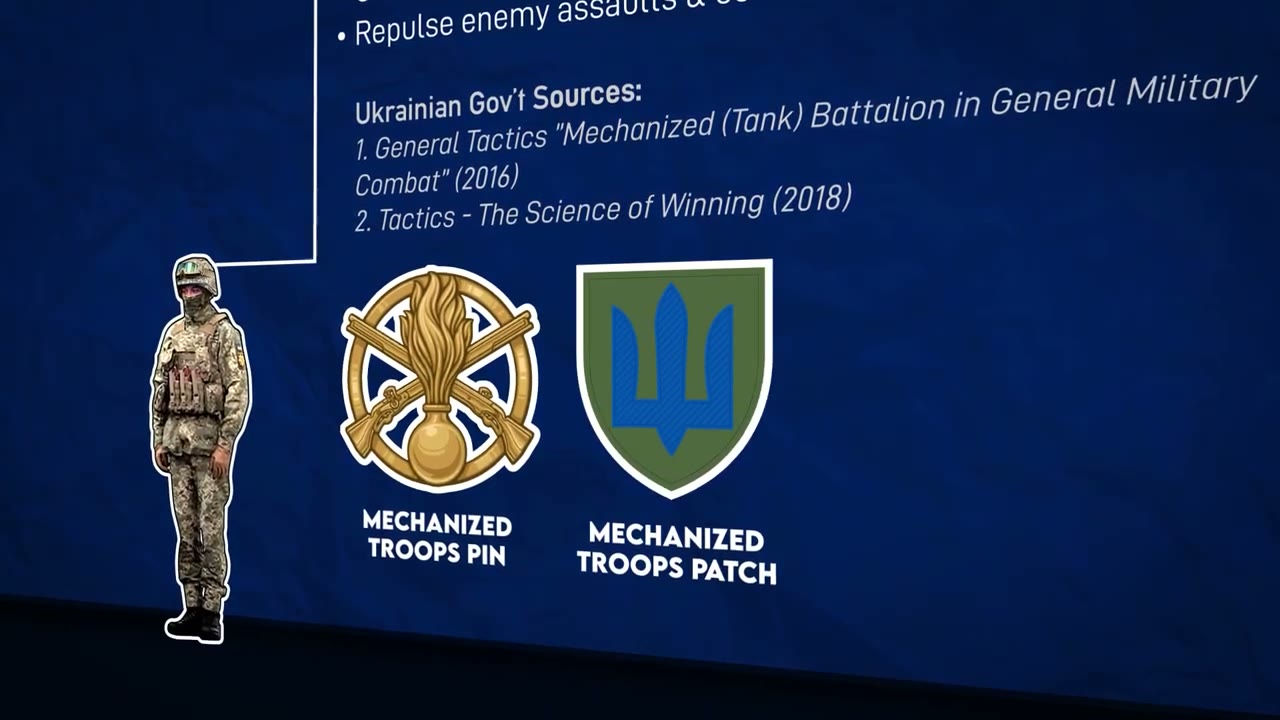
A Ukrainian private fighting nonstop earns roughly what an American sergeant makes in a month. The base salary is 13,244 Hryvnia a month — about $358 as of late 2022. Volunteers add 30,000 Hryvnia a month in wartime pay, and up to 100,000 Hryvnia a month for combat, scaled to time spent on the front. The mechanized troops are Ukraine's regular infantry branch, marked on their berets by two crossed wheel lock muskets and a bursting bomb. Their tactical patch is an olive shield with a blue trident — not the similar Territorial Defense patch, which has battlements.
2Squad vehicles: Soviet BMPs, BTRs and foreign-donated carriers
Ukraine's nine-man squads ride to battle in Soviet-era BMPs and BTRs — plus carriers donated from abroad. Most are Soviet-vintage BMP-1 and BMP-2 fighting vehicles or BTR-70 and BTR-80 armored personnel carriers, with smaller numbers of upgraded versions like the BTR-4, which the 92nd Mechanized Brigade is known to have. Foreign aid has added more: about half a battalion's worth of Slovenian BVP M-80As with the 24th Mechanized Brigade, and Dutch YPR-765 APCs that outfitted the 5th Reserve Tank Brigade's mechanized battalion in May. French VABs with the 46th Air Assault Brigade and Humvees with the 58th and 59th Motorized Brigades sit outside the mechanized brigades.
3Nine-man squad roles and small arms
Every Ukrainian mechanized squad carries a small arsenal: AK-74 rifles, an RPG-7 and RPK-74 machine guns. The nine-man squad has a leader, senior rifleman, sniper, RPG-7 gunner and assistant gunner, one or two machine gunners, and a driver and gunner for the vehicle. The AK-74 is the army's standard service weapon, though depending on the unit the driver and RPG-7 gunner may carry the shorter AKS-74U carbine — a choice that seems to vary. The senior rifleman also carries a GP-25 underbarrel grenade launcher, similar to Russian practice. Most squads are meant to field two RPK-74 light machine guns, one RPG-7 rocket launcher and one SVD marksman rifle.
4Platoon weapons mix and donated anti-tank munitions
A Ukrainian platoon fields four RPK light machine guns, one PKM, two SVDs and three RPG-7s. The mix shifts squad by squad: one of the platoon's three squads has a PKM belt-fed machine gun team in place of the RPKs, and one squad per platoon has a Medic-Rifleman instead of an SVD. Disposable anti-tank munitions — RPG-22s and donated M72 LAWs, AT4s, M141s and NLAWs — have also been available. Apart from more capable donated systems like the NLAW, there isn't a big capability gap between Ukrainian and Russian squads, though Russians generally have a larger share of PKP general purpose machine guns rather than RPKs.
5Javelin missiles centralized in brigade anti-tank batteries
Ukraine keeps its scarce Javelins in centralized batteries rather than handing them to every squad. The US Army uses Javelins as platoon or squad weapons, but pretty much no other military can afford that. Ukraine's Research Center of Missile Troops and Artillery has published a document stating Javelins should be centralized in a battery — part of a brigade's anti-tank battalion or directly under the brigade. Each battery has three platoons, with three Javelin squads of three Javelin teams each. The battery can serve as the brigade commander's anti-tank reserve or attach its platoons to mechanized battalions, where a platoon becomes the battalion's anti-tank reserve or attaches its squads to companies — more or less one Javelin team per infantry platoon.
6Javelin crews branch artillery while NLAW stays with infantry
Ukrainian Javelin crews traditionally branch artillery — and photos of soldiers wearing artillery patches training on the Javelin just before the war back that up. The NLAW, by contrast, seems to be used more by infantrymen. In August, Ukraine put out a video on Facebook covering the 87th Anti-Tank Artillery Battalion of the reserve 45th Artillery Brigade, referencing their use of the Javelin, Stugna and old Rapira anti-tank guns.
7Company organization: BTR versus BMP companies
A Ukrainian BTR company fields 112 personnel; a BMP company fields 95. Each mechanized company has three platoons, plus a commander and assistant commander who ride with the squads. BTR companies add an anti-tank platoon of 17 personnel, three BTRs and three Metis anti-tank guided missiles. BMP companies skip that platoon because their BMPs can mount ATGMs themselves. In company headquarters, one vehicle carries the commander, deputy commander, senior technician, company sergeant major, medical instructor — usually an NCO — an SBR-3 radar operator, senior driver and APC gunner. The structure is, overall, very Soviet.
8BTR battalion support units and supply company
A Ukrainian BTR battalion rolls with six 120mm mortars, six AGS-17 automatic grenade launchers and nine Igla MANPADs. Supporting units include an anti-tank platoon with four ATGMs and two SPG-9 recoilless rifles, a reconnaissance platoon with one BRM and two BMP-2s, an engineering and sapper platoon with a PZM-2 earth mover, a signals platoon, a supply company and a battalion medical center. The supply company — equivalent in capacity to a Russian battalion material support platoon — has 48 personnel manning eight cargo trucks, six fuel tankers, one water tanker, four PAK-200 field kitchens, mobile repair shops and one BREM-2 armored recovery vehicle. The whole battalion numbers around 600 soldiers and about 45 BTRs.
9BMP battalion strength and battalion tactical groups
A Ukrainian BMP battalion fields about 520 people and 40 BMPs at full strength — and lacks the anti-tank platoon its BTR counterpart has. These battalions fight as battalion tactical groups reinforced with assets from their parent brigades. Three of them form the core of a separate mechanized brigade.
10Motorized infantry and new rifle battalions in mechanized brigades
Some Ukrainian mechanized brigades now run five infantry battalions after absorbing rifle units raised in the war's first weeks. Brigades that existed before 2022 have had one motorized infantry battalion since 2016 — converted from the first territorial defense battalions formed in 2014 so the army could plan their activities. Brand-new and reserve brigades now in combat don't necessarily have one as standard, though some have integrated new separate rifle battalions formed early in the war for national defense. The pre-existing 72nd Mechanized Brigade has the new 48th Separate Rifle Battalion, for example.
11Brigade tank battalion and flexible tank employment
Ukrainian mechanized brigades have one tank battalion, and the closest thing to standard is the T-64BV and its upgraded versions — though some brigades operate T-72s, both on hand and donated. Notionally, that would let each mechanized battalion be reinforced by a tank company. But since tanks are a brigade asset, they can be weighted wherever they're needed most: as a brigade reserve, with more than one tank company supporting by fire during a battalion assault, or as the spearhead of an attack.
12Brigade artillery group and anti-tank battalion
Each Ukrainian mechanized brigade is backed by a brigade artillery group of roughly regiment size. It includes a control and reconnaissance battery, two self-propelled howitzer battalions providing direct support to first-echelon battalion tactical groups, and a rocket artillery battalion — the same setup as in a Russian brigade. A separate anti-tank battalion armed with towed MT-12 anti-tank guns and ATGMs also serves as an anti-tank reserve.
13Brigade support subunits and operational commands
Every Ukrainian brigade carries an anti-aircraft missile battalion as standard — one of a long list of support units packed into each formation. Engineer, maintenance and logistics battalions sit alongside sniper, reconnaissance, electronic warfare, radar, NBC defense, signals and medical companies.
A commandant platoon provides security for brigade command posts.
At the highest level, brigades fall administratively under geographically based Operational Commands: North, East, South and West.
14Operational Tactical Group Sumy and regional defense
Major General Nesterenko took command of Operational Tactical Group "Sumy" on April 14th, a new grouping built to tighten command and control over a swath of northeastern and central Ukraine.
The group consists of two of the new rifle battalions raised for the defense of Kyiv — the 116th and 117th — plus the 116th and 117th territorial defense brigades and units of the border guards, police and national guard.
It is now responsible for the defense of the Sumy, Poltava, partly Kharkiv and Cherkasy regions.