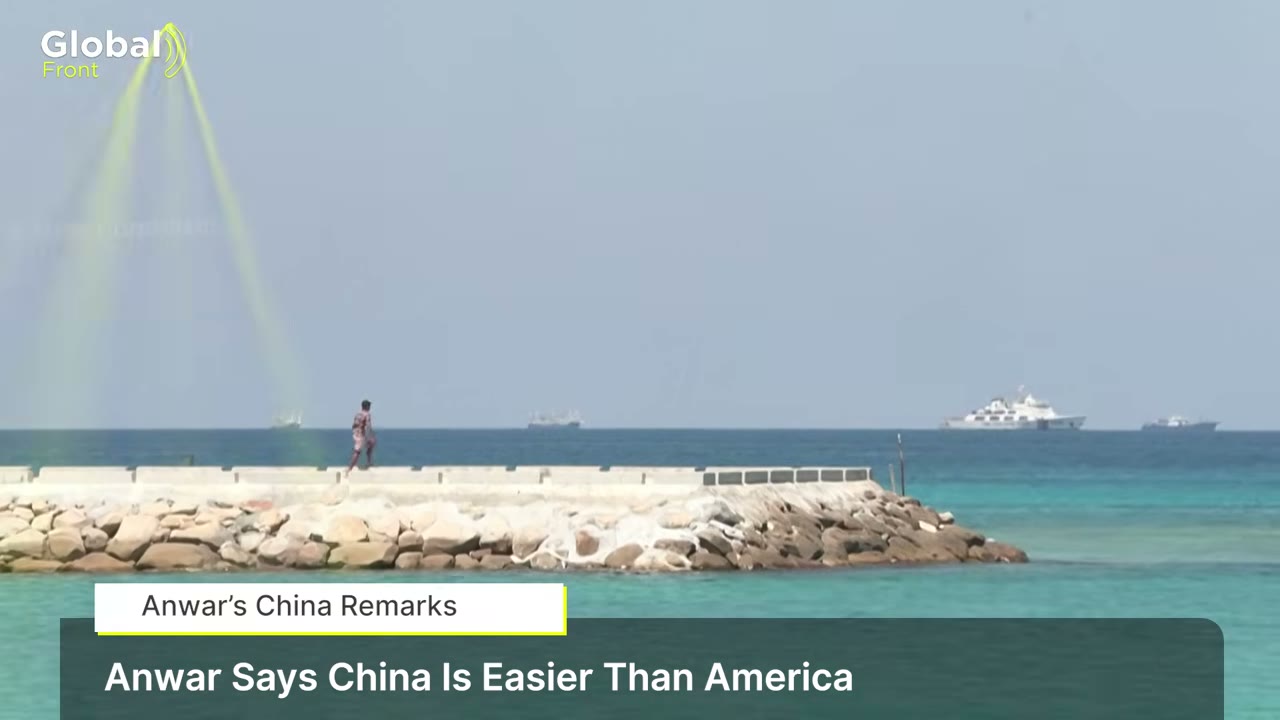
Malaysia's Prime Minister Anwar Ibrahim said dealing with China is easier than with the United States, citing proximity and access to leaders. He called Beijing extremely prudent in the South China Sea and the Philippines' confrontations an exception, raising questions about ASEAN unity.
1Anwar Ibrahim Says Dealing With China Is Easier Than With the US
Malaysia's prime minister has said out loud what many in Southeast Asia only whisper: dealing with China is easier than dealing with the United States. Asked directly which was easier, Anwar Ibrahim did not hesitate. "I will be very frank," he said. "It's definitely easier with the Chinese."
The remark lands against a backdrop of open confrontation at sea. The Philippines has faced water cannons, blockades and dangerous maneuvers in the South China Sea.
Anwar called Beijing "extremely prudent" and described the Philippines' experience as an exception.
2Anwar Gives Three Reasons China Is Easier and Denies Picking Sides
Anwar Ibrahim gave three reasons why Beijing is easier to deal with than Washington: geographic proximity, cultural affinity, and direct access to leaders.
He made the comments in an interview with the South China Morning Post in Shenzhen, after this month's APEC leaders' meeting and ahead of a bilateral meeting with Chinese President Xi Jinping.
"Meeting with President Xi Jinping or Premier Li Keqiang is much easier," he said. "They take the time to listen."
He added that China has never raised concerns about Malaysia's close ties with the US and has never obstructed Malaysia's technology deals with American companies. But he insisted Malaysia is not choosing sides. "Having a great relationship with China," he said, "does not mean we cannot continue to engage with the United States."
3US Chip Export Controls and Entity List Hit Malaysia and Southeast Asia
New US export controls now require government permission to ship advanced artificial intelligence chips to Malaysia — and four other countries.
Washington imposed the restrictions about a week before Anwar's interview. Under licensing rules from November 16, shipments of advanced chips to Malaysia, Singapore, Thailand, Indonesia and Brazil need approval from the US government.
The rules also cover overseas facilities that provide significant capacity to companies headquartered in China.
The timing matters: Malaysia had just been affected when Anwar spoke.
4Malaysia Balances US Chip Rules With Chinese Data Center Projects
Malaysia says it will enforce US conditions so restricted chips are not diverted — but it will not block Chinese firms or their data center projects.
On November 23, the US added seven South Asian organizations to its trade blacklist, the Entity List. Malaysia's trade ministry said two of them were registered in Malaysia.
The backdrop is an AI data center boom in Johor and Selangor. Chinese firms have reportedly rented computing power in data centers in countries such as Malaysia, as direct sales of advanced American chips to China are limited.
Malaysia's Ministry of Commerce ordered all 117 approved data center projects to comply with regulations and not serve blacklisted companies. Malaysia also joined the China-led Organization for Cooperation in Artificial Intelligence with six other ASEAN members.
5Malaysia Weighs Joining US-Led Pax Silica While in China AI Group
Malaysia has joined a China-led artificial intelligence body — and is weighing an invitation to a US-led tech coalition at the same time.
Anwar said Malaysia is open to joining PAC Silica, a US-led technology and logistics coalition that already includes the Philippines and Singapore. He said he did not expect objections from Beijing.
Malaysia is also working with the United States to develop a sovereign artificial intelligence cloud platform.
The contrast with Manila is sharp: PAC Silica sparked protests in the Philippines, where President Marcos has firmly chosen a security alliance with Washington.
6Anwar Describes Unwritten Red Lines With China in South China Sea
Malaysia and China operate on an unwritten understanding in the South China Sea, Anwar Ibrahim said — each side has red lines it will not cross.
"I must say frankly," he said, "that the Chinese are treating us extremely prudently."
He described territories China considers too close to its interests, and waters Malaysia considers its own. "As for them," Anwar said, "okay, we won't touch them."
Beyond those red lines, he described room for compromise. "Well, then there are mutual concessions," he said. "They are a bit intrusive. We are intruding a little."
7Anwar Dismisses Warnings of Conflict, Calls Philippines an Exception
Anwar Ibrahim dismissed warnings from Western and European leaders that conflict was brewing in the disputed waters.
According to the Malaysian publication Rocky at Post, he called the Philippines' experience in relations with China exceptional.
So why does Manila's experience look so different? Just look at last week, when the Philippine military counted 48 Chinese ships.
Anwar's remarks suggest he sees the confrontations as a Philippine problem, not a regional one.
8Philippines Counts 48 Chinese Ships as Incidents Escalate
The Philippine military counted 48 Chinese Navy and Coast Guard ships around Philippine facilities between November 17 and 23 — up from 19 a week earlier.
Thirteen coast guard ships and five Chinese warships were near Scarborough Reef.
On November 23, a Chinese maritime patrol vessel maneuvered toward a Philippine Coast Guard ship near Panat Island, closing to 200 yards.
That same day, an H6 strategic bomber flew about 45 nautical miles off Luzon — the closest such flight by a Chinese bomber, according to the military.
9Why Manila Confronts Beijing While Kuala Lumpur Negotiates Quietly
Manila won a 2016 arbitration case against Beijing's broad claims to historical rights in the South China Sea. Beijing rejected the ruling. Malaysia, by contrast, generally resolves disputes with China quietly, through private diplomacy.
The physical stakes differ too. China has held Scarborough Shoal since 2012, and Philippine forces are stationed at sites such as the BRP Sierra Madre on Ayungin Shoal, from which China once tried to dislodge them.
Manila has chosen to publicly document what happens at sea, releasing videos and photos of China's actions. Malaysia avoids confrontation.
So when Anwar calls China "extremely prudent," he is partly describing a different strategy.
10Malaysia's Own Friction With China Off Sarawak and Sabah
Malaysia's relations with China at sea are not without friction: Chinese coast guard ships keep a constant presence around the Luconia shoals, waters Malaysia claims as its own, near some of its most important offshore oil and gas fields.
China's claims overlap with Malaysia's exclusive economic zone off Sarawak and Sabah.
In 2020, a Chinese research vessel chased a drilling vessel working for Malaysia's state-owned energy company Petronas in a month-long standoff that drew American and Australian warships to the area.
So when Anwar says China is meddling a bit, he is describing real things. The difference is how Kuala Lumpur responds.
11Anwar's Balancing Act: China as Friend, US as Traditional Ally
Malaysia does not lean toward China, Anwar Ibrahim said in 2023 — but geographically, China is closer.
He described China as a reliable friend and the United States as an equally important, traditional ally and major investor.
Instead of releasing videos or filing public protests over maritime friction, Malaysia has largely stayed silent, continuing negotiations and supporting the operation of its energy projects.
His latest comments are the same balancing strategy, expressed more directly.
12ASEAN Fails to Conclude South China Sea Code of Conduct
ASEAN and China could not conclude a South China Sea code of conduct, despite agreeing on about 80% of the draft.
The Philippines chaired ASEAN this year and made completing the code a major goal. On November 15, Foreign Minister Maria Teresa Lazaro announced the failure.
Key issues remain unresolved, including whether the code will be legally binding.
When one ASEAN leader calls China "extremely prudent" and another country's military counts 48 Chinese ships in its waters, it is hard for the bloc to speak with one voice.
13Malaysia's Economy Ties It to China as ASEAN Splinters
Malaysia's economy is closely linked to China, its largest trading partner — and its data center boom depends in part on demand from China.
That helps explain Anwar's calculus: Malaysia has decided that engaging with Beijing is in its interest.
His comments are a reminder that each Southeast Asian country is making its own calculations, which makes it difficult to pressure Beijing on the hardest issues.
The split has real implications for a bloc struggling to speak with one voice.
14Debate: Does Quiet Engagement or Public Pushback Work Better?
Malaysia's quietly pro-China stance has a price, critics say: accepting a certain amount of Chinese interference. Anwar himself acknowledged it plainly — they interfere a little. Supporters argue his approach keeps the peace, avoids dangerous incidents and protects economic ties. Backers of the Philippine route counter that transparency and international law are the only way to stop Beijing from quietly appropriating more. But critics of Manila's public pushback warn it raises tensions and puts Filipino crews at risk. Two strategies, one question: which keeps the region safer?
15What to Watch Next: Manila's Response, Code Talks, Tech Race
Manila has stayed publicly silent on Anwar's remarks — for now. The Philippine government has not yet responded to his comments, but his description of their experience as an exception is unlikely to go unnoticed in Manila. Next, watch the negotiations on a code of conduct, which move to Singapore as the next ASEAN chair. Then there's the tech race: both Malaysia and the Philippines are courting American and Chinese investment in artificial intelligence and chips. How they balance that pressure will shape the region for years.