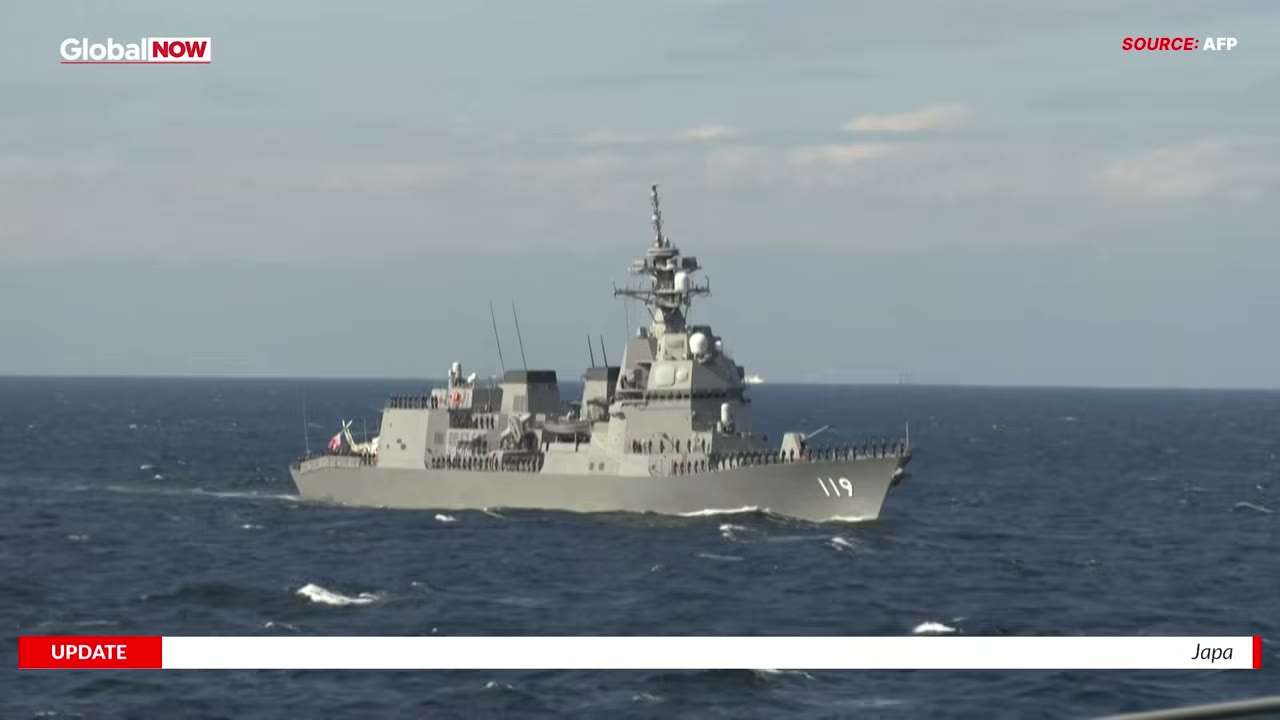
Japan is commissioning new Mogami-class stealth frigates while deepening defense cooperation with the Philippines through aid packages, joint exercises, and talks on transferring warships. China has criticized the growing Tokyo-Manila security partnership as tensions persist in the South China Sea.
1Japan Commissions Mogami-Class Frigates JS Mogami and JS Nagara
Japan commissioned its ninth Mogami-class stealth frigate on May 21, 2026, at the Mitsubishi Heavy Industries shipyard in Nagasaki. The JS Mogami, hull number FFM-9, joined a fleet Japan is expanding fast.
The tenth ship, JS Nagara, was accepted into the fleet on 29 June. Twelve more ships under the original program are expected to be finished by the end of the fiscal year in March 2027.
Tokyo frames the build-up as part of a wider maritime transformation, with the ships extending Japan's reach beyond its own waters — including toward the Philippines and the contested South China Sea.
2Takaichi and Marcos Reaffirm Japan-Philippines Strategic Partnership
Japanese Prime Minister Sanae Takaichi met Philippine President Ferdinand Marcos Jr. on November 16, on the sidelines of the ASEAN Summit in Manila.
The two leaders reaffirmed their commitment to a comprehensive strategic partnership, with regional security and maritime cooperation at the top of the agenda.
The talks came as Japan pushed to deepen its defense relationship with the Philippines, and just a week after a major security assistance deal between the two countries.
3Japan Signs 4.3 Billion Yen Security Aid Deal With Philippines
Japan signed a security assistance deal with the Philippines worth 4.3 billion yen — about $27 million — a week before the two leaders met in Manila.
Under the agreement, Japan will give the Philippine Navy coastal radar equipment and the Air Force drones for monitoring and reconnaissance.
Tokyo is expanding defense support as Manila faces what it describes as growing maritime pressure from China. Repeated incidents involving China's coast guard and maritime police ships are straining Philippine Navy and Coast Guard resources.
The aid is meant to help Philippine authorities monitor surrounding waters and respond more effectively to maritime incidents.
4JS Natori's Stealth Design and Automated Systems Explained
A warship about 133 meters long and 3,900 tons standard can run with a crew of around 90 — far fewer than many of Japan's older destroyers.
That is the JS Natori, a new-generation Mogami-class frigate built for automation. Its angular superstructure and reduced external equipment are designed to shrink its radar signature.
On one compact platform it packs surveillance systems, underwater detection, defense equipment and anti-submarine warfare, and it can control unmanned underwater and surface vehicles. Top speed is over 30 knots.
With a shrinking population and recruitment challenges, Japan is leaning harder on automation to keep its forces staffed and ready.
5Japan Plans 12 More Frigates; Australia to Buy 11 Ships
Australia has picked Japan's upgraded Mogami-class frigate for its fleet, planning to buy 11 ships — the first three built in Japan, the other eight in Australia.
In April 2026, Deputy Prime Minister and Defense Minister Richard Marles confirmed contracts for the first three were finalised, with the first delivery scheduled for December 2029.
Japan itself plans to acquire 12 more modernized frigates with better surveillance, stronger defenses and more operational flexibility.
The export deal marks a shift for a country that spent decades keeping military exports limited.
6Japan Supplies Patrol Vessels and Aid to Philippine Navy
Japan announced a separate security assistance package worth 900 million yen — roughly $6 million — in January 2026 to back the Philippines' naval infrastructure and maritime security.
Beyond the money, Tokyo is supplying patrol vessels and surveillance technology, and providing personnel training and infrastructure development.
The support targets Manila's ability to police its waters as it faces maritime pressure from China.
Equipment and funding are only part of a broader relationship between the two countries.
7Japan-Philippines Mutual Access Pact Powers Balikatan 2026 Role
About 1,400 Japanese Self-Defense Forces personnel deployed to the 2026 Balikatan exercises — well beyond the observer and humanitarian roles Japan traditionally played.
Japanese ground troops, warships and aircraft trained alongside Filipino and American forces. The drills followed a mutual access agreement the two countries signed in July 2024, which entered into force in September 2025.
The pact lets military personnel from both sides take part in coordinated exercises on each other's territory.
The exercises do not create automatic military obligations for Japan if a future conflict involves the Philippines.
8Japan and Philippines Advance Talks on Transferring Destroyers
Japan and the Philippines are negotiating the transfer of Japanese escort destroyers after they are withdrawn from Japan's fleet.
At an October 28 meeting, Defense Minister Shinjiro Koizumi and Philippine Defense Secretary Gilberto Teodoro Jr. agreed to keep talking, aiming to deliver the first ship as soon as possible after its expected decommissioning.
"We will deepen defense cooperation between Japan and the Philippines, covering operations, logistical support, human resource development, and information sharing," Koizumi said.
The two countries also signed an agreement to exchange logistical supplies and services. Japan has not confirmed any plan to transfer the JS Natori or other Mogami-class frigates.
9China Criticizes Japan-Philippines Security Cooperation
China's Defense Ministry criticized deepening Japan-Philippines security cooperation on November 26, accusing Tokyo of escalating disputes in the South China Sea.
Chinese officials have repeatedly cited Japan's military history, accusing Tokyo of using regional security concerns to justify military expansion. Japan says its partnerships support regional stability, freedom of navigation and compliance with international law.
China continues to pursue large-scale territorial and maritime objectives in the South China Sea, regularly sending naval and coastal vessels into disputed areas.
The Philippines rejects Chinese claims that overlap with its maritime rights, citing a 2016 international arbitration ruling that rejected the legal basis for China's sweeping "nine-dash line" claims. Beijing rejects that decision.
10Japan, US, Australia, Philippines Meet in Cebu on Security
Defense leaders from Japan, Australia, the Philippines and the United States met in Cebu on October 28 to discuss regional security and expand military cooperation.
A joint statement issued on November 10 reaffirmed their concerns about tensions in both the East China and South China Seas.
The four-way meeting points to defense cooperation becoming more interconnected across the region — through joint exercises, equipment agreements, data sharing and regular high-level consultations.
11Japan Maritime Self-Defense Force Restructures Patrol Command
At the end of March 2026, the Japan Maritime Self-Defense Force created a specialized patrol and defense group as part of a major organizational reform.
After commissioning, the JS Natori was assigned to the Fifth Patrol and Defense Squadron at Ominato Naval Base in Aomori Prefecture.
The assignment reflects Japan's growing emphasis on continuous maritime surveillance and preparedness as its responsibilities expand.
12Japan's Economic Security Hinges on Indo-Pacific Sea Lanes
Japan's economy runs on ships — and the waters those ships cross are getting more contested. Tokyo is tying its economic security directly to stability in the Indo-Pacific as Chinese naval activity expands, because Japan depends heavily on international maritime transport for energy, raw materials and commercial goods.
Much of that trade moves through Asia's strategically important waterways. The Philippines sits near the South China Sea and the Luzon Strait, a position that makes stability there a direct concern for Japan's economic and security interests.
That geography is why Tokyo is watching Manila's neighborhood so closely.
13Takaichi and Marcos Reshape Indo-Pacific Naval Balance
Japan is rebuilding its navy and arming partners across the Indo-Pacific — and its partnership with Manila may end up shaping the region's naval balance for years. Under Prime Minister Sanae Takaichi, Japan is strengthening its armed forces, expanding defense cooperation and supplying increasingly sophisticated equipment to regional partners.
For President Ferdinand Marcos Jr., closer ties with Japan offer a way to strengthen the Philippines' maritime capabilities and diversify its security partnerships.
The changes go beyond one modern stealth frigate. Japan's naval modernization, its growing commitment to Philippine maritime security and expanding cooperation with Australia and the United States are gradually shifting the region's security landscape. As tensions in the South China Sea persist, the Tokyo-Manila relationship could become one of the region's most significant strategic partnerships.