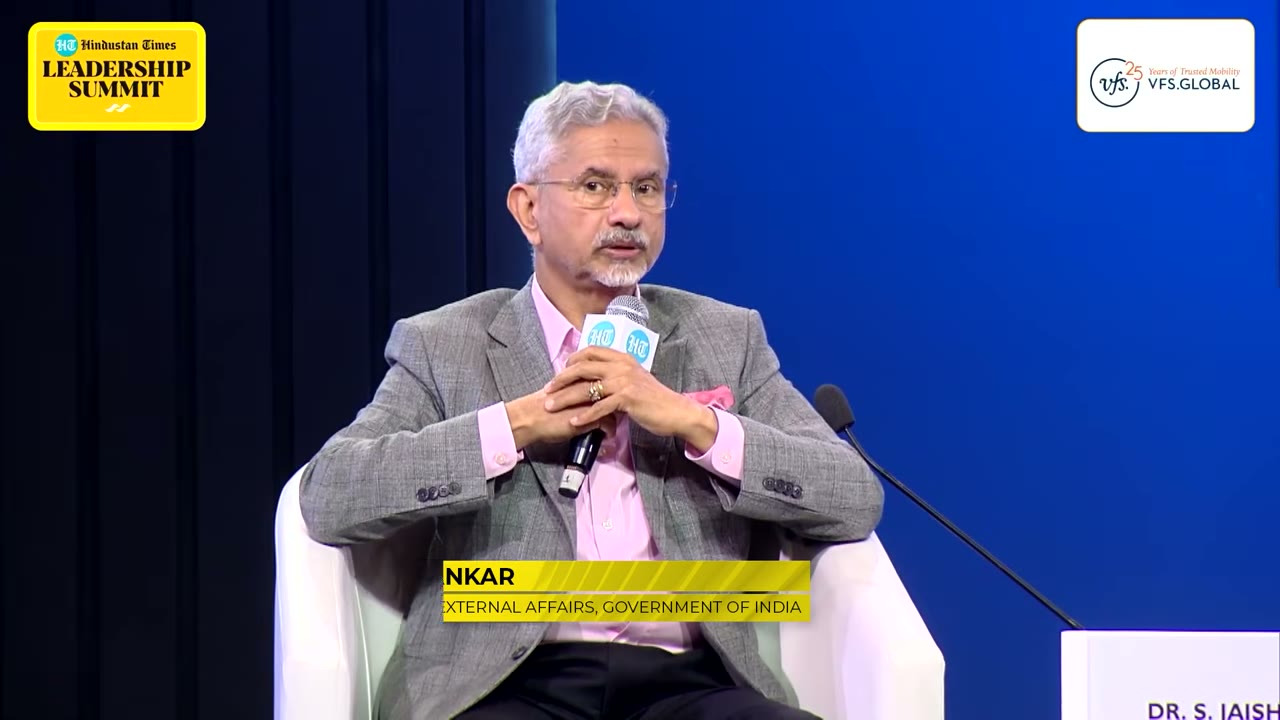
External Affairs Minister S. Jaishankar discusses India's power asymmetry with China, claiming border infrastructure has improved over the last decade. He also admits India missed industrialisation opportunities and now needs leapfrogging to catch up.
1Jaishankar Says India Has Narrowed Border Infrastructure Gap With China
India has narrowed the border infrastructure gap with China after decades of neglect, External Affairs Minister S. Jaishankar said, pointing to a steady stream of new tunnels, bridges and airfields along the frontier.
"The border infrastructure was really neglected till about a decade ago," Jaishankar said, adding that plans were drawn up but little was done on the ground. He said the truth is visible to anyone who tracks year-by-year road kilometers, tunneling and troop positioning, and "certainly anybody associated with the armed forces dealing with that sector knows the truth."
He said the last decade brought attention, resources and a policy push. As evidence, he asked listeners to count how often they now hear of a new tunnel, bridge or commissioned airfield — news, he said, arriving with "greater and greater frequency."
That build-up matters because the border with China has become "more alive," requiring a much greater and sustained commitment of troops. The work already done, he said, allowed those numbers to be deployed, and ongoing work will maintain them.
Asked specifically about Galwan, Jaishankar said India's ability to sustain and deploy forces on that border has "very definitely" improved — "in a very market way," he put it.
He described the two sides' capabilities as unequal and sectoral rather than evenly matched, and said India must build on its particular strengths. The next step, in his account: keep the construction and deployment going so the improved position holds.
2Jaishankar Admits India Missed Industrialisation Bus, Needs Leapfrogging
India "simply missed the bus" on industrialisation in the 1980s, External Affairs Minister S. Jaishankar said, conceding decades were lost while other developing countries modernised.
He recalled that around the time Rajiv Gandhi went to China in 1988, the Indian and Chinese economies were about the same size. China made a huge push toward modernisation and industrialisation in the 1980s, he said. "I'm sorry to say India in the 1980s simply missed the bus."
The 1990s brought corrections and reforms, but Jaishankar said they were not carried through sector by sector. Reforms, he argued, are not a one-time job for the finance or commerce ministry — they are continuous and multi-sectoral, and are meant to build capacities.
He said that 15 to 20 years ago there was active opposition to industrialising the country, with projects stalled in the name of the environment. He cited phones and semiconductors: India had semiconductor plants going back to the 1980s, yet never built a semiconductor industry.
"There were decades where we messed up," he said.
The task now is catch-up — but not by following the same track. India must leapfrog, he said, coming in on some fronts and passing up on others, and build its particular strengths to deal with asymmetry. In asymmetry, he said, you don't go toe-to-toe on every issue; you pick the ones where you have the advantage.