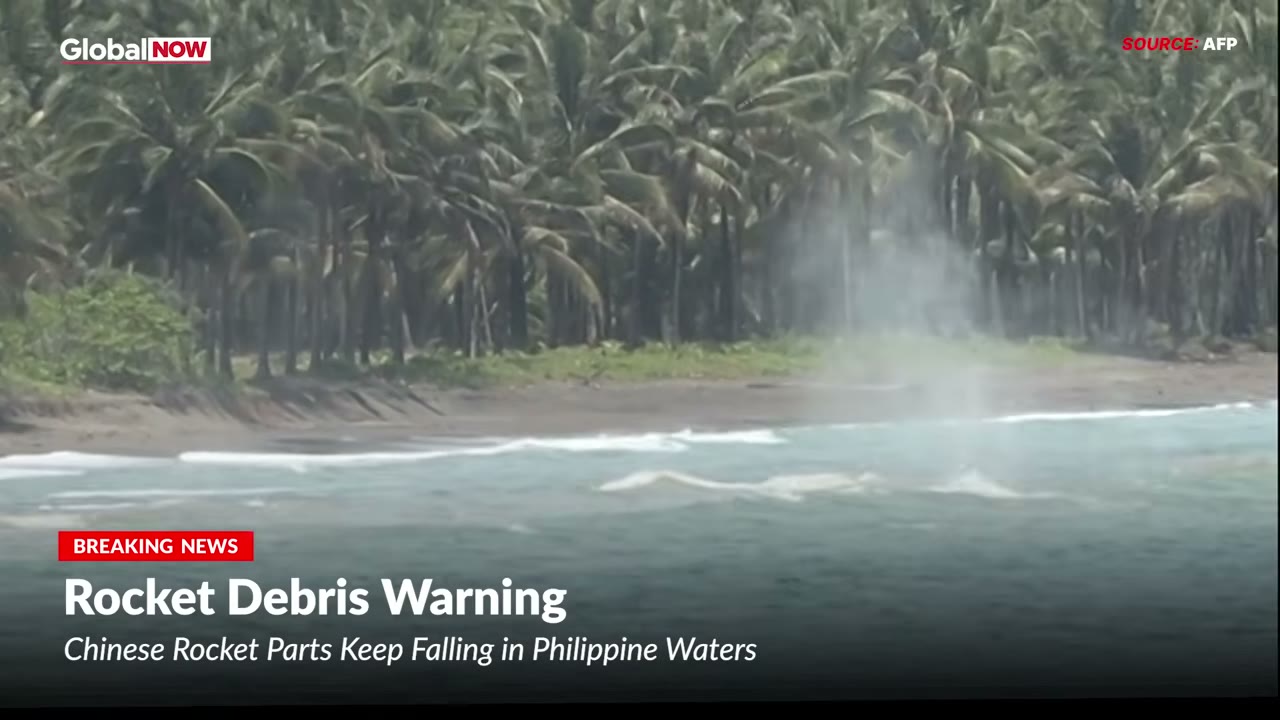
China launched three rockets from Hainan in a month, and each time the Philippines warned citizens about falling debris in its waters, sometimes near Palawan and the Tubbataha Reefs. The video explains why this keeps happening, the risks, and what international law says.
1China's Three Rocket Launches Send Debris Toward Philippine Waters in One Month
Three Chinese missile launches in one month, and each time the Philippines had to warn its citizens about debris falling into their waters. China is launching missiles more often than ever before, and the location of its new launch sites means the remains keep dropping into Philippine waters — sometimes just a few dozen kilometers from the coast. The pattern raises hard questions: what exactly is falling, why does this keep happening to the Philippines, is it dangerous, and what does international law say?
2October 10 Long March-12 Launch Drops Debris Near Palawan
China launched the Long March-12 rocket from the Wenchang International Commercial Spaceport on Hainan Island at around 3:28 a.m. Philippine time on October 10. The Philippine Space Agency (PhilSA) reported that the area where the rocket debris fell was in the archipelagic waters of the Philippines near Palawan. It was the first of three debris cases in a single month, each forcing Philippine authorities to warn citizens about falling rocket parts.
3October 25 Long March-8A Launch Creates Two Drop Zones in Philippine Waters
Fifteen days after the first case, China launched the Long March-8A rocket from the same Hainan spaceport at around 10:03 a.m. on October 25. This time, PhilSA identified two drop zones. One of them was within the exclusive economic zone of the Philippines; the other was in Philippine archipelagic waters. A notice to pilots (NOTAM) was issued about activity in the airspace.
4November 9 Launch Puts Debris Zone 19 Nautical Miles From Tubbataha Reefs
Another Long March-12 rocket launched from Hainan at around 4:24 a.m. on November 9, and PhilSA said the predicted impact zone was approximately 25 nautical miles from Puerto Princesa, the capital of Palawan — and only 19 nautical miles from the Tubbataha Reefs Natural Park. The Philippine Coast Guard issued a 30-minute warning from 4:17 a.m. to 4:47 a.m. for possible debris fall. Tubbataha is a UNESCO World Heritage Site in the middle of the Sulu Sea, known for its coral reefs, sea turtles, sharks and hundreds of species of fish.
5Why Rocket Stages Fall on the Philippines: Hainan Launch Site Geography
Rockets are built in stages, and during ascent they drop empty boosters, lower stages and fairings that fall back to Earth. Space agencies usually pick launch sites where falling parts land in the sea, away from people — the United States, for example, launches over the Atlantic from Florida. China's old spaceports sit deep in the mainland, where spent stages have sometimes fallen on villages and fields. To avoid that, China built a launch center in Wenchang on Hainan Island, opened in 2016, and a new commercial spaceport opened nearby in 2024. Rockets launched from Hainan often fly south and east, putting Philippine waters in their flight path.
6Philippines Has Faced Repeated Chinese Rocket Debris Warnings Since 2026
The debris warnings did not start this month. In May 2026, PhilSA warned that debris from the Long March-7A rocket could fall in the Philippines' exclusive economic zone — approximately 69 nautical miles from Santa Ana in Cagayan and 81 nautical miles from Camiguin Norte. More launches mean more debris warnings, and China is launching more and more rockets from Hainan as it builds satellite networks and expands its commercial space industry.
7Chinese Rocket Debris Washes Ashore in Cagayan and Ilocos Norte
Sometimes the debris does not stay in the sea. In November 2025, suspicious debris from a Chinese-marked missile washed ashore on Camiguin Island in Kalayaan, Cagayan Province, shortly after the launch of a Chinese Long March-7A rocket. A few days later, more suspicious debris with Chinese markings was found off the coast of Burgos in Ilocos Norte. That same month, the Philippine Navy recovered a large piece of suspected missile debris near Tubbataha Reef. It measured approximately 12 by 21 feet and, according to the military, could have belonged to the Long March-12 rocket.
8Long March-5B and Other Chinese Rockets Left Debris in Philippine Waters
Earlier, in 2022, metal debris found near Busuanga Island in Palawan and Occidental Mindoro was most likely identified as parts of the Chinese Long March-5B rocket. The center stage of that rocket made an uncontrolled return to Earth, falling into the sea near the Philippines in late 2024. That same year, PhilSA warned that debris from two Chinese missiles launched within days of each other could have fallen in Philippine waters in the West Philippine Sea — Long March 12 launched from Hainan on November 30 and Long March 3B from Xichang on December 3. PhilSA urged the public to report any fragments to local authorities.
9China's Space Boom Means More Launches and More Debris Warnings
The trend has run for years and is likely to grow. China is in a space boom: it operates its own space station, Tiangong, and regularly sends astronauts to it — just this week, Chinese astronauts held a press conference ahead of the manned Shenzhou-24 mission. China is also building vast networks of internet satellites, similar to SpaceX's Starlink, which will require hundreds of launches in the coming years, and more private Chinese rocket companies are entering the market. Not every launch will pass over the Philippines, but many launches from Hainan will — meaning PhilSA debris warnings are likely to become a regular part of life, especially in Palawan, the Sulu Sea and northern Luzon.
10Fishing Communities Struggle to Receive Launch Warnings in Time
For coastal communities, the warnings raise practical problems. Fishermen in Palawan, the Sulu Sea and off Cagayan often go to sea before dawn — the time when some of these launches occur. Many small fishing boats do not have radios or internet access at sea, so warnings do not always reach them in time. Local authorities and the Coast Guard are trying to spread notifications through radio stations, social media and community leaders before each launch window.
11Three Main Problems: Safety, Environment and Sovereignty
Getting information to everyone is not easy in a country with over 7,000 islands and thousands of fishing villages. There are three main problems. First, safety: fishermen and vessels in these areas may be at risk during launch windows, and a large metal fragment falling from the sky can be deadly — which is why the Philippine Coast Guard issues warnings with specific time frames and advises fishermen and sailors to avoid the drop zones. Second, the environment: fuel residue and metal fragments can pollute the sea, especially near vulnerable ecosystems such as Tubbataha, and some types of rocket fuel used in old Chinese rockets are very toxic. Critics in the Philippines have called these regular discharges a form of deliberate pollution. Third, sovereignty: the drop zones sit within Philippine waters, and for a country already dealing with Chinese coast guard ships, maritime police vessels and the recent flyby of a Chinese strategic bomber about 45 nautical miles off Luzon, missile debris is yet another way Chinese activity is literally landing on Philippine territory.
12How Dangerous Is Rocket Debris: Hypergolic Versus Kerosene Fuel
How dangerous the debris is depends on the rocket. Some of China's older missiles use hypergolic fuel, which ignites when its components touch each other — reliable, but very toxic and dangerous if touched or inhaled. Many of China's newer rockets, including the Long March-12 and Long March-8A, use mostly kerosene and liquid oxygen, which are much less toxic. Even then, rocket stages can contain fuel residue, other chemicals and sharp metal. It is not always possible to tell from looking at a fragment which rocket it came from.
13Philippines Weighs Diplomatic Protests and Flight Path Changes
So what can the Philippines do? There are several options. A country could file diplomatic protests every time a drop zone ends up in its waters, just for the record. It could ask China to provide even earlier and more detailed notice of launches and drop zones so fishermen and pilots have more time to prepare. It could pressure China to adjust flight paths where possible, keeping impact zones away from the Philippine coast and protected areas such as Tubbataha, and raise the issue in regional and international forums to strengthen demands for better rules on handling missile debris. So far, Manila has focused its response elsewhere.
14International Law Makes China Liable for Debris Damage
China would be legally on the hook to pay if its rocket debris damages anything in the Philippines. Under the 1967 Outer Space Treaty, countries are responsible for national space activities, including those run by private companies. The 1972 Convention on International Liability obliges the launching state to compensate for damage caused by its space objects on Earth's surface. No damage to people or property has been reported from the latest launches. Manila has so far leaned on warnings and public safety, but more launches are raising pressure for a stronger response.
15Dropping Rocket Stages at Sea Is Standard Practice
Dropping spent rocket stages into the sea is routine for space programs worldwide — and China shares launch details in advance. That heads-up lets the Philippine Space Agency and the Coast Guard issue warnings before debris comes down. PhilSA was created in 2019 partly to monitor exactly this kind of activity and protect Filipinos. Still, the growing frequency of launches is fuelling questions about whether more can be done.
16What to Do If You Find Rocket Debris: Don't Touch It
Find a piece of suspected rocket debris and the rule is simple: don't touch it. PhilSA warns against trying to find, move or sell it yourself, because it may carry toxic fuel residue. Keep your distance, keep others away, and notify local authorities, the Coast Guard or the police, who will remove it and examine it. Fishermen and boat operators in Palawan, the Sulu Sea and northern Luzon should check Coast Guard and PhilSA announcements before heading out, especially early in the morning. Warnings list precise coordinates and time frames — avoiding those zones is the easiest protection.
17China's Presence Now Extends From Seabed to Space
The West Philippine Sea dispute is usually framed around ships, reefs and fishing grounds. But China's growing presence around the Philippines now stretches from the seabed to the sky and into space, making it harder for Manila to track it all and keep people safe each year. As China's space program expands, that challenge is only set to grow.