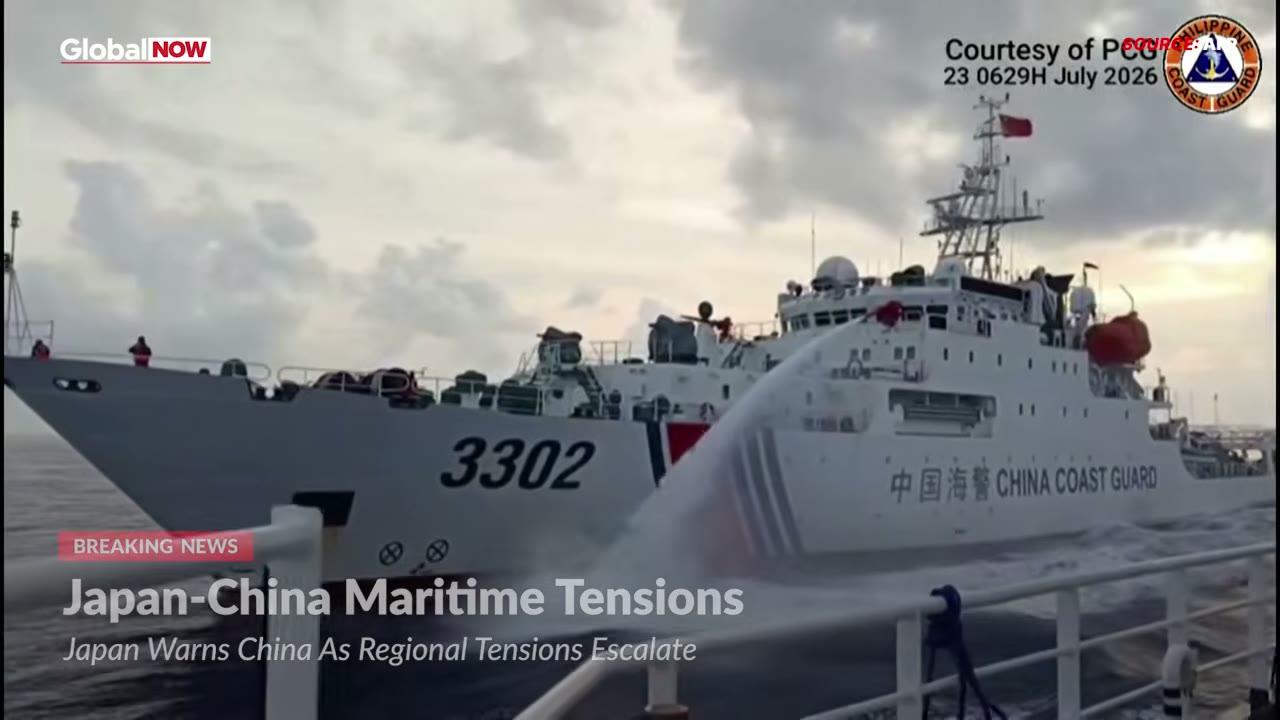
A new coast guard standoff near the disputed Senkaku Islands sharpens Japan-China tensions as Prime Minister Sanae Takaichi accelerates military modernization. The video also covers her APEC trip to Shenzhen, Trump's diplomacy, Ukrainian strikes on the Crimean bridge and reports of a Russian space nuclear weapon.
1Chinese Coast Guard Vessels Confront Japanese Fishing Boat Near Senkaku Islands
Two Chinese coast guard vessels approached a Japanese fishing boat near the disputed Senkaku Islands on November 26, 2026, Japan's Coast Guard confirmed. Japanese patrol vessels responded by repeatedly demanding the Chinese ships leave the surrounding waters.
Beijing told a different story: it claimed the Japanese fishing boat had entered China's territorial waters and that its coast guard took lawful measures to remove it.
The islands are controlled by Japan but also claimed by China and Taiwan. They are uninhabited, yet their strategic location has fueled decades of territorial disputes.
The standoff follows Prime Minister Sanae Takaichi's November 2025 remarks about Japan's potential military response to a security emergency involving Taiwan, which Beijing strongly condemned. Japanese officials are also reportedly seeking permission to visit the islands, though no landing has been independently confirmed.
The main worry: repeated collisions between Japanese and Chinese vessels could spark an unintentional confrontation.
2Takaichi's Gangway Mishap at APEC Summit in Shenzhen Sparks Speculation
A 40-centimeter height gap between the plane door and the gangway platform forced Japanese Prime Minister Sanae Takaichi to step out with extra caution at the APEC summit in Shenzhen. The footage quickly became a controversy.
Takaichi arrived in China on November 18 for discussions involving some of the world's largest economies. Speculation followed that Chinese authorities had deliberately arranged an uncomfortable reception for her.
Other allegations claimed Takaichi ordered her plane to arrive early to meet U.S. President Donald Trump. She denied ordering an early arrival, and subsequent reports pointed to a ladder malfunction as the more likely explanation.
No credible evidence has been found that any government deliberately orchestrated the incident.
3Takaichi Meets Xi but No Formal Bilateral Talks; Trump Contacts Tokyo
Sanae Takaichi shook hands and exchanged greetings with Chinese President Xi Jinping at the summit — but no official bilateral meeting between the two leaders took place.
Meanwhile, President Donald Trump held high-profile discussions with Xi and Russian President Vladimir Putin. That does not mean Trump ignored Takaichi: the American and Japanese leaders had already attended the Quad summit in Manila on November 17, alongside the leaders of India and Australia.
Trump later phoned Takaichi to inform her of his talks with the Chinese and Russian presidents. The contacts showed Washington-Tokyo ties remained active despite regional uncertainty.
4Takaichi Pledges Bigger Japanese Role in International Order at ASEAN Summit
Japan will play a more active role in supporting and strengthening the international order, Prime Minister Sanae Takaichi told the ASEAN-Japan Summit.
Her pledge reflects Tokyo's push to expand international security partnerships by deepening cooperation with countries that share similar strategic interests.
The diplomatic outreach comes alongside a military buildup: Japan is accelerating the modernization of its defense capabilities, a shift in its long-term strategy.
5Japan Deploys Upgraded Type 25 Missiles in Kumamoto and Hokkaido
Japan has deployed an upgraded Type 12 coastal defense system, designated Type 25, in Kumamoto Prefecture. The Ministry of Defense also plans to send a separate Type 25 long-range missile system to Hokkaido in December 2026.
Tokyo argues that stronger deterrence and retaliatory strike capabilities are increasingly necessary given rapid changes in the security environment.
Hokkaido sits near Russia; Kyushu and Japan's southwestern islands lie near the East China Sea. Those regions are growing more important for defense planning amid China's expanding military activity and concerns about Russia and North Korea.
Tokyo insists the buildup aims to deter potential aggression and protect Japanese territory, not to provoke confrontation with neighboring countries.
6Critics Question Defense Spending as Japanese Households Face Rising Costs
Critics of Sanae Takaichi's security policy are asking whether faster military modernization could further undermine regional stability. They argue Tokyo should prioritize diplomacy, economic cooperation and peaceful relations with neighbors instead of deeper military rivalry.
At home, Japanese households face rising living costs, falling purchasing power and financial uncertainty. For some citizens, higher defense spending raises questions about whether enough resources go to domestic economic priorities.
Proponents counter that economic and national security cannot be separated — especially for a country that relies heavily on international trade and safe maritime transport routes.
7Japan Weighs Threats from North Korea's Nuclear Program and Russia
North Korea's nuclear and strategic weapons programs under Kim Jong-un remain a core concern for Tokyo. Relations with Moscow are also strained by long-standing territorial disputes and Russia's ongoing conflict with Ukraine.
Japan's reliance on international trade and safe maritime transport routes makes these threats especially costly, and its defense planning increasingly weighs the risks from all three directions.
8Ukraine Strikes Crimean Bridge, Halting Rail Service as Winter Nears
Ukrainian President Volodymyr Zelensky confirmed on November 17 that Ukrainian forces conducted operations against the Crimean bridge, calling them a response to Russian strikes on Ukrainian infrastructure.
The bridge is the main transport link between mainland Russia and occupied Crimea, which Moscow annexed in 2014. Ukraine says the facility supports Russian military logistics and has struck it repeatedly.
Strikes reported on November 19 suspended rail service across the bridge. Russian President Vladimir Putin later warned of retaliation.
Russian forces continue striking Ukrainian infrastructure, including power grids and transport facilities, raising fears of electricity shortages, heating outages and worsening humanitarian conditions as winter approaches.
9Western Intelligence Warns Russia May Orbit a Nuclear-Armed Satellite
Western intelligence agencies believe Russia may be preparing to launch a satellite allegedly capable of delivering nuclear weapons into Earth orbit, according to reports published on November 23.
The satellite, known as "Sputnik S", has drawn attention from NATO member states. Western estimates say the equipment was developed several years ago and could potentially launch within the coming months.
The allegations remain publicly unconfirmed, and the Kremlin has strongly rejected them. No independently verified evidence shows Russia has placed such a nuclear device in orbit.
Germany, under Chancellor Friedrich Merz, is taking the new security challenges seriously with European and NATO partners.
10Space Nuclear Threat Could Cripple Satellites and Global Services
A nuclear incident in outer space could damage satellites, disrupt communications and knock out critical services that millions of people depend on.
The allegations about Russia's "Sputnik S" have renewed debate about the militarization of space and the vulnerability of satellite infrastructure. Telecommunications, navigation, weather forecasting, emergency services, financial transactions and international transportation all rely heavily on space.
Radiation and electromagnetic disturbances could extend the damage far beyond military facilities. But the exact scale depends on several factors, so predictions of mass and immediate satellite destruction should be treated with great caution.
11Starfish Prime and the 1967 Outer Space Treaty Set Precedents
A US nuclear test in space damaged satellites in 1962 — the same risk now haunting modern space security. In July 1962, the United States detonated a high-altitude nuclear weapon over the Pacific Ocean in a test called Starfish Prime. Radiation from the blast damaged several satellites and caused further spacecraft malfunctions.
Both the US and the Soviet Union ran high-altitude nuclear tests during the Cold War, raising international awareness of the dangers of nuclear activity outside Earth's atmosphere. In 1967, the Outer Space Treaty banned countries from placing nuclear weapons or other weapons of mass destruction in Earth's orbit.
The treaty remains a cornerstone of international space law, though technological progress and rising military competition have created new security challenges.
12Analysts Split on Space Warnings and Risks of Military Escalation
Warnings about Russia's alleged nuclear capabilities in space are splitting analysts — some say they deepen mistrust, others say the risk is too grave to ignore. Critics argue the warnings could fuel geopolitical distrust and push for more military spending in Europe.
Supporters of taking the intelligence seriously say a nuclear incident in space would have consequences far beyond any single country's borders. Russia itself would not necessarily be immune, given its dependence on satellite technology.
China, Japan, the United States, European countries and many other nations could also face significant disruptions.
13Leaders Face Complex Global Security Landscape and Hard Choices
From the East China Sea to Ukraine to orbit, the world's security landscape is getting more complex — and leaders are running out of easy options. For Prime Minister Sanae Takaichi, the immediate challenge is balancing Japan's ambitious defense modernization, diplomatic engagement and domestic economic priorities.
Chinese President Xi Jinping must preserve Beijing's territorial claims while resolving regional tensions. President Donald Trump faces preserving Washington's international security partnerships while keeping diplomatic engagement with China and Russia.
Vladimir Putin and Volodymyr Zelensky continue to pursue fundamentally different goals, while European governments juggle growing security concerns and domestic economic pressures. Whether diplomacy returns or divisions deepen will depend on leaders' decisions in the coming months.