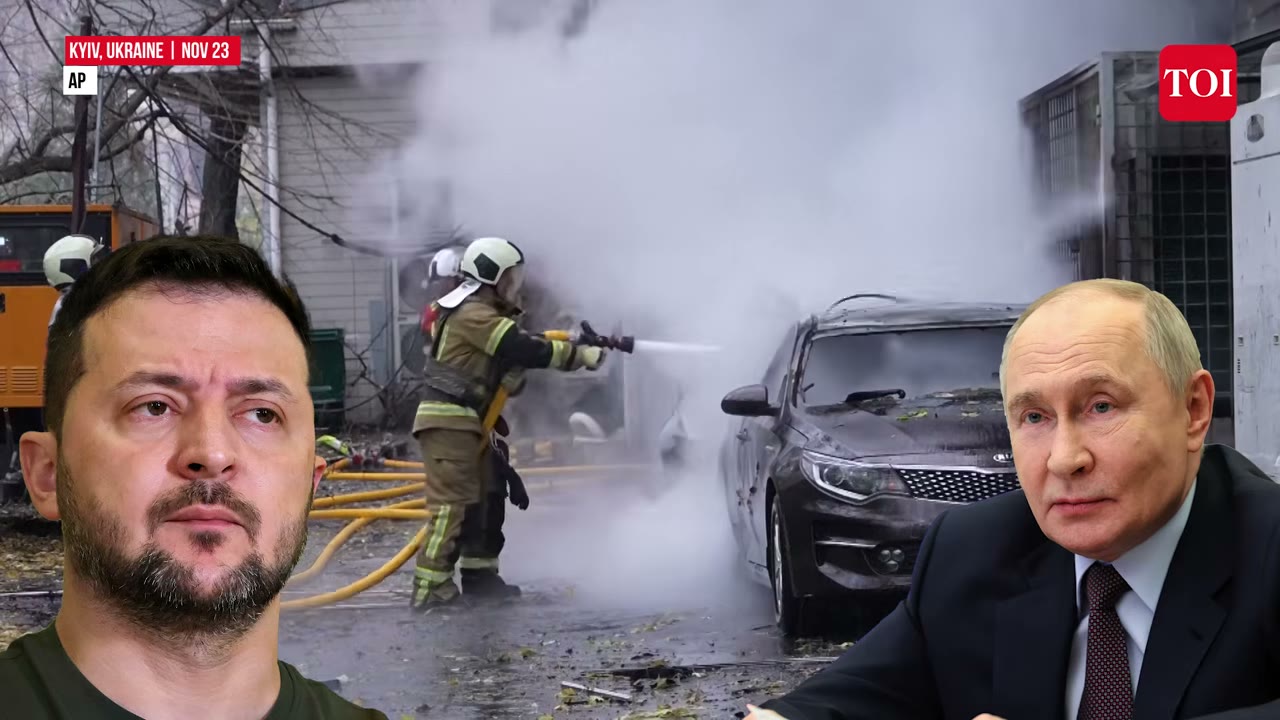
Ukraine's Zelensky says Kyiv will freeze fighting along the current line of contact and accept temporary Russian control of occupied territory as a major compromise. Russia meanwhile escalates attacks on Ukrainian drone and supply infrastructure and warns foreign defense workers may face prosecution.
1Zelensky offers to freeze frontline and accept temporary Russian control
Ukraine is ready to stop fighting where its troops stand — even if that leaves occupied land under Russian control. President Volodymyr Zelensky told Qatar-based broadcaster Al Jazeera that Kyiv would freeze the front line along the current line of contact and move toward diplomatic negotiations.
He described the offer as a major compromise, acknowledging that Russian President Vladimir Putin will not withdraw his troops from Ukrainian territory. His message, as relayed: stop the fighting first, then take the dispute to the negotiating table.
Zelensky also aimed a message at Washington, calling on US President Donald Trump to keep using his influence and constitutional powers to find a way to end the conflict.
2Zelensky warns Ukraine must not be sole side making concessions
Ukraine will not be the only side forced to give ground for peace, Zelensky warned, even as he offered to freeze the front line. His remarks came amid stalled diplomatic efforts.
Recent US-mediated talks in Abu Dhabi failed to produce a breakthrough. Kyiv said Moscow returned to maximalist demands.
3Kushner says Putin not interested in ceasefire-first approach
Vladimir Putin is still not interested in a ceasefire-first approach, US presidential envoy Jared Kushner has acknowledged. That leaves Moscow's position as the biggest obstacle to any deal.
Kushner's praise of the Russian leader as a political grandmaster — and his description of the invasion as a European proxy war — drew criticism in Kyiv and across Europe.
The question now: will Putin accept a ceasefire as the starting point for negotiations, or does the diplomatic deadlock continue?
4Russia strikes Ukrainian drone and ammunition infrastructure across regions
Russian 2S1 Gvozdika self-propelled howitzers have reportedly destroyed Ukrainian drone control centers in the Zaporizhzhia region. Russia's defense ministry says the 122 mm gun has a firing range of up to 15.2 km and a four-member crew.
Moscow says the strikes aim to disrupt Ukraine's drone operations. It also claims its forces damaged workshops at the JTI Ukraine tobacco factory in the Kremenchuk, Poltava region, alleging ammunition for Ukrainian troops was made there.
Other reported targets: the Mirosh logistics center in Odesa, the Preobrazhensky bridge across the Dnieper in Zaporizhzhia, a warehouse storing long- and medium-range drones in Shka, and a dry cargo vessel carrying dual-use goods in the Black Sea.
5Russia says strikes respond to Ukrainian attacks and NATO-linked sites
Russia says its strikes are a response to Ukrainian attacks, aimed at facilities supporting Kyiv's military capabilities — including infrastructure allegedly linked to NATO specialists.
Notably, the Russian statement did not include Ukraine's account of the reported damage or the military use of these sites.
The claims point to Russia's continued effort to disrupt Ukraine's weapons production.
6Russia threatens criminal liability for foreign defense company employees
Civilian employees of foreign defense companies who directly take part in attacks against Russia are "legitimate military targets" and may be held criminally liable, Moscow has declared.
It went further: if personnel of companies supplying military equipment in Ukraine are there on the instructions of and under the control of states, those states lose neutral-power protections under a 1907 convention and must be recognized as participants in the conflict, with all the legal and military-political consequences.
The statement did not spell out what action would follow.
7Russia accuses Japan of remilitarization and NATO activity near Far East
Japan's leadership is "stubbornly pursuing a path of remilitarization," Russia says, building up the strike capabilities of its self-defense forces and adapting its doctrinal documents to that course.
Moscow says it has observed more Japanese military training activity, including drills involving NATO contingents near Russia's borders in the Far East.
In response, Russia says it is compelled to take countermeasures to strengthen its defense capabilities.
8Russia protests Canada's visa refusal to Russian Paralympians
Canada refused visas to Russian Paralympians traveling to Canmore, Alberta, for an International Ski and Snowboard Federation Continental Cup in para cross-country skiing — and Moscow calls it blatant discrimination.
The events took place in November this year. Russia's Foreign Ministry said the refusal came after a final request and called the treatment "neo-Nazi style" and based on nationality.
Canada, it said, is violating the principle of depoliticization of sport and the Olympic charter.
9Russia says no prospect of dialogue with NATO and EU, reserves retaliation
There is no prospect of genuine dialogue with Western Europe or the wider NATO-EU community, Russia says, accusing their politicians of building a security system in open opposition to Moscow.
Russia "reserves the right to take a range of retaliatory, political, and diplomatic measures" to protect its national interests and the legitimate rights of Russian citizens, a statement said.
Any decisions will be taken in close coordination with ally Belarus.
10Russia praises China's balanced stance and peace settlement role
Moscow is thanking Beijing for its "balanced stance" on the crisis surrounding Ukraine, saying China's approach takes in the background of the issue and recognizes the need to address its root causes.
Russia also said it appreciates China's willingness to play a positive role in facilitating a peaceful settlement.
The statement came as Russia said it would coordinate its decisions closely with ally Belarus.
11Putin and Japan's Takaichi hold first summit-level meeting in Shenzhen
Vladimir Putin and Japan's Prime Minister Sai Takay met face to face in Shenzhen — the first summit-level contact between the two countries after a long break. The meeting was arranged on the sidelines of the apex summit at Japan's request, a Russian official said.
Moscow hopes the talks will produce at least some improvement in relations between the two countries. The official added a condition: this depends on the Japanese side not once again losing its composure.
Russia says it is ready to build a mutually beneficial partnership with Japan. No further meetings or agreements were announced.
12Russia courts Serbia on partnership and Kosovo rights
Russia is courting Serbia's incoming leadership with an offer of closer economic and cultural ties. Moscow says it wants a mutually beneficial partnership built on the historical and spiritual ties between the two countries.
The plan covers joint bilateral projects in the economy, culture and humanitarian cooperation, plus coordinated action on the international stage. That includes, Moscow said, protecting the rights of Serbs in Kosovo.
Russia is counting on a constructive and cooperative attitude from the Serbian incoming leadership. As for the Serbian people, the official said he has no doubt about their attitude.
13Russia warns Latvia against closing border crossings
Russia warned Latvia that closing its border crossings with Russia would be shooting itself in the foot. The warning came after Estonia and Finland took the same step.
Moscow said the move would make life harder not only for Latvia's own citizens but also for residents of other European Union states. Those travelers regularly use Latvia's border crossings to visit Russia's northwestern regions.
No deadline or response from Riga was mentioned. The remark signals Moscow is watching whether Latvia follows its neighbors.