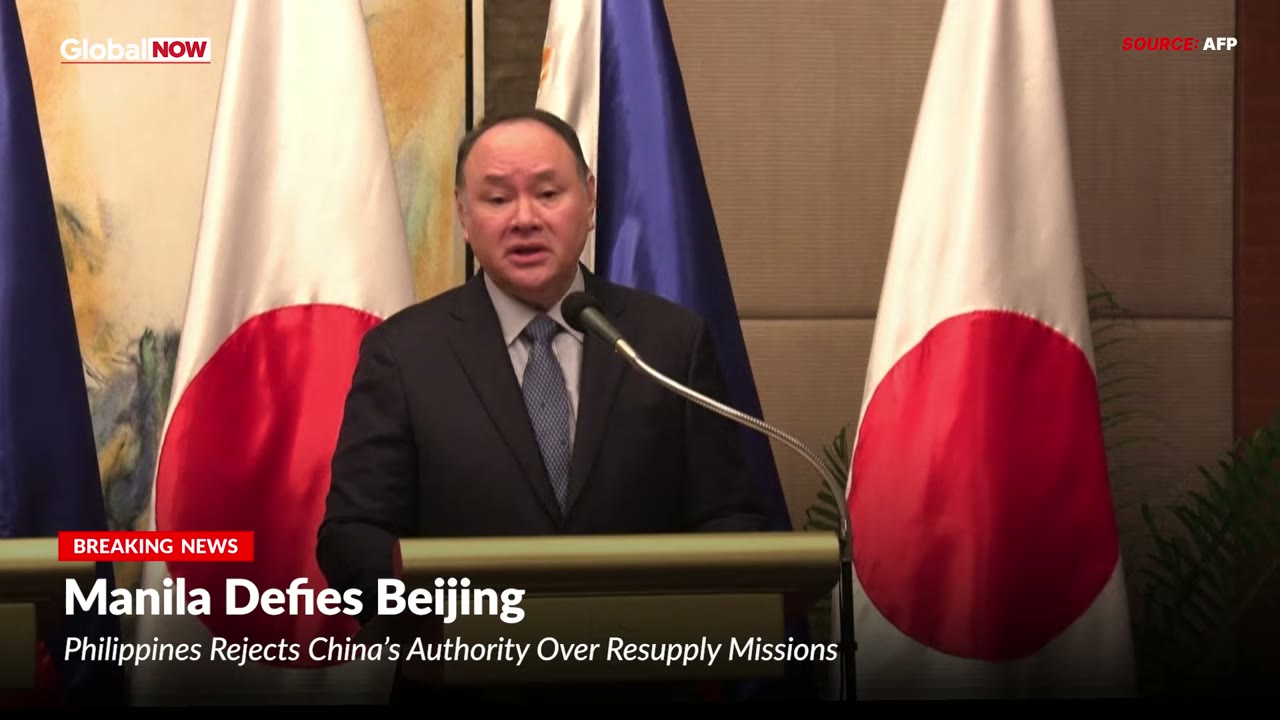
Manila insists it needs no foreign approval to resupply troops on the BRP Sierra Madre, rejecting Beijing's claim it authorized the October mission. The Philippines also recorded 48 Chinese naval and coast guard vessels in the West Philippine Sea, up from 19, while a separate US warship encounter near Sabine Shoal raised tensions.
1Philippines Rejects China's Claim It Needs Permission for Ayungin Missions
Manila has told Beijing that no foreign government gets to approve Philippine military missions in the West Philippine Sea. The Philippines rejected China's claim that Filipino personnel need Chinese permission to rotate and resupply troops aboard the BRP Sierra Madre at Ayungin Shoal.
After the October grounding operation was completed, Manila made clear it would keep maintaining personnel on the vessel without seeking permission from any foreign government.
The rejection comes as Philippine military authorities recorded a significant increase in Chinese naval and coast guard vessels following the recent ASEAN summit.
Separately, a meeting involving a US warship near Sabine Shoal highlighted the growing competition between Washington and Beijing in the South China Sea.
Together, the developments point to a more complex security situation as the Philippines defends its maritime interests while pursuing diplomacy with China.
2Philippine Military Confirms October Resupply Mission Reached Sierra Madre
The Armed Forces of the Philippines confirmed that its October 22, 2026 mission to rotate and resupply personnel aboard the BRP Sierra Madre was completed with no reports of incidents.
Retired Rear Admiral Roy Vincent Trinidad, the Philippine Armed Forces spokesman for the West Philippine Sea, rejected China's claim that Beijing authorized the operation. "We do not need to seek permission or approval from any foreign state to carry out our mandate," he said.
His remarks reflected Manila's determination to keep its military presence on Ayungin Shoal despite continued pressure from Chinese naval forces.
Philippine authorities view rotation and resupply missions as normal military duties, ensuring Filipino personnel on the grounded naval vessel receive supplies and can safely complete their deployment.
For Manila, a successful operation is more than a logistical achievement.
3China Says It Allowed Supplies Through as Manila Disputes Account
China's Coast Guard claimed its personnel monitored Philippine vessels and allowed supplies to be delivered to the BRP Sierra Madre — a version Manila has categorically rejected.
The Philippine military argued that the presence of Chinese vessels during the Philippine operation does not establish Beijing's authority over the mission.
The discrepancy carries significant implications for future operations. Accepting the Chinese interpretation could create an expectation that Philippine vessels must obtain Chinese permission every time they deliver supplies to Ayungin Shoal — a position Manila has consistently refused to acknowledge.
The successful October operation followed a difficult naval encounter on September 24.
4September 24 Resupply Mission Halted by Chinese Interference
Chinese vessels were accused of obstructing a Philippine resupply mission about 60 nautical miles from Ayungin Shoal on September 24, forcing commanders to suspend it.
The Philippine formation included the civilian supply vessel MV Lapu-Lapu, accompanied by three Philippine Navy and Philippine Coast Guard support vessels.
According to the Philippine military, Chinese vessels carried out dangerous maritime maneuvers that created serious navigational risks and threatened the safety of Filipino personnel. Commanders temporarily suspended the mission to avoid further escalation.
Supplies and reserve personnel did not reach their destination in that operation, which Manila disputed, while Philippine authorities maintained the mission was legal and necessary.
The encounter showed how routine deliveries of food, drinking water and medicine can turn into complex maritime operations. The successful October mission followed.
5China's Southern Theater Command Spots USS Charleston Near Sabine Shoal
China's Southern Theater Command announced on October 20 that its naval forces had observed the USS Charleston near Sabine Shoal, known in the Philippines as Escoda Shoal.
The USS Charleston is an Independence-class littoral combat ship serving in the United States Navy.
Beijing accused a US ship of entering waters near a disputed maritime feature without China's permission, claiming its presence threatens regional maritime security. Chinese military authorities argued their surveillance was necessary to protect Beijing's claimed sovereignty and security interests.
The United States has consistently defended its right to conduct legitimate maritime operations under international law, opposing excessive maritime restrictions that impede freedom of navigation.
The South China Sea remains one of the world's most strategically important waterways.
6Analysts Separate US Warship Patrol From Philippine Resupply Mission
There is no independently verified evidence that an American ship directly escorted a Philippine supply formation, or that Chinese forces retreated due to American military pressure.
The USS Charleston operated near Escoda Shoal, while the Philippine resupply operation involved Ayungin Shoal — two separate marine objects.
Although both events occurred during the same period, they should not be interpreted as a confirmed joint military operation, analysts said.
The long-standing defense alliance between the Philippines and the United States is taking on increasing importance amid ongoing maritime tensions with China.
7BRP Sierra Madre Grounding and the 2024 Resupply Arrangement
The Philippines intentionally ran the BRP Sierra Madre aground on Second Thomas Shoal in 1990-99, creating a permanent military outpost aboard the aging naval vessel.
Despite its deteriorating condition, the ship keeps the Philippine military presence in the area. Personnel aboard depend on regular supplies of food, drinking water, medicine and other essentials, and rotations are equally important given the challenging living conditions.
Repeated maritime confrontations prompted Manila and Beijing to reach a preliminary agreement in July 2024, intended to reduce the likelihood of dangerous collisions during rotations and resupply operations without resolving broader maritime differences.
By August 2026, the Philippine Department of Foreign Affairs reported the mechanism had facilitated 15 resupply missions without incident.
8Manila and Beijing Clash Over Meaning of Resupply Agreement
Philippine Foreign Secretary Maria Teresa Lazaro said in September that the resupply mechanism was designed to facilitate communication, not to impose a requirement for Chinese permission.
"It's just an exchange of information," she said.
Her remarks reaffirmed Manila's position that the previous agreement does not jeopardize the Philippines' sovereign rights or jurisdiction in the West Philippine Sea. Under Manila's interpretation, the Philippine military leadership remains responsible for determining the timing of replenishment operations.
Beijing continues to assert a supervisory role over activities around Ayungin Shoal — a difference Manila and Beijing have yet to resolve.
92016 Arbitration Award Anchors Manila's Legal Case on Second Thomas Shoal
A July 12, 2016 arbitration award sits at the center of Manila's legal position on Second Thomas Shoal.
An international tribunal established under the United Nations Convention on the Law of the Sea determined that the shoal is a low-tide elevation within the exclusive economic zone and continental shelf of the Philippines. It also found the feature does not create maritime rights on its own and that China has no overlapping maritime rights in the area.
The decision rejected China's claims to historical rights to resources beyond maritime rights established by international law. Beijing continues to reject the award, while Manila considers it a fundamental part of its maritime policy.
The exclusive economic zone is not equivalent to sovereign territorial waters: coastal states hold sovereign rights over living resources and certain economic activities, while foreign vessels retain navigation rights under applicable international law.
10Philippines Monitors 48 Chinese Vessels in West Philippine Sea
The Philippine Armed Forces monitored 48 Chinese naval and coast guard vessels in four strategically important areas of the West Philippine Sea between November 17 and 23, 2026 — up from 19 in the previous reporting period.
Of the 48 registered vessels, 31 belonged to the Chinese Coast Guard and 17 to the People's Liberation Army Navy. Ayungin Shoal was among the monitored areas.
Retired Rear Admiral Roy Vincent Trinidad explained that China's naval presence decreased during the ASEAN summit in the Philippines, then increased again after the regional meeting concluded.
Despite the increase, Philippine military authorities did not report any significant incidents in the four controlled maritime areas during the reporting period.
11Manila Vows to Continue Lawful Operations Without Beijing's Permission
A successful resupply operation in October showed Manila can keep its military presence in the disputed waters despite earlier setbacks — but Chinese vessels are gathering again. The renewed concentration of Chinese ships signals the security challenges the Philippines still faces, with maintaining a permanent maritime presence, protecting Filipino personnel and preventing dangerous collisions all described as urgent priorities.
Diplomatic communication may lower the immediate risk of confrontation, but neither side has dropped its core maritime position, so the dispute remains far from resolved.
Manila's message is unchanged: it will keep conducting lawful maritime operations, maintaining its military personnel and exercising what it calls its internationally recognized maritime rights without seeking permission from Beijing.
The central question now is what comes next.