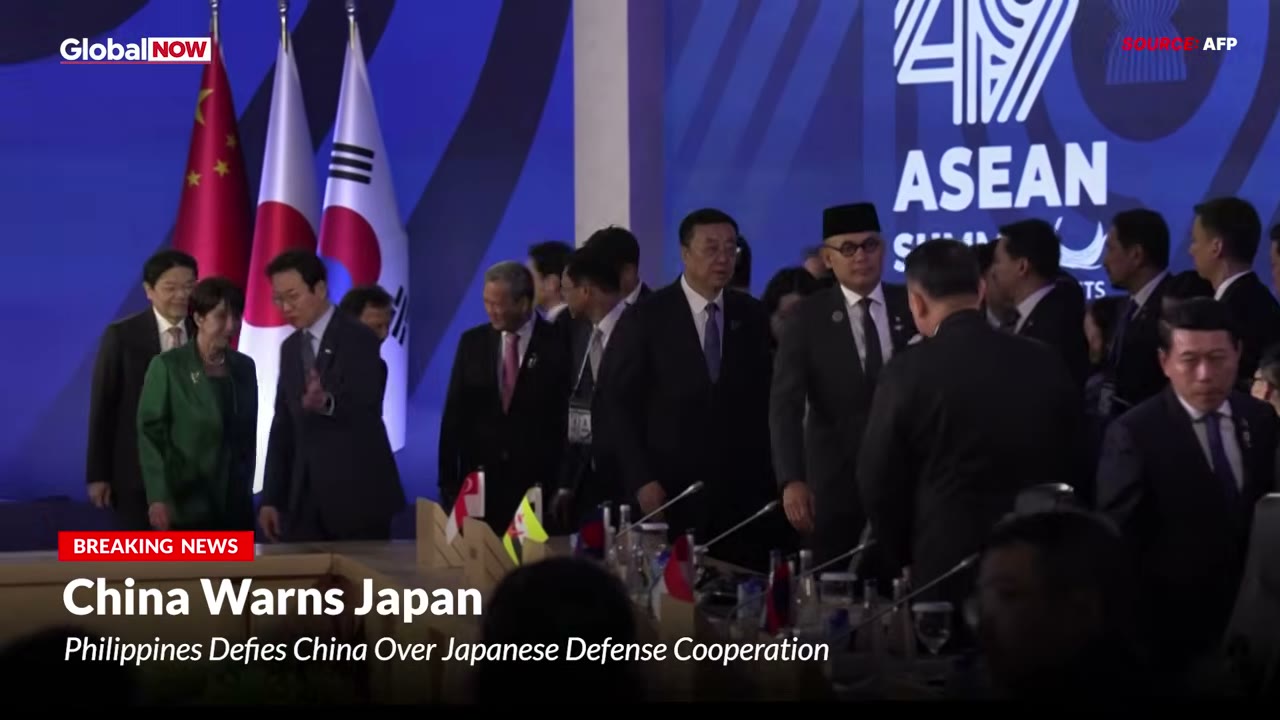
China's Defense Ministry criticized Japan for deepening security ties with the Philippines, including a 4.3 billion yen radar and drone package. Manila rejected Beijing's objections, defending its right to choose defense partners as South China Sea and Taiwan tensions persist.
1China Warns Japan Over Defense Cooperation With Philippines
China has told Japan to stay out of the South China Sea, warning that Tokyo's new defense deal with the Philippines is stoking regional tension.
Japan is preparing to hand the Philippines advanced coastal radar systems and unmanned reconnaissance aircraft. Beijing says that makes Japan a meddler in a dispute it has no claim to.
"We demand that Japan stop provoking problems around the South China Sea issue," said Senior Colonel Tan Shi, a spokesman for China's Ministry of National Defense, at a press briefing in Beijing on November 26.
Tan accused Tokyo of exaggerating external threats, alarming its neighbors and building exclusive military partnerships to expand its influence in strategic waters.
The deal at the center of the dispute was signed in Manila on November 9, 2026, by Philippine Foreign Secretary Maria Teresa Lazaro and Japanese Ambassador Katsuro Kitagawa. It is worth 4.3 billion Japanese yen — about 27 million US dollars, or 1.72 billion Philippine pesos.
Under Japan's official security assistance program, the Philippine Navy gets a coastal radar system and the Philippine Air Force gets unmanned aircraft for monitoring and reconnaissance. It marks the first transfer of defense equipment under that program.
Manila has already rejected Beijing's criticism, saying China has no authority over its defense partnerships.
2Philippines Rejects Beijing's Objections to Defense Partnerships
The Philippines has told China it needs no permission from Beijing to sign defense deals with other countries.
Manila's Department of National Defense issued the response on November 27, a day after Beijing warned Japan over its deepening security cooperation with the Philippines.
"We do not need Beijing's permission regarding our relations with other nations, especially in matters of our defense and security," said Assistant Secretary Arsenio Andolong, the department's spokesman.
Andolong said China has neither the authority nor the moral justification to decide how the Philippines defends its sovereignty. Manila also urged Beijing to respect other countries' maritime rights under international law, including the United Nations Convention on the Law of the Sea.
The pushback follows Japan's decision to supply coastal radar and surveillance equipment. The two countries' Reciprocal Access Agreement took effect in September 2025, opening the way for military visits and joint activities.
Manila frames better maritime awareness as a practical need: responding to incidents, documenting activity in disputed waters and protecting Filipino fishermen.
A 2016 international arbitration tribunal ruled China's historical rights claims had no legal basis. Beijing rejected that decision and still insists on its claims.
3China Holds Large-Scale Drills Around Taiwan
China's navy ran large-scale, unscheduled military exercises in parts of the western Pacific and around Taiwan in early November, drawing alarm from Taipei.
Taiwan's government called the operations ongoing intimidation aimed at pressuring the island and showing off China's growing military power.
Taiwan's Minister of National Defense Wellington Koo raised concern about the drills, which involved an aircraft carrier and other formations. The exercises highlighted China's ability to operate beyond its coastal waters, in corridors linking Japan, Taiwan and the Philippines.
Asked about the drills at a briefing on November 26, Chinese Defense Ministry spokesman Chen Jie called the increased training and operational readiness completely legal and justified. He said stronger military capabilities are needed to protect national sovereignty and territorial integrity.
Chen also accused certain parties of exaggerating China's military activities for political purposes, and blamed Taiwan's ruling Democratic Progressive Party for undermining stability in the Taiwan Strait.
Taiwan's government rejects Beijing's sovereignty claims and says the island's future should be decided by its people.
4US Alliances and Competing Security Views in Indo-Pacific
Japan and the Philippines are calling their expanding defense partnership protective. Beijing sees it as a threat — and neither side is backing down.
Japan sits close to Taiwan, and the Philippines lies just south of the island, so any crisis in the Taiwan Strait feeds directly into both countries' security planning. The United States, which holds separate formal alliances with Japan and the Philippines, also has a major interest in regional stability.
Washington's allies are tightening cooperation among themselves while Beijing grows more critical of arrangements it sees as aimed at containing China.
The core problem: steps one government calls defensive are increasingly read as threatening by another. Better surveillance, closer military coordination and stronger partnerships can make countries feel safer — but without communication and diplomacy, the same steps can deepen mistrust.
There is no sign Japan intends to abandon its security assistance agreement with the Philippines after China's objections. Manila insists its partnerships are a legitimate expression of sovereignty; Tokyo stresses open sea lanes and regional stability.
The question now is whether diplomacy can settle these competing interests, or whether more military activity and harsher statements push the region toward further instability.