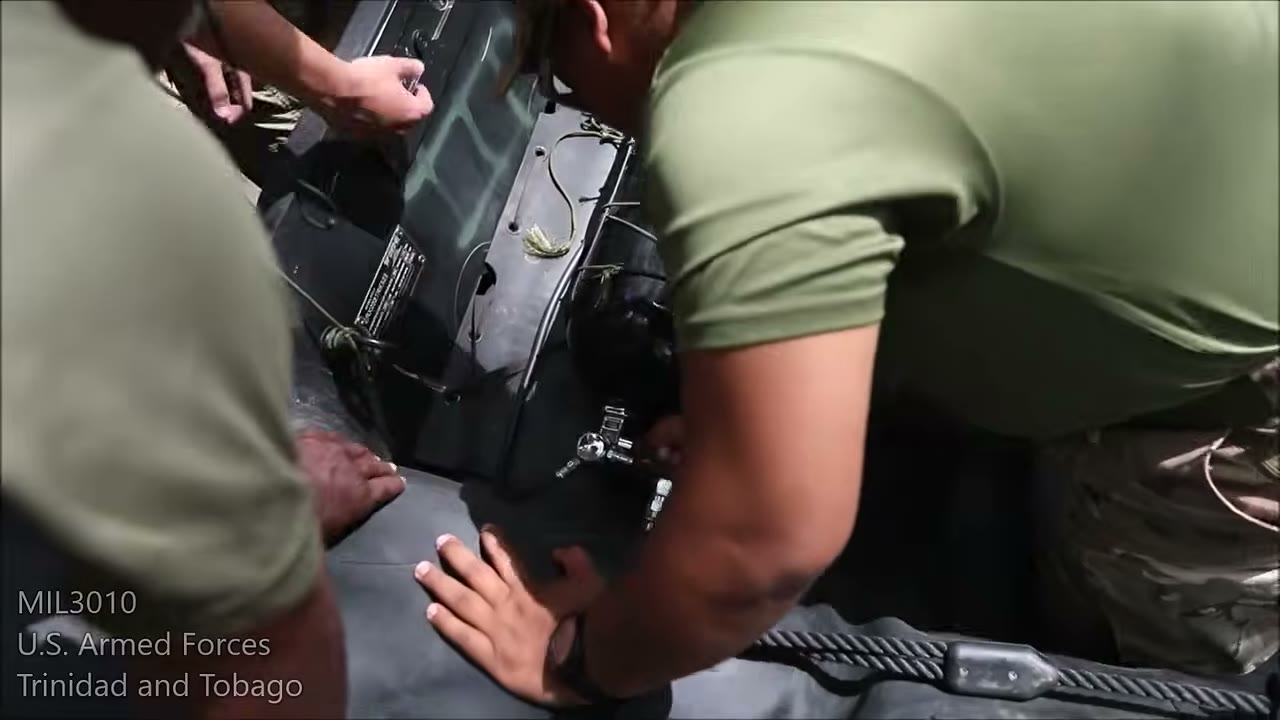
A MIL3010 report shows US and Trinidad and Tobago forces training together in jungle and urban settings. The drills cover radios, medical care, patrol tactics, live fire and site security at energy facilities.
1Troops Prep Engines and Gear for Jungle Training
Soldiers checked their watches and timing before jungle field training, with one instructor calling out a pace of 35 to 40 minutes. Troops then worked on removing a fuel tank, with warnings to watch for holes in the ground.
One soldier was told he looked like a professional as the gear prep continued. Another was sent to grab more equipment.
The work was routine preparation before field exercises began.
2Soldiers Learn Radio Menu Navigation and Frequency Checks
Soldiers learned to navigate radio menus by reading a map display instead of clearing out when lost. The instructor said the screen shows where you are in the menus.
Troops then walked through frequency checks: receive only, know the transmit frequency, use the receive frequency, then verify transmit.
The instructor urged them to go through every step even if they think they know it. "It's going to save you problems down the down the road," he said.
One radio was checked off and the group moved to the next frequency.
3Heat Becomes a Concern During Field Exercises
Heat became the talking point in the field, with troops sounding off about the conditions in just a few words.
"Heat up here. Heat," came the call during the exercise.
The complaint was brief but pointed to the oppressive conditions troops were working in during field training.
4Instructor Explains Yellow Marking and Post-Threat Procedures
A yellow marking signals that the gun no longer has a threat, an instructor explained, meaning troops can take their time and get their equipment out.
The lesson covered what to do after a threat is cleared: address the soldiers, get jackets off and ready them, and load gear so it can be put on tight until bleeding stops.
Asked if treating a wound will hurt, the answer was yes. Asked if the soldier can still function, the answer was also yes.
5Radio Tracking System Shows Best Signal Source
A tracking system flags the best radio link with a small star on screen, putting that radio first.
A soldier working the system noted you can go through the chat function and pick it up, but the icon itself is not visible.
The exchange moved between call signs as the team worked through the setup.
6Teams Use Terrain Landmarks to Plan Movement
Troops tied their movement plans to what they could see, using a building and a bridge as reference points on the route.
Radio checks followed, with call signs sounding off loud and clear. "Actual hatchet 01 loud and clear," came one transmission.
For one part of the plan, the team said they would move by transportation.
7Instructors Drill Close-Contact Reaction Tactics
Instructors drilled troops on close contact: fire three shots and move, fast.
"Close react. Bang. Bang. Bang. And move. Move. Move speed," the drill call went.
Troops were told to space out and form two stacked lines so they could set up based on that. Walking through the area, they were warned it is very dangerous on the wood.
One instructor pushed for a good line with proper distance, telling the seven soldiers it should be easy.
8Forest Assault Rehearsal Covers Team Order and Spacing
Troops rehearsed an assault in the forest, spreading out from the side and coming down in a line.
The plan called for 18 soldiers to take part in the forest exercise. Instructors stressed keeping a good line and proper distance between troops.
One soldier was told he would feel second in the sequence as the teams worked through their order.
9Troops Practice Return Fire and All-Round Defense
Shouts of "Return fire" rang out as troops reacted to enemy contact, with Team One ordered to move.
A soldier checked for the enemy, and the call came back that he was not really dead. The drill then shifted to all-round defense, with everyone turning to face outward.
The instructor explained the setup: an assault team, a support team and a security team. The support team must be able to support the main action, he warned, because if it is too far away, support becomes impossible.
10Live-Fire Range Drills Emphasize Backblast Safety
Every live shot on the range came only after repeated safety calls: checking left, right and rear, then confirming the backblast area was clear.
"Fire when ready," the range call went, followed by "Good shot" after each round. One shot was called a little high.
Instructors coached a slow, steady squeeze, and one shooter admitted he was not expecting the shot. He was told that if he is on the line, it counts, with two more rounds to go.
The range ran with two shooters per gun and one PSO for each gun.
11Shooters Practice Controlled Pairs and Hammer Drills
Two quick shots to the chest — that is the drill, and it has a name: the hammer pair. Shooters on the range ran it as a standard exercise, then moved on to a second task, the controlled pair.
Safety came first. One shooter was told to holster with the safety on, and an instructor checked it was up before anyone fired. The command "Contact" sent the drill live.
"Two quick shots to the chest," an instructor said, describing the hammer pair.
The controlled pair followed. Both drills train the same core skill: firing fast, accurate pairs under command rather than at will.
12Commanders Brief Phase Two and Three at Energy Sites
Troops are set to secure two major energy sites — Borakara and Atlantic LNG — with a third phase aimed at the Guar oil refinery.
Commanders briefed the plan as time was called at 24 staging. The Trinidad and Tobago Defence Force is placing assets at both objective sites, Borakara and Atlantic LNG, as phase two begins.
Phase three follows at point 4 and the Guar oil refinery. Relief is in place, and the J1 branch thanked everyone for the support given throughout the exercise, with J9 noting the backing it provided.
"Phase two, sir, phase three at point 4 and Guar oil refinery," a briefer said.
What comes next is the relief handover at the sites as the later phases get under way.