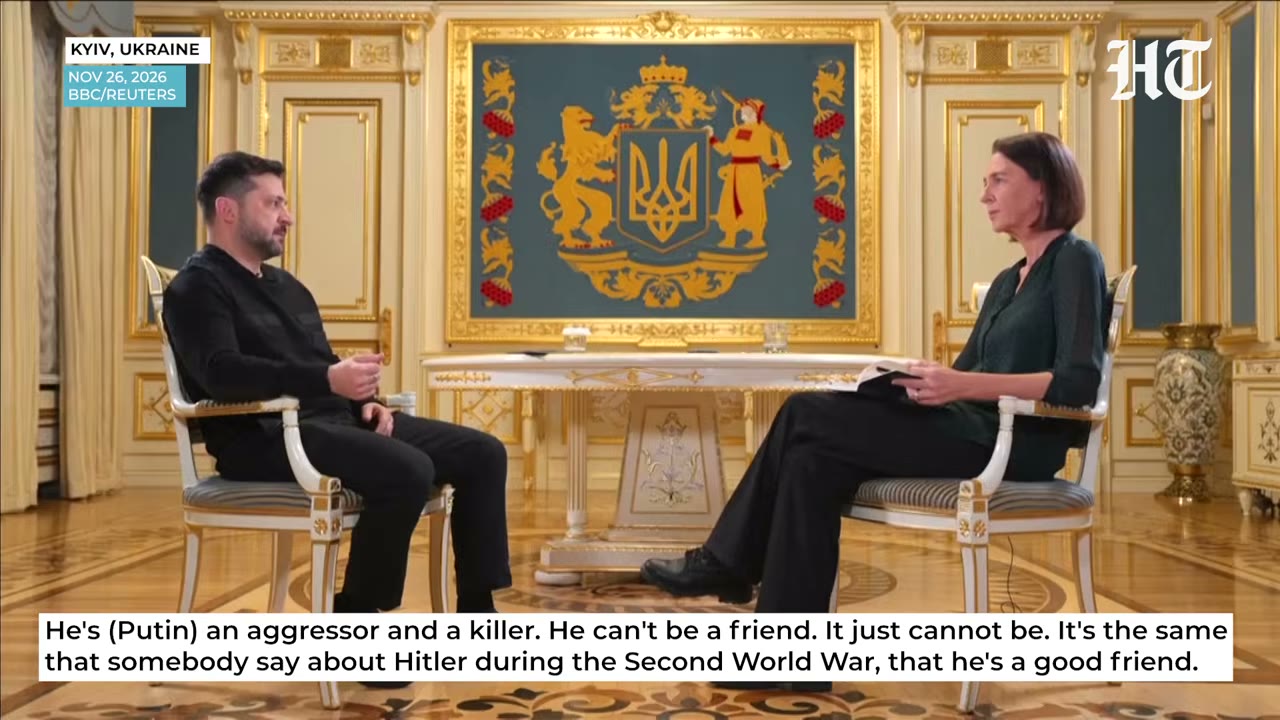
Zelensky compares Putin to Hitler in a British TV interview and urges the US to pressure Russia. EU leaders clash over a 45 billion euro Ukraine loan, with Germany threatening a budget veto and France warning of a strategic mistake.
1Zelensky Compares Putin to Hitler and Urges US Pressure on Russia
Zelensky compared Vladimir Putin to Adolf Hitler and said the US must stop treating the Russian leader as a potential friend. "He's an aggressor. How and a killer," Zelensky said. "He can be afraid a friend. Just cannot be."
He drew a direct parallel to the Second World War, saying it was the same as someone calling Hitler a good friend. "No. He's not a friend," he said.
Zelensky also criticised Washington's focus on the Middle East, saying the US had helped there more. He called it their choice but said Ukraine needs more progress.
He urged the US to act as a mediator with real pressure, not to send signals that could come from Russia. "It's not about comfortable talks," he said. "It's about strong country who can pressure because this country has power and respect."
2Germany Demands All EU Members Back 45 Billion Euro Ukraine Loan
German Chancellor Friedrich Merz demanded that all 27 EU members back a proposed 45 billion euro loan for Ukraine, warning Germany could veto the bloc's next seven-year budget if they refused.
The demand came on November 26 as European leaders faced a fresh dispute over long-term financial support for Ukraine, exposing divisions over how the war effort should be funded.
The Guardian reported further details of the dispute over Ukraine aid on November 26. Merz's veto threat set up a confrontation with member states that oppose contributing to the loan.
3Slovakia, Hungary and Czech Republic Seek Exemptions From Ukraine Loan
Slovakia, Hungary and the Czech Republic — all net beneficiaries of EU funding — sought exemptions from contributing to the 45 billion euro loan for Ukraine.
Slovak Prime Minister Robert Fico accused German Chancellor Friedrich Merz of blackmail after Merz threatened to block the bloc's next budget over the funding plan.
Berlin also sought to protect future funding for Kyiv against a possible victory by Marine Le Pen in France. The National Rally leader, who was leading in opinion polls, had pledged to end French financial assistance for Ukraine.
Germany wanted EU decisions on future funding taken by majority vote rather than requiring unanimous approval from all member states.
4Germany Pushes Majority Voting to Shield Ukraine Aid From Le Pen
Germany wants future EU decisions on Ukraine funding taken by majority vote instead of unanimous approval, a change that would stop any single member state from blocking support.
Under the existing unanimity rule, any one EU member could block future financial support for Ukraine.
Bulgaria signalled support for the loan, but Prime Minister Rumen Radev ruled out contributing to its military component. Radev said Sofia would instead prefer to contribute to the proposed 20 billion euro civilian support package for Kyiv.
The push came as Berlin sought to shield funding for Kyiv from a possible French shift under Marine Le Pen.
5Czech PM Babiš Rejects Compromise on Separate Ukraine Funding
Czech Prime Minister Andrej Babiš rejected a compromise on Ukraine funding, insisting financial support for Kyiv be negotiated separately and vowing to prioritise highways, hospitals and EU cohesion funding at home.
The European Commission's proposal allocated 25 billion euros for Ukraine's military needs and another 20 billion euros for civilian assistance.
Swedish Prime Minister Ulf Kristersson backed Merz, arguing countries should pay for the financial assistance they chose to support.
Some governments backing Ukraine feared Merz's budget veto threat could deepen divisions within the European Union.
6EU Council Concedes No Budget Deal at Summit
The European Council conceded that no agreement on the EU budget would be reached at its summit. "I think I can say that we will not reach an agreement on the budget during this European Council meeting," a speaker said.
The same briefing flagged a resumed constructive dialogue between the European Commission, the ECB and the Eurogroup presidency and the Chinese side on macroeconomic imbalances and exchange rates.
The speaker said the RMB is structurally undervalued, weighing on European competitiveness, with a loss of around 20% depending on the sector. The exchange was called productive, but the budget verdict was blunt: no deal today.
7France Warns EU Budget Cuts Are a Strategic Mistake
France warned that 204 billion euros in cuts to the EU budget compared with the Commission's initial proposal amount to a strategic mistake, saying Europe is falling behind China and the United States on public investment.
A French speaker said the bloc faces three challenges at once: funding traditional policies such as agriculture, cohesion and fisheries; investing in sovereignty through competitiveness, defence, space and innovation; and stabilising national contributions.
The speaker cited the Letta and Draghi reports as saying Europe needs to invest more and needs a larger budget. "Europe is making a strategic mistake," the speaker said, adding that no one was willing to follow France on a budget matching its ambitions.
8France Demands EU Preference Rules and Own Resources
France demanded European preference and reciprocity rules for EU defence spending, arguing that European money must build a European industrial base.
The speaker said France does not support any additional budget cuts and warned the budget is becoming far too Malthusian, a problem for future growth and innovation.
On own resources, the speaker said there had been real progress with the proposal put forward by President Costa and that this is where the balance of the negotiations lies.
France wants clear reciprocity rules, limiting access geographically. "This is not protectionism," the speaker said. "It is common sense."
9France Sets December Deadline and Threatens to Block Budget
France will not sign an unbalanced EU budget and warned it cannot reopen talks after December 31, setting a hard deadline for a deal at the December European Council.
"An agreement is not an end in itself," a French speaker said, pledging every effort to reach one but only on clear conditions, not at any price.
If the conditions are not in place at the December summit, the speaker said it would not be possible to continue the discussion beyond that point and that this had been made clear to colleagues.
After December 31, the speaker said, France would be too close to its presidential election to reopen and conclude budget discussions.
10France Says Abandoning Ukraine Would Endanger European Security
France called the war in Ukraine existential for European security, warning that abandoning Kyiv would put Europe's own safety at risk in the short or medium term.
A French speaker said the Ukrainians are fighting for their country's sovereignty and territorial integrity but are also on the front lines of European security. "This war is existential for the security of Europeans," the speaker said.
The speaker credited a collective European awakening to COVID, the war launched by Russia against Ukraine and uncertainty over whether American solidarity would last forever.
The speaker warned there can be no naivety, pointing to Russia's daily aggression toward Europe collectively, and said the short-term risk is more likely than the medium-term one.