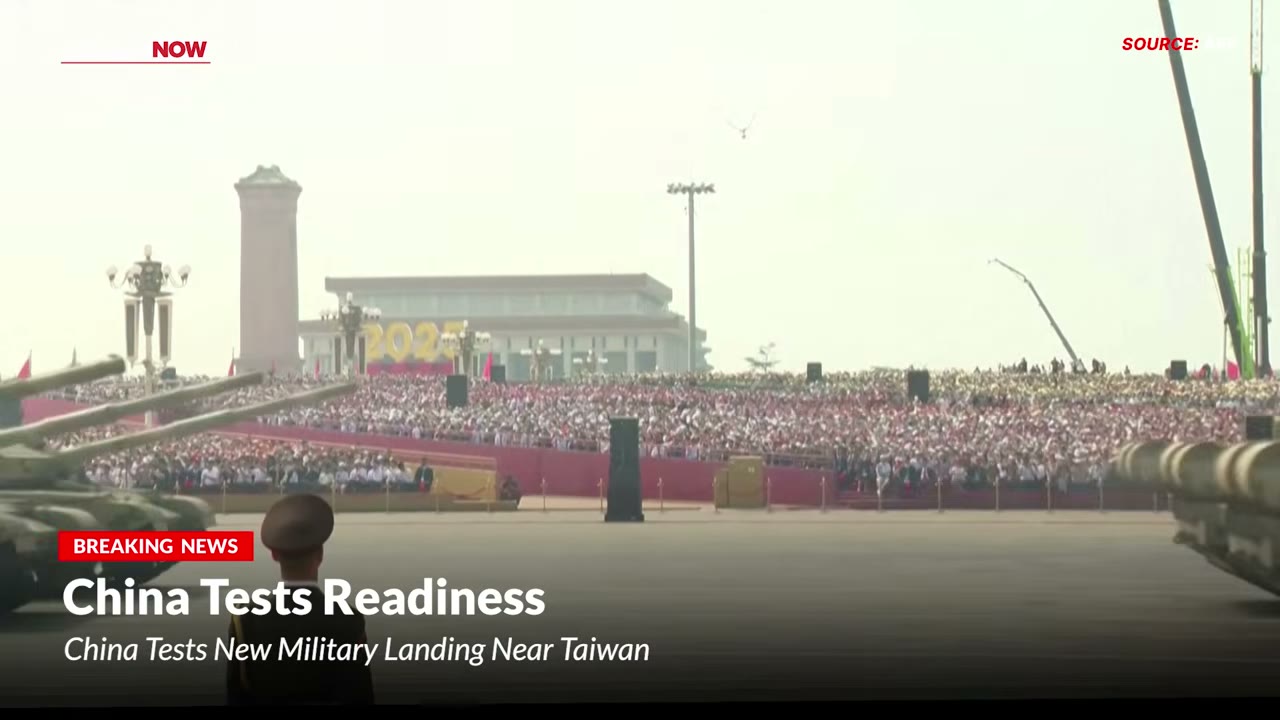
Satellite images show China's PLA using civilian vessels in amphibious exercises at Dacheng Bay, Fujian, about 280 km from Taiwan. Taipei says it is monitoring the drills and reported 30 Chinese military aircraft near the island on November 27.
1Satellite Images Show China Testing Civilian-Ship Amphibious Drills in Fujian
Satellite images show China practicing invasion-style amphibious operations with civilian ships in Dacheng Bay, Fujian province — about 280 km from Taiwan's main island.
The exercises were first recorded on November 1, 2026, and military activity was reportedly ongoing as of November 27. The People's Liberation Army appears to be experimenting with civilian vessels to move personnel and heavy equipment.
November images captured civilian ships helping build a temporary floating structure about 800 meters long. The drills point to Beijing exploring how its commercial maritime resources can complement military capabilities.
The activity comes amid heightened military pressure around Taiwan and growing regional security concerns. Taiwan's defense ministry has said it is aware of the drills and is assessing what they mean for Taiwan Strait security.
2Taiwan's Defense Ministry Confirms Awareness of Dacheng Bay Drills
Taiwan's Ministry of National Defense confirmed it was aware of the activity in Dacheng Bay, including the participation of civilian vessels.
Authorities are assessing what the drills mean for security in the Taiwan Strait and stability across the region.
There is currently no confirmed evidence that Beijing has decided to launch military action against Taiwan, despite the international attention the exercises have drawn.
Military exercises are often held to assess combat readiness, test equipment and improve coordination between units.
3Analysts Debate China's Strategic Goals Despite No Sign of Attack
No confirmed evidence points to an imminent attack, but the Dacheng Bay drills have reignited debate over China's broader strategic goals.
Beijing consistently claims Taiwan is part of its territory and calls reunification a fundamental national goal. President Xi Jinping has repeatedly stressed national sovereignty and territorial integrity.
Beijing says peaceful reunification remains its preferred approach, though it does not rule out military force under certain circumstances. Taiwan's government rejects Beijing's sovereignty claims and insists the island's future should be decided by its people.
In his October 10 National Day speech, President Lai Tsing-de said: "Taiwan values peace, but we will not give up our freedom."
4Drills Put First Island Chain and China's Naval Build-Up in Focus
The drills are drawing attention for their potential importance to the First Island Chain — the strategic region stretching from Japan through Taiwan toward the Philippines.
The area is central to security calculations for China, the United States and several other Indo-Pacific countries.
China has significantly expanded its naval presence in these waters in recent years, introducing more sophisticated warships, aircraft carriers, amphibious assault ships and surveillance assets. Beijing has also invested heavily in coordination between its military and civilian industrial sectors.
Using commercial shipping in military exercises is not entirely new.
5China Has Used Civilian Ships in Drills Since 2023
Taiwanese authorities found similar Chinese amphibious exercises in Daqing Bay in September 2023 and September 2024, and more drills involving civilian maritime resources were observed along China's southern coast in 2025.
The pattern shows China keeps experimenting with different approaches to military logistics, and defense analysts are studying whether these changes could alter the regional security balance.
China's commercial shipbuilding industry is a major factor: it is one of the world's largest maritime industrial sectors, giving Beijing resources beyond those used directly by its armed forces.
The link between commercial infrastructure and national defense is drawing growing attention in international security discussions.
6Analysts Warn Exercise Success May Not Translate to Real Conflict
A capability that works in controlled military exercises does not necessarily perform as effectively in a real conflict, defense observers caution.
Weather conditions, equipment reliability, communication difficulties and unforeseen events can all create significant complications.
Analysts therefore warn against reading the latest satellite images as proof that China has solved all the problems of a large-scale amphibious operation.
The studies show experiments continuing, but their actual effectiveness under different circumstances remains uncertain.
7China Defense Spokesman Calls Military Readiness Legal and Reasonable
Beijing has defended its military activities in the region, with a defense ministry spokesman calling the increased readiness completely legal and reasonable.
Senior Colonel Chen Shi made the comment at a press briefing on November 26. Chinese authorities argue that military modernization and training are necessary to protect state sovereignty and security.
Beijing has repeatedly criticized foreign governments for interfering in matters concerning Taiwan, arguing that external military cooperation risks raising tensions rather than promoting stability.
The remarks came as studies showed China's amphibious experiments continuing, with their effectiveness under different circumstances still uncertain.
8Taiwan Reports 30 Chinese Aircraft, 26 Crossing Strait Median Line
Taiwan's defense authorities reported detecting 30 Chinese military aircraft around the island on November 27 — 26 of them crossed the median line of the Taiwan Strait during a coordinated patrol involving naval vessels.
Taipei views the growing frequency of Chinese military operations as a source of pressure and regularly releases updates on significant developments.
The median line has historically served as an unofficial marker of military activity in the strait. Beijing does not recognize it as an official border, while Taiwan considers constant crossings a security threat.
The patrol has heightened concerns about Chinese military activity near Taiwan becoming normalized.
9Drills Coincide With Taiwan Local Elections on November 28
The drills are unfolding at a politically sensitive moment for Taiwan, with local elections scheduled for November 28.
Officials have not established a direct link between the amphibious exercises in Fujian and the upcoming vote.
Taiwan's political leadership faces a difficult task: responding to external pressure while maintaining internal stability and public trust.
President Tsai Ing-wen argues that strengthening defense capabilities can help prevent confrontation and protect the democratic institutions that govern the island.
10Taiwan Broadens Security to Civil Preparedness and Public Services
Taiwan's preparations go beyond modernizing its conventional armed forces, with authorities emphasizing civil preparedness, emergency response coordination, communications security, healthcare continuity and protection of essential public services.
The goal is to keep Taiwanese society functioning during major emergencies — whether from natural disasters, technological failures or military tensions.
The broader approach reflects a growing understanding that national security involves much more than the capabilities of the armed forces.
11US Backs Taiwan Defense Under Taiwan Relations Act
Washington maintains unofficial relations with Taiwan and provides defense equipment under the Taiwan Relations Act, while Beijing calls the aid interference in its internal affairs.
Successive American administrations have stressed the importance of peace and stability in the Taiwan Strait.
Washington insists that supporting Taiwan's defense capabilities contributes to regional deterrence and reduces the likelihood of unilateral changes to the status quo.
China strongly opposes US military aid to Taiwan.
12Japan and Philippines Watch Taiwan Tensions Closely
Japan and the Philippines are watching developments around Taiwan closely, citing their geographical proximity and significant economic and security interests across the Western Pacific.
Any serious deterioration in relations across the Taiwan Strait could have consequences extending far beyond China and Taiwan.
The economic fallout would be particularly significant, though the full extent remains to be seen.
13Taiwan Semiconductor Role Makes Strait Conflict a Global Economic Risk
Taiwan sits at the center of the global semiconductor industry, making any large-scale crisis in the Taiwan Strait an economic risk far beyond the region.
The island produces advanced technologies essential for consumer electronics, communications, transportation and artificial intelligence.
The surrounding sea routes are also important for international trade. A large-scale regional crisis could disrupt shipping, increase transportation costs, affect energy supplies and put significant pressure on global production networks.
These economic realities explain why governments and businesses around the world continue to emphasize the importance of avoiding confrontation in the Taiwan Strait.
14Frequent Close Military Operations Raise Risk of Misunderstandings
Frequent military operations in close proximity are raising the likelihood of misunderstandings, a concern that could create diplomatic complications.
When aircraft and naval vessels regularly operate near each other, unexpected incidents can escalate by accident.
Governments and businesses around the world continue to emphasize the importance of avoiding confrontation in the Taiwan Strait, the report said.
Effective communication and responsible military behavior remain essential to prevent unintended escalation.
15Fujian Drills Seen as Modernization, Not Imminent Confrontation
China's latest exercises in Fujian province are another phase of its ongoing military modernization, not confirmed evidence of imminent confrontation, according to the report.
Still, the involvement of civilian maritime resources highlights the expanding scope of Beijing's military planning and the changing nature of regional security challenges.
Taiwan is expected to continue monitoring these developments while strengthening its defense preparedness and supporting international cooperation. Beijing is likely to continue military training as part of its broader modernization goals.
The key question is whether both sides can manage their increasingly complex security relationship without allowing military competition to undermine regional peace.