Anti-government protests in Tirana have turned violent, with students burning state buildings and Prime Minister Edi Rama ordering arrests and fines. The unrest, sparked by a luxury resort project, threatens Albania's EU accession and exposes deep democratic problems.
1Anti-government protests leave central Tirana badly damaged
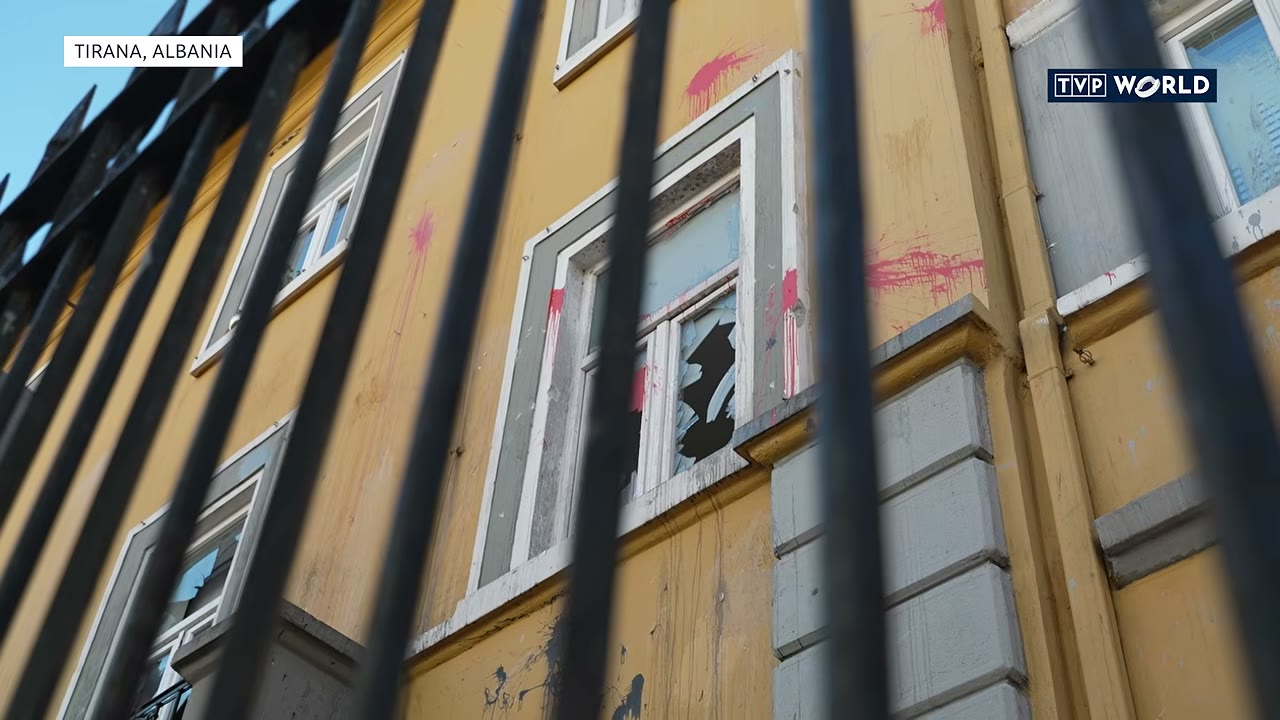
The Ministry of Education building in central Tirana now stands wrecked, its facade a shell of broken glass and debris after anti-government unrest swept through Albania's capital.
A massive protest is underway in Tirana, and the city center has been badly affected by the recent unrest. The damage is visible at government buildings, including the education ministry.
The unrest traces back to October 2026, when anti-government protests began. What started then has left Albania's capital scarred, with the full scale of the destruction still unfolding as demonstrators remain on the streets.
2Students defend violent protest after 145 days of ignored peaceful appeals
Students who spent 145 days protesting peacefully say no one listened — so they chose violence, and they say they feel joy watching state-owned stores burn.
Two students spoke anonymously. One said they had advocated violent protest "since day one." Asked whether the broken windows, burned buildings, garbage-strewn streets and downed streetlights were necessary, the student answered: "It was. This was extremely necessary."
For 145 days, the students said, they raised their voices peacefully on the streets. "No one heard us. They just laughed at us," one said. The students argued that if the government won't take them seriously "in a good way," they will show "how it's done in a bad way."
One described watching state-owned stores burn with "such joy," saying most big business in Albania belongs to oligarchs.
3Protesters blame corrupt officials and call Edi Rama a drug lord
Protesters in Tirana are directing their anger at Albania's leadership, with one declaring Prime Minister Edi Rama "the drug lord of the entire Balkan Peninsula."
The accusation reflects what protesters describe as a general opinion: that oligarchs are "draining our money." One demonstrator said they regret the violence but argued people are "forced to take some action" against government officials they call "very, very corrupt."
The protesters want the world to know their grievances. "Everyone should know about this," one said, framing the unrest as a response to corruption at the top of Albania's government.
4Edi Rama orders crackdown with arrests, drones and travel bans
Police drones are flying over Tirana, likely scanning protesters' faces, as Prime Minister Edi Rama orders a harsh crackdown that has swept up people with no connection to the unrest.
Arrests are being made. Peaceful protesters are being fined simply for taking part and banned from leaving the country, and sometimes even random passersby are detained, according to what a lawyer told TVP World.
One lawyer is representing a person with "no connection to the protesters, no connection to the acts of violence against the police." The lawyer said police punched, kicked and pepper-sprayed the client during an arrest that did not follow proper procedure, and will ask the Court of Appeal to declare it unlawful.
5Lawyers challenge 24-hour protest ban as unconstitutional
Albanian police can ban a protest for 24 hours if the government or an institution decides it could turn violent — without defining what violence is or who makes that call, lawyers say.
One lawyer called it "literally a ban on the right to protest, which is a constitutional right." It is reported that officers receive a reward of 5,000 euros for taking part in the crackdown.
Lawyers described the tactics: officers grab protesters, shout in their faces and tell them to go home. One said police asked him, "Where did you even find the right to protest?"
Meanwhile, Edi Rama, who has long promised Albanians a path to EU membership, now faces scrutiny over the crackdown.
6EU progress report praises Albania's talks but flags democratic flaws
Albania has reached the final stage of its EU negotiations — but the European Commission's annual progress report says key reforms remain unimplemented and democracy is deeply polarized.
The report calls for comprehensive electoral reform, particularly ahead of the 2027 municipal elections, and urges dialogue between the government and protesters in the streets.
It highlights systemic problems in Albanian democracy: a deeply polarized climate, limited parliamentary oversight of the government, and a lack of meaningful public consultation. It also notes that negative narratives about human rights organizations are spreading.
Prime Minister Edi Rama has long promised Albanians a path to EU membership. The report suggests that path still has obstacles.
7Independent MP Mariana Cotechu vows to fight undemocratic electoral code
Albania has exactly one independent MP: Mariana Cotechu, born in 2000, elected in 2025 on Edi Rama's Socialist Party list, who quit the party in June 2026 after the "Flamingo Revolution" protests began.
She says her family received threats from one of the well-known Albanian groups. She plans to run again as an independent, calling it a way to fight "the very undemocratic electoral code."
Under that code, she says, candidates are personally selected by party leaders Edi Rama and Sali Berisha — two men who have dominated Albanian politics for three decades. The loudest protest cry is "Rama to prison, Berisha to prison."
Her demand, and one of the protests' main demands, is a new electoral code with 100% national open lists.
8Hundreds of thousands of young Albanians leave as living standards lag
Hundreds of thousands of young Albanians have left the country since Edi Rama came to power in 2013, most heading to EU countries like Greece, Italy and Germany.
Those who stay describe a striking gap in living standards. "We want to have light in our homes 24 hours a day and running water 24 hours a day," one said. "Why not like everyone else in the world?"
Mariana Cotechu is a rare example of a young Albanian woman who decided to stay. She argues the country has the resources to provide basic services, but "the government is simply not doing its job the way it should be."
9Albania's resources underused as water and oil wealth goes to waste
Albania could power its entire electricity system on hydroelectric power — yet many households get running water for only two hours a day.
The country's geography gives it chrome, copper and, importantly, water. It could also be self-sufficient in oil: the deposits are not huge by world standards, but enough for a nation of fewer than 3 million people.
Instead, the infrastructure is rusting. The gap between what Albania's resources could deliver and what households actually receive is at the heart of the discontent driving the protests.
10Albania's beaches closed to public despite tourism potential
Albania's warm blue waters and breathtaking landscapes were long supposed to make it a Mediterranean hotspot — but almost none of its beaches are open to the public.
Visitors have to pay for entry. The country has history, food and beaches, yet access to the shoreline is restricted.
The tourism gap sits alongside other frustrations: rusting infrastructure and resources that residents say are not being used for their benefit.
11Ivanka Trump-linked luxury resort sparked the Flamingo Revolution
Residents of the coastal village of Zvernets woke up one morning in June 2026 to find their land fenced off for a huge luxury resort — the spark that ignited the "Flamingo Revolution."
The project was not confined to Zvernets. Construction was also planned in the neighboring Vjosa-Narta reserve, a protected bird paradise, and on Sazan Island, a rocky island without fresh water but with bunkers and minefields.
The resort was promoted by Ivanka Trump, daughter of the US president, who called it "an incredible, beautiful private island of 1,400 hectares." Affinity Partners, a private equity firm linked to her husband Jared Kushner, announced plans for a luxury resort. The company now denies any connection to the project. Edi Rama says Albania is reviewing the investment procedures.
12Resort threatens bird reserve as Rama denies any island sale
Albania's prime minister calls claims that an island was sold a "big lie" — but the fight is not really about the island. It is about migratory birds losing their feeding grounds and residents losing their land.
"No island has been sold, concessioned, or leased," Edi Rama said, dismissing what he called a generally accepted untruth.
The ecological stakes are real: the Vjosa-Narta reserve is a protected stopover for migratory birds, and the resort plans threaten what one account describes as a looming ecological disaster.
According to Albanian court decisions seen by TVP World journalists, land plots in Zvernec were sold to foreign investors using forged documents from the Ottoman Empire, drawn up by Artur Shehu, who is wanted in Albania on drug trafficking charges.
13Professor says both main parties benefit from violent protests
A Tirana political science professor says Albania's two main parties want the protests to turn violent. Afrim Krasniqi told TVP World that responsibility for the violence does not lie with the students.
"I think the two main parties, the Democratic and the Socialist, are interested in violent protests in Albania," he said.
Krasniqi described an informal consensus between the Socialists and Democrats to block reforms, saying both are satisfied with the current system and happy to keep third parties out of elections.
He said trust in the authorities is low, but he does not think Albania is becoming authoritarian. He had a warning for the younger generation: freedom is not given for free.
14Greta Thunberg joins daily protests as Flamingo Revolution continues
Greta Thunberg has appeared at Albania's "Flamingo Revolution," where crowd sizes swing wildly from day to day. Some demonstrations draw a few hundred people; on cold evenings, fewer than a hundred. On weekends, tens of thousands.
Students and others take to the streets every day, and the world is following, according to the report.
Protesters say they are fighting so they don't have to leave the country. "It's better for us to fight here for a few months or years than to live in a foreign land forever," one said.
Not every protest turns violent. The fire, meanwhile, continues to burn.