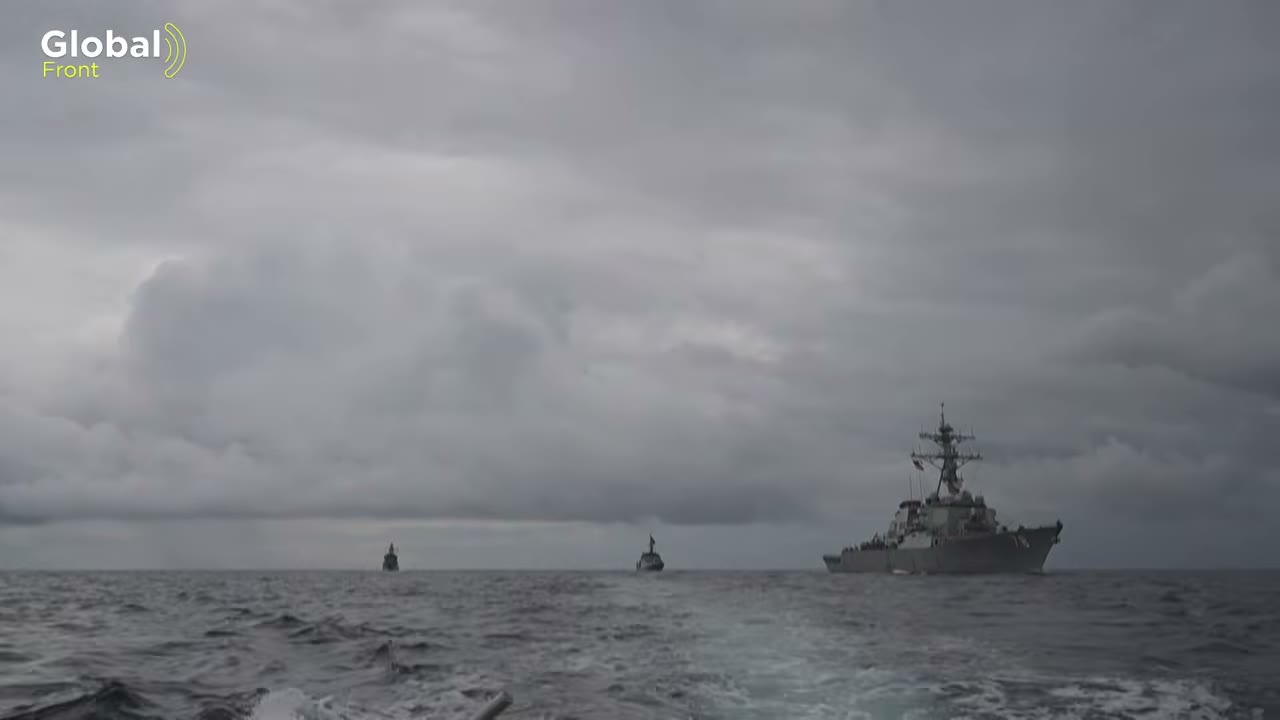
A third US aircraft carrier, the USS Theodore Roosevelt, has arrived in the Middle East with about 2,000 Marines, raising pressure on Iran over the Strait of Hormuz. Iran's Revolutionary Guard warns any US ground attack would trigger strikes on American bases and ships across the region, as diplomacy continues.
1US sends third aircraft carrier and 2,000 Marines to Persian Gulf
Three US aircraft carriers now sit in the Middle East, with about 2,000 Marines moving toward the region behind them. The arrival of the USS Theodore Roosevelt raised the American naval presence to three carriers, a significant show of force as Washington keeps enforcing restrictions on shipping tied to Iranian ports.
The amphibious task force accompanying the Roosevelt is also heading to the region. The standoff with Iran has entered what the report calls a new critical phase, with fresh threats from the Iranian Revolutionary Guard and growing uncertainty over the future of the Strait of Hormuz.
President Donald Trump now faces a decision: intensify military operations or seek a diplomatic agreement to end months of confrontation.
2Marine force's mission unclear as no ground invasion confirmed
About 2,000 US Marines are moving toward the Persian Gulf, but there is no confirmation President Trump has authorized a ground invasion of Iran. That distinction matters.
At the time the Roosevelt's arrival was announced on November 17, the Arleigh Burke-class ships had not yet arrived. Amphibious forces can handle maritime security, evacuation, defensive reinforcement and limited coastal operations. They give American commanders flexibility, but their presence does not mean any specific operation has been approved.
In Tehran, the expanded US presence has only heightened concerns about Washington's intentions.
3Iran's IRGC warns US ground attack would trigger region-wide strikes
Iran's Revolutionary Guard has warned that any American ground attack would draw strikes on every US base and ship in the region, not just at the point of invasion. Ali Fadavi, head of the advisory group to the IRGC commander, delivered one of the clearest warnings in early October.
"If the Americans launch a ground attack, we will strike every facility related to the Americans, American bases, and every ship related to the Americans," Fadavi said.
The threat is meant to dissuade Washington from widening the conflict. It is also causing concern among neighboring Gulf countries, where American military facilities are located. Iranian officials maintain that US bases on foreign soil remain legitimate targets if used for operations against Iran.
4Gulf states caught between US security ties and instability fears
Gulf governments are caught in a bind: they must keep their security ties with Washington while trying to stop instability from spreading inside their own borders.
Iranian officials maintain that American bases on foreign territory remain legitimate military targets if they are used for operations against Iran. That puts host governments in the middle of a confrontation they did not start.
The Strait of Hormuz remains the central link in the standoff.
5Strait of Hormuz disruption threatens a fifth of world oil
About one-fifth of the world's oil consumption passes through the Strait of Hormuz, the narrow waterway connecting the Persian Gulf to the Gulf of Oman. Months of military operations and maritime restrictions have sharply cut shipping volumes.
Commercial vessels still face security threats. Shipping companies are weighing rising insurance costs, uncertain transit conditions and the risk of further disruption.
The fallout reaches far beyond Iran and the United States. Energy importers in Asia and Europe depend on stable Gulf supplies, and prolonged uncertainty could affect transport costs, industrial production and consumer prices. For Washington, keeping commercial access open has become a key military and economic goal; for Tehran, influence over maritime traffic is leverage in negotiations against a far more powerful opponent.
6US fighter jet disables cargo ship Ocean Molika in Gulf of Oman
A US fighter jet struck the stern of a cargo ship in the Gulf of Oman, disabling its propulsion, after the vessel ignored repeated warnings, according to US Central Command.
The Panamanian-flagged ship, identified as the Ocean Molika, also known as the Erica Sun, had reportedly left an Iranian port before encountering US forces enforcing the blockade. The strike came on October 10.
"A US military fighter jet struck the stern of the Panamanian-flagged MV Ocean Molika," Central Command said. The military reported the crew was not injured.
The incident showed Washington will enforce its maritime restrictions with direct military action, and raised questions about the risks to commercial shipping in disputed waters.
7Blockade economics: Iran oil revenue falls, world energy prices rise
Washington says its blockade is meant to squeeze Tehran's economy and cut revenue tied to Iranian trade. Iran condemns the restrictions and insists normal maritime activity cannot resume without a broader deal covering sanctions and regional security.
The costs are mounting on both sides. Restrictions on Iranian oil exports have cut Tehran's access to foreign currency, while instability around the Strait of Hormuz has pushed energy prices up worldwide.
Iranian officials suggest pressure on shipping gives them leverage in talks. Washington believes prolonged economic restrictions could push Iran to accept a deal without another major military campaign.
8Midterm election setbacks pressure Trump over the war
The November midterm elections delivered serious setbacks to President Trump's Republican Party, as public discontent over the conflict and its economic consequences drove the debate.
Trump continues to defend his administration's approach and has left open the possibility of further military operations. He alternates between statements that Iran's military capabilities have been significantly weakened and warnings that American forces are ready to resume larger operations if necessary.
The war has become a major domestic political issue in Washington.
9Nuclear talks stall over Iran's 440.9 kg of 60% enriched uranium
Before military operations hit Iran's nuclear facilities in 2025, international inspectors estimated Iran held about 440.9 kg of uranium enriched to 60% purity. The exact condition of that stockpile remains unknown, and it is now one of the hardest obstacles to a deal.
Tehran wants guarantees that Washington will not resume large-scale military action after any agreement, while US negotiators push for limits on Iran's nuclear activities and regional security guarantees. Talks continue through regional mediators, including Qatar and Pakistan.
Foreign Minister Abbas Araqchi said Tehran remains interested in negotiations if any deal addresses Iran's security concerns and brings lasting results. On November 20, Iran confirmed readiness for a diplomatic settlement, making clear it would not simply accept Washington's demands.
10Iran's Rezaei warns renewed US operations would bring strong response
Mohsen Rezaei, secretary of Iran's Supreme National Security Council, warned that renewed large-scale American military operations would provoke a significant response from Iran.
Rezaei, a former commander of the Islamic Revolutionary Guard Corps, takes a firm stance toward Washington. His statements reflect the continuing disagreement in diplomacy over whether military pressure can produce an acceptable agreement.
Meanwhile, regional governments have stepped up efforts to prevent further significant escalation.
11Gulf states fear strikes on energy and desalination infrastructure
Gulf countries fear new military action could hit energy facilities, power grids, communication networks and vital trade routes, with damage reaching well beyond military sites.
Disruptions to energy supplies, desalination plants or communication systems could hit civilian populations and regional economies. Recent clashes between American and Iranian forces have deepened those fears.
Military incidents at sites in Bahrain and Kuwait have shown how quickly a confrontation can spread beyond Iran's immediate territory.
12Three carriers give US surveillance and strike options after eight months
The USS Theodore Roosevelt has joined the USS George H.W. Bush and USS George Washington in the region, backed by destroyers, cruisers and other vessels. Three carriers give the US the ability to maintain surveillance, enforce maritime restrictions, protect military assets and respond to emerging threats.
The deployment also shows the scale of resources Washington is pouring into a conflict now more than eight months old.
For Iran, the challenge is keeping enough military and economic leverage without provoking a response that damages its infrastructure and economy. For the US, it is reaching its strategic goals without getting pulled into an even longer, costlier confrontation.
13Iran offers Hormuz reopening and nuclear talks; Trump rejects terms
Iran has offered to reopen the Strait of Hormuz, resume nuclear talks and take steps to prevent further military escalation — and Washington has not said yes.
President Trump said Iran wants a deal but called the terms offered so far unacceptable to the United States. Officials in both governments see potential benefits in an agreement, though significant differences remain, according to the discussions.
American military power keeps growing across the region while Iranian officials keep up their warnings. International mediators are trying to narrow the gap.
The question now: whether rising economic and military costs push both sides toward compromise, or a new confrontation erases the progress already made.
14Hormuz reopening hinges on sanctions, nuclear and security disputes
Reopening the Strait of Hormuz would ease months of uncertainty for shipping companies, energy markets and Middle East governments — but it depends on bargains that go far beyond shipping.
Sanctions, nuclear activities, military deployments and regional security guarantees remain linked in the negotiations.
The arrival of more American naval forces signals more than another deployment: it shows the pressure around a diplomatic process in which neither side has yet secured what it believes it needs.
As Trump weighs Washington's next steps and Iranian leaders defend their terms, upcoming talks will decide whether the standoff moves toward a lasting settlement or stays trapped in another cycle of military pressure and economic turmoil.