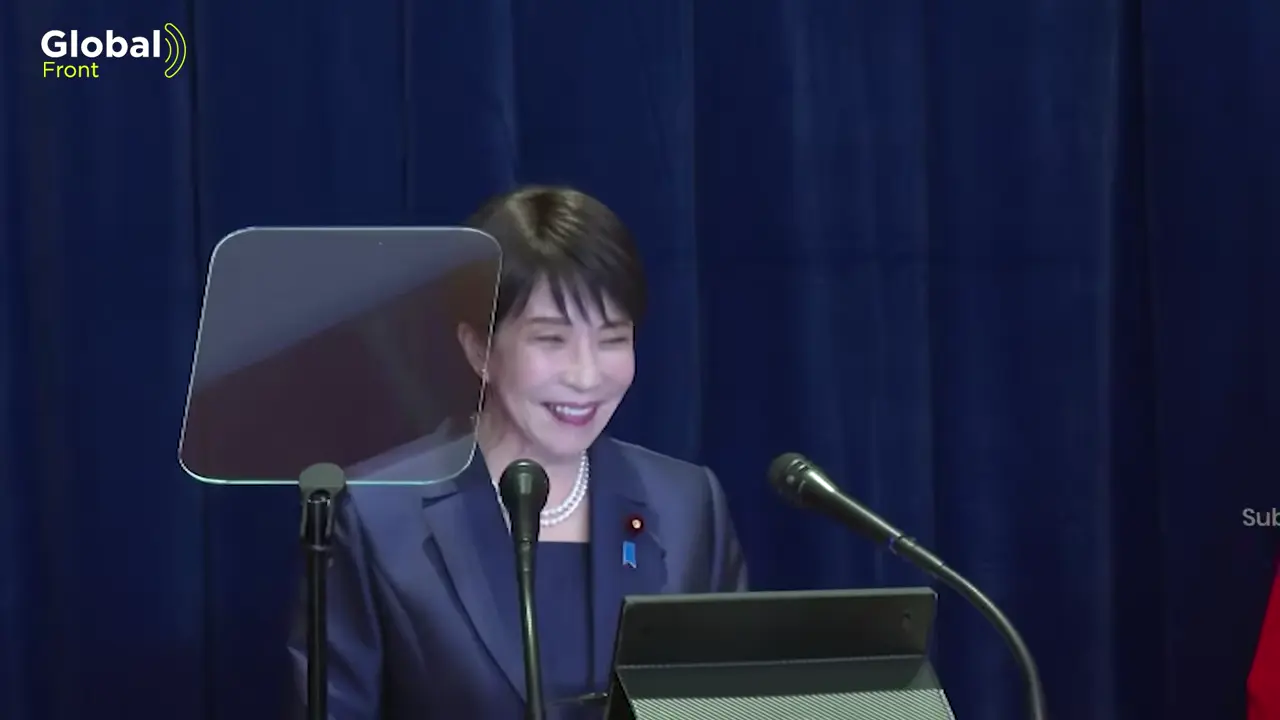
Japanese Prime Minister Sanae Takaichi says a week of summits in Manila, Shenzhen and elsewhere restored unity among Japan, the US, Australia and India. The Quad backed a free and open Indo-Pacific, new maritime exercises and mineral supply chains, while Takaichi also met Xi Jinping and Vladimir Putin.
1Takaichi Hails Quad Unity After Week of Asian Summits
Japan's prime minister says the Quad is back together, after a diplomatic week that took her from Manila to Shenzhen. Sanae Takaichi said the meetings restored unity between Japan, the United States, Australia and India.
Her week included the Quad leaders' summit in Manila, ASEAN-related meetings in the Philippines and the Asia-Pacific Economic Cooperation summit in Shenzhen, China. Takaichi called the Quad meeting on November 17 one of the most important results of her efforts. It brought together US President Donald Trump, Australian Prime Minister Anthony Albanese, Indian Prime Minister Narendra Modi and Takaichi herself.
"This has been an extremely important diplomatic week for the future of our country and the region," she said. Talks covered shared security concerns, economic cooperation and measures to build resilience across the Indo-Pacific.
2Quad Reaffirms Free and Open Indo-Pacific Vision
A vision first floated by Shinzo Abe is getting fresh backing from four democracies. The Quad leaders reaffirmed support for a free and open Indo-Pacific, known as FOIP.
The framework stresses respect for international law, freedom of navigation, the peaceful resolution of disputes, and countries' ability to make independent decisions without external pressure. It began as a Japanese diplomatic idea under former prime minister Abe and has grown into a broader framework mixing security cooperation with economic development, technology, infrastructure and regional partnerships.
Takaichi's message was that the approach should produce practical results, rather than remain a set of diplomatic commitments.
3Quad Warns Against Changing Status Quo by Force
Four leaders voiced strong opposition to any attempt to change the regional status quo by force or coercion. The warning came out of the Manila summit, without China being named.
Prime Minister Sanae Takaichi said the leaders also raised serious concerns about economic pressure, including arbitrary export restrictions. The joint statement did not explicitly name China as a target, but the language reflected concerns increasingly shaping security debates in the East and South China Seas, as well as the use of trade restrictions as tools of political influence.
The signal was one of the strongest to emerge from the summit.
4Quad Puts Maritime Security and Surveillance at Center
Maritime security now sits at the centre of the Quad's renewed agenda. The four governments agreed to strengthen maritime surveillance, improve information sharing and support movement through strategically important waters.
Japan and several regional partners remain concerned about maritime disputes, strategic competition and possible disruption to trade routes linking Asian economies to international markets. For these countries the problem goes beyond military security: smaller economies must keep access to trade, important resources and critical technologies without becoming overly dependent on a single supplier or influential trading partner.
The commitments are meant to help countries monitor maritime activity and respond more effectively to challenges affecting commercial shipping and national security.
5Quad Announces 2027 Maritime Exercise With Patrol Aircraft
The Quad will hold a maritime exercise in 2027 involving patrol aircraft from all four member countries. The plan was announced as one notable event of the Manila summit.
The drills mark a new phase in operational cooperation and are meant to demonstrate the ability to coordinate surveillance activities across the region. Leaders also backed measures to increase the security and resilience of maritime transit corridors.
Such routes are critically important for international trade, energy, transportation and the movement of industrial materials.
6Quad Targets Critical Minerals and Supply Chain Security
Minerals used in batteries, electronics and energy technology are now a Quad priority. Leaders identified critical economic security as another important part of their discussions, with mineral supply chains flagged as an area needing more collaboration.
The concern is that concentrated production and processing capacity could leave countries vulnerable when exports are restricted or international relations deteriorate. By encouraging more diversified supply chains, Japan and its partners hope to reduce those vulnerabilities while supporting new investment across the Indo-Pacific.
The push covers materials moving between Asia, the Middle East and other major markets.
7Energy Security Tops Quad Agenda Amid Middle East Instability
Energy sustainability was named a priority as instability in the Middle East and uncertainty over international energy transport worry importing countries. Japan remains heavily dependent on foreign energy supplies.
That dependence makes access to reliable transportation routes and stable international markets an important national interest, Takaichi's government signalled. The concern is shared across the Indo-Pacific, where importing economies face the same exposure to disrupted routes and volatile markets.
The issue sits alongside maritime security and economic resilience on the Quad agenda.
8Quad Expands Into AI and Cybersecurity Cooperation
Artificial intelligence and cybersecurity have joined the Quad's security brief. The leaders supported efforts to build robust AI ecosystems and widen access to advanced technological capabilities in the region.
Their collaboration includes initiatives on technology adoption, technical assistance and opportunities for countries seeking to participate more actively in the digital economy. At the same time, the four governments acknowledged growing risks from cyber incidents affecting businesses, governments, communications systems and critical infrastructure.
Strengthening cybersecurity cooperation is meant to support a safer digital environment through closer coordination and exchange of experience between participating countries.
9Takaichi Says Quad Must Deliver Practical Benefits
Japan insists the Quad is not an exclusive political club. Prime Minister Sanae Takaichi said it should keep bringing practical benefits to the Indo-Pacific rather than acting as a closed grouping.
Leaders reaffirmed their commitment to humanitarian assistance, emergency response and cooperation with regional partners. The agenda now reaches beyond traditional security into areas that directly affect economic growth, technological competitiveness and everyday life.
"The Quad, as a group of democratic states sharing fundamental values, has established concrete cooperation and consistently contributed to peace and stability in this region," Takaichi said.
10Japan Courts ASEAN With Renewed Free and Open Indo-Pacific
Japan's diplomatic week went beyond the Quad, with ASEAN at the centre of a second push. At ASEAN-related meetings in Manila, Takaichi said Southeast Asian countries play a central role in maintaining regional peace and prosperity.
She said Japan's Indo-Pacific vision must evolve in parallel with ASEAN's priorities and the long-term partnerships connecting Japan with Southeast Asian economies. Tokyo presented its renewed free and open Indo-Pacific approach as a framework supporting greater economic independence, stronger institutions and more secure access to needed resources.
An important outcome was the adoption of a joint statement by ASEAN and Japan on economic sustainability.
11Japan and ASEAN Adopt Joint Statement on Economic Sustainability
Japan and ASEAN adopted a joint statement on economic sustainability, aimed at strengthening economic stability and helping regional countries respond to international disruptions.
For Japan, the agreement reflects the importance of moving beyond security issues to politics that can deliver tangible economic benefits. Takaichi stressed long-term cooperation, pointing to the trust ASEAN partners place in Japan as an economic and diplomatic partner.
"During a series of meetings in Manila, I expressed Japan's determination to work with ASEAN countries and like-minded partners within the framework of the renewed FOIP," she said.
12Japan Pushes AZEC 2.0 Energy Partnership With Philippines
Japan used a leaders' meeting co-chaired by Takaichi and Philippine President Ferdinand Marcos Jr. to promote an expanded regional energy partnership known as AZEC 2.0. The initiative aims to combine energy security, economic growth and the transition to low-emission technologies.
Takaichi proposed strengthening the structure by focusing more on preparedness for regional energy challenges, diversification of energy supplies and cooperation during possible supply disruptions.
Japan also proposed closer cooperation through its "Power Golf" initiative, which aims to strengthen economic and energy ties between Asian consumers and energy-producing countries in the Middle East.
13Japan Pitches 'Power Golf' Energy Ties With Middle East
Japan wants to link Asian energy consumers directly to producers in the Middle East. It proposed closer cooperation through its "Power Golf" initiative, aimed at strengthening economic and energy ties between the two sides.
The proposals reflect the economic importance of reliable energy supplies for industrial production, transportation and domestic consumption. They also show Japan's intention to play a leading role in developing regional measures in response to energy uncertainty.
After the ASEAN meetings concluded, Takaichi travelled to Shenzhen for the Asia-Pacific Economic Cooperation summit.
14Takaichi Takes Supply Chain and Trade Message to APEC
Japan's prime minister brought a supply-chain warning to Shenzhen, telling APEC leaders that economic stability depends on transparent international agreements. Sanae Takaichi traveled to the city for the APEC Economic Leaders' Meeting on November 18 and 19. There, Japan pushed for international economic cooperation, sustainable supply chains and a rules-based trading system. The talks covered trade and investment, regional integration, digital technologies and energy sustainability. Takaichi stressed that cooperation between countries matters especially as global trade faces mounting pressure from geopolitical competition. For Japan, the stakes go beyond commerce: disruptions in energy, advanced technologies or industrial materials could quickly hit domestic production and international competitiveness.
15Takaichi and Xi Exchange Brief Remarks as Ties Stay Tense
A handshake and a few brief remarks were all Xi Jinping and Sanae Takaichi got at APEC — no full bilateral summit. The Chinese president and the Japanese prime minister exchanged the greetings during the Shenzhen summit, with ties still tense after Takaichi's earlier comments about a possible emergency surrounding Taiwan. Tokyo had sought the contact to stabilize communications with Beijing, and Takaichi reaffirmed Japan's commitment to constructive and stable relations with China while protecting its own national interests. She said Japan's position on Taiwan, as set out in the 1972 Japan-China Joint Statement, has not changed. The balancing act continues: security cooperation with the United States and other partners, alongside a working relationship with China, one of Japan's most important economic neighbors.
16Takaichi Meets Putin for First Time in Seven Years
Japan and Russia's leaders met face to face for the first time in seven years — and the talk turned to a jailed journalist. Sanae Takaichi and Vladimir Putin spent about 30 minutes in discussions on the sidelines of APEC in Shenzhen. Relations between Tokyo and Moscow remain extremely tense following Russia's full-scale invasion of Ukraine in 2022, with Japan backing international sanctions against Russia. During the meeting, Takaichi pressed Moscow over the detention of a Japanese journalist working for the Hokkaido Shimbun newspaper. Japanese authorities are seeking the journalist's release.