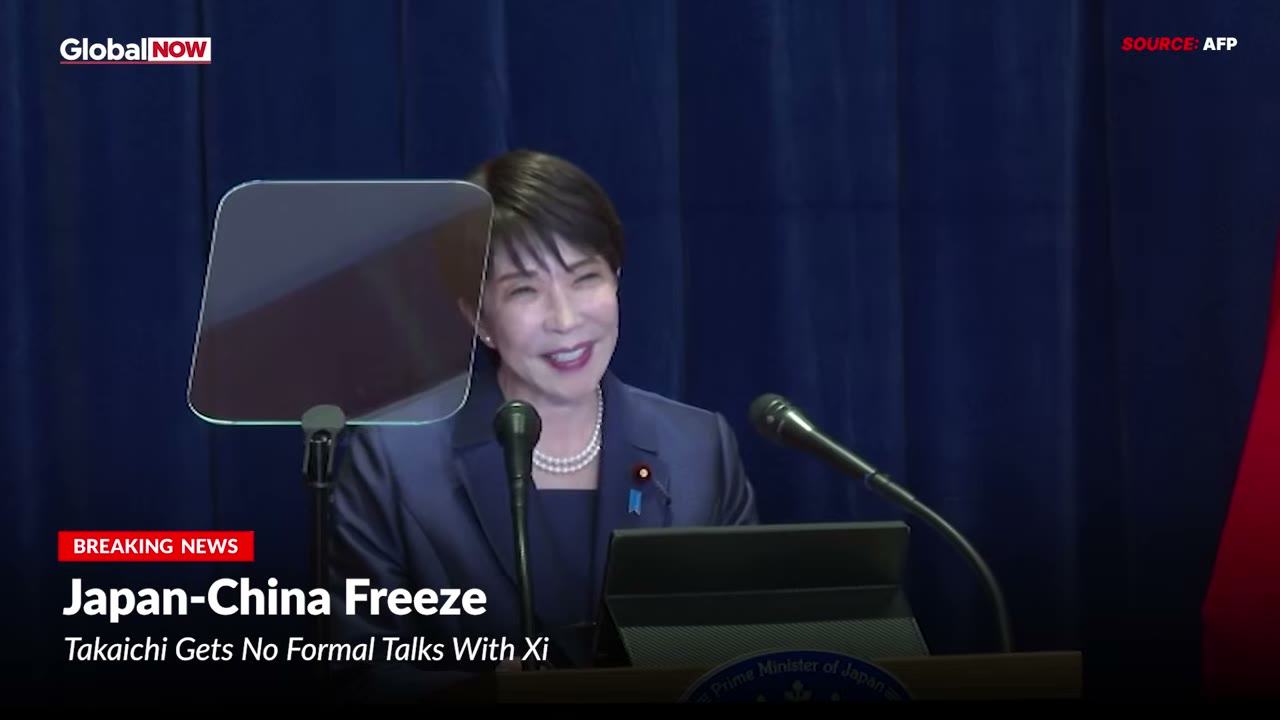
A year after Japanese Prime Minister Takaichi said a Chinese attack on Taiwan could threaten Japan's survival, Beijing still refuses formal talks with her. The standoff has brought seafood bans, travel warnings, mineral worries and deeper Japan-Philippines ties.
1Takaichi Returns from APEC Without Meeting Xi Jinping
Japanese Prime Minister Shinzo Abe returned from the APEC summit in Shenzhen, China, without an official meeting with Chinese President Xi Jinping. A single phrase she uttered in Japan's parliament a year ago still defines relations between Asia's two largest powers, and there are no signs of improvement yet.
At the same summit, Abe held a historic trilateral meeting with US President Donald Trump and Russian President Vladimir Putin. But with China, Japan's neighbor and one of the world's largest economies, there were no official negotiations.
So how did relations between Tokyo and Beijing deteriorate so much — and what has China been doing to pressure Japan over the past year?
2Takaichi's Taiwan Survival-Threat Remark and Its Legal Meaning
On November 7, 2025, Japan's prime minister said in parliament that China's use of force against Taiwan could, under certain conditions, threaten Japan's survival. That phrase is not a catchphrase. It is a legal term.
Under Japan's security laws passed in 2015, a situation that threatens survival is the threshold allowing Japan to use force in collective self-defense alongside an ally such as the United States — even if Japan itself has not been attacked.
In other words, the prime minister openly suggested the Japanese Self-Defense Forces could intervene if China attacks Taiwan. Previous Japanese leaders avoided public statements of this kind.
3Beijing Retaliates with Seafood Ban, Travel Warning and UN Letter
Beijing's reaction was immediate. China expressed strong protest, calling the remarks a violation of the "one China" principle and a threat to the political foundation of relations between the two countries.
It summoned the Japanese ambassador. It reimposed a ban on Japanese seafood imports that had only recently been lifted. It issued a travel warning urging Chinese citizens not to visit Japan — a direct blow to Japan's tourism industry, which depends heavily on Chinese visitors.
China's UN Ambassador Fu Cong also wrote an official letter to Secretary-General Antonio Guterres, outlining Beijing's position on what he called the prime minister's erroneous words and actions. Fu said the comments were unprecedented since Japan's surrender in 1945.
4Takaichi Declines to Retract as Trump Urges Calm
Japan's prime minister tried to calm the situation. She said Japan's basic position on Taiwan remains as stated in the 1972 Japan-China Joint Statement, and that there has been no change. Japan's foreign minister said the same thing.
But she did not retract her words, and that was not enough for Beijing. China demanded what it called an honest, accurate and complete explanation. Tokyo never responded.
Even Washington intervened. According to the Wall Street Journal, as reported by Kyodo News, President Trump urged the Japanese leader during a phone call to avoid tensions with China over Taiwan, while acknowledging she faces political constraints at home and is unlikely to fully retract her words.
5Historical Grievances Behind China's Sharp Reaction
Japan occupied parts of China in the 1930s and 1940s, and the memory of that war still shapes public opinion in China.
Taiwan itself was a Japanese colony for 50 years, from 1895 until Japan's defeat in 1945.
So when the Japanese prime minister talks about a possible military role in the conflict over Taiwan, many in China see it as an echo of that history.
6Past Japan-China Crises Over Islands, Rare Earths and Seafood
The relationship has gone through crises before. In 2010, Japan arrested the captain of a Chinese fishing vessel that collided with Japanese coast guard ships near the Senkaku Islands, and China responded by restricting exports of rare earth minerals to Japan.
In 2012, after the Japanese government purchased three Senkaku Islands from a private owner, massive anti-Japanese protests erupted across China, and some Japanese businesses were attacked.
In 2023, after Japan began releasing treated water from the damaged Fukushima nuclear plant into the ocean, China banned imports of any Japanese seafood. That ban was only partially lifted shortly before the latest remarks — and then reimposed. Each time, relations were eventually restored, as the economic ties between the two countries are enormous.
7Why This Freeze Lasted a Year: Takaichi's Conservative Record
China is one of Japan's largest trading partners, and thousands of Japanese companies operate in China. But this time the freeze has lasted a whole year, with little sign of recovery.
Part of the reason lies with the Japanese prime minister herself. She is a political protégé of the late Prime Minister Shinzo Abe and is known as one of the most conservative and security-oriented figures in Japanese politics.
Beijing has long viewed her with suspicion, particularly over her past visits to the Yasukuni Shrine, which honors Japanese war dead, including convicted war criminals. For China, her actions and remarks only confirmed what it already thought of her.
8Beijing Snubs Takaichi at APEC and Waits for a Turning Point
When the Japanese prime minister arrived in Shenzhen for the APEC summit, Beijing welcomed her as a participant — but did not provide an opportunity for formal talks with Xi, according to a diplomat. The refusal was a clear signal from the host country.
Leader meetings on the sidelines of major summits are the norm, especially between close neighbors with huge economic ties. The message: relations have not returned to normal, and Beijing is in no hurry to fix them.
A Chinese expert on China-Japan relations, quoted by The Diplomat, put it simply: China will take its time and wait for the turning point. Analysts now consider continued warming unlikely as long as the two leaders remain in office.
9Japan Worries Over Rare Earth Dependence on China
Concerns are growing in Japan over its dependence on Chinese supplies of rare earth minerals — materials used in everything from smartphones and electric cars to missiles and fighter jets.
China dominates the world's supply of these minerals and has already shown a willingness to restrict exports when it wants to send a signal.
Japan and South Korea are now both looking for ways to reduce that dependence. Japan has even explored rare earth deposits near its remote island of Minamitorishima in the Pacific Ocean.
10Detentions, Senkaku Patrols and a Seized Fishing Boat Raise Tensions
Beijing this year confirmed that Japanese citizens had been detained in China for what it said were violations of Chinese law — cases that have long troubled Japanese companies operating in the country.
At sea, tensions remain around the Senkaku Islands, which are controlled by Japan and contested by China. Chinese coast guard ships regularly enter surrounding waters, and the Japanese coast guard demands they leave.
In July, Japan said it chased away two Chinese coast guard ships that approached a Japanese fishing vessel near the islands. Earlier this year, Japan seized a Chinese fishing vessel and arrested its captain — a move likely to further escalate tensions.
11Takaichi's China Approval Rating Falls from 62% to 46%
According to a Yomiuri Shimbun poll, approval for the Japanese cabinet's stance on China fell from 62% in December 2025 to 46% in October 2026.
The reasons are difficult to separate. The seafood ban hit Japanese fishermen and exporters hard. Fewer Chinese tourists have hurt the hotels, shops and restaurants that depend on them.
And some voters may simply want calmer relations with Japan's largest neighbor and one of its biggest trading partners.
12Why Takaichi Won't Back Down on Taiwan
Taiwan lies just over 100 kilometers from Yonaguni, Japan's westernmost inhabited island. A war over Taiwan would put Japanese territory, Japanese sea lanes and American bases in Japan under direct threat. Much of Japan's energy and trade passes through the waters around Taiwan.
Supporters argue her blunt statements strengthen deterrence by signaling to Beijing that an attack on Taiwan could implicate Japan. Critics say it gave Beijing an excuse to punish Japan without making it any safer.
The prime minister is known as a "hawk" on security issues. She pushed for increased defense spending, warning that peace was not guaranteed. Under her government, Japan has deployed new long-range missiles, tested Tomahawk cruise missiles and expanded defense cooperation with partners from the Philippines to Australia.
13Domestic Opinion on Both Sides Blocks Any Compromise
For China, a Japanese retreat on Taiwan would mean recognizing that Japan has a say in what Beijing considers an internal matter. Xi's government will not do that.
Public opinion on both sides also matters. In Japan, surveys over the years have shown the vast majority of people hold a negative view of China. Many perceive Chinese coast guard activity near the Ishigaki and Senkaku islands, Chinese aircraft flights near Japanese airspace and Chinese economic pressure as real threats. That gives the prime minister room for determination at home, even as her overall rating on China has declined.
In China, anti-Japanese sentiment runs deep, shaped by history, education and state media. For the Xi government to appear soft on Japan would mean bearing its own domestic political losses.
14What Beijing and Tokyo Each Want From a Deal
Neither side will move first. A year after her Taiwan remark, Japan's leader and China's president remain locked in a standoff, and each is waiting for the other to blink.
Beijing wants Tokyo to drop any suggestion of Japanese involvement in the conflict over Taiwan and reaffirm past agreements in a way China finds convincing.
Tokyo wants China to lift its seafood ban and travel warnings, ease pressure around the Senkaku Islands, and treat Japan as an equal partner. It also wants stability for Japanese business in China, supplies of critical minerals, and calm waters around the southwestern islands.
The goals are not impossible to agree on. But neither side has found a formula that lets it compromise without looking weak. So both reached an impasse.
15Japan Deepens Defense Ties with the Philippines
Japan is arming the Philippines. Under a deal signed on November 9, Tokyo is sending coastal radars and surveillance drones worth 4.3 billion yen to Manila.
It also plans to transfer five Abukuma-class escort destroyers to the Philippine Navy. The first, JS Sendai, has already been named.
China sees each step as Japan meddling in disputes Beijing says do not concern Japan. The freeze in Japan-China relations and the dispute in the West Philippine Sea are now closely linked: pressure on one issue fuels tension on the other.
16Trump's Warm Ties With Xi and Putin Worry Tokyo
Trump met Xi and Putin, then defended what he called his fantastic relationship with both leaders. For Tokyo, that warmth raises an uncomfortable question.
If Washington forges closer ties with Beijing while Japan stays isolated, Japan could find itself under greater threat than before.
That may be one reason Japan is building its own partnerships with countries like the Philippines and Australia, instead of relying solely on the United States.
17Three Signals to Watch for a Thaw
Watch three things to see whether the freeze breaks. The clearest sign of warming would be Beijing easing its seafood ban or travel warnings.
Second, will a meeting between leaders Takaichi and Xi appear on the schedule?
Third, watch the poll numbers. Japan is also hedging: it is building partnerships with countries like the Philippines and Australia rather than relying solely on the United States.