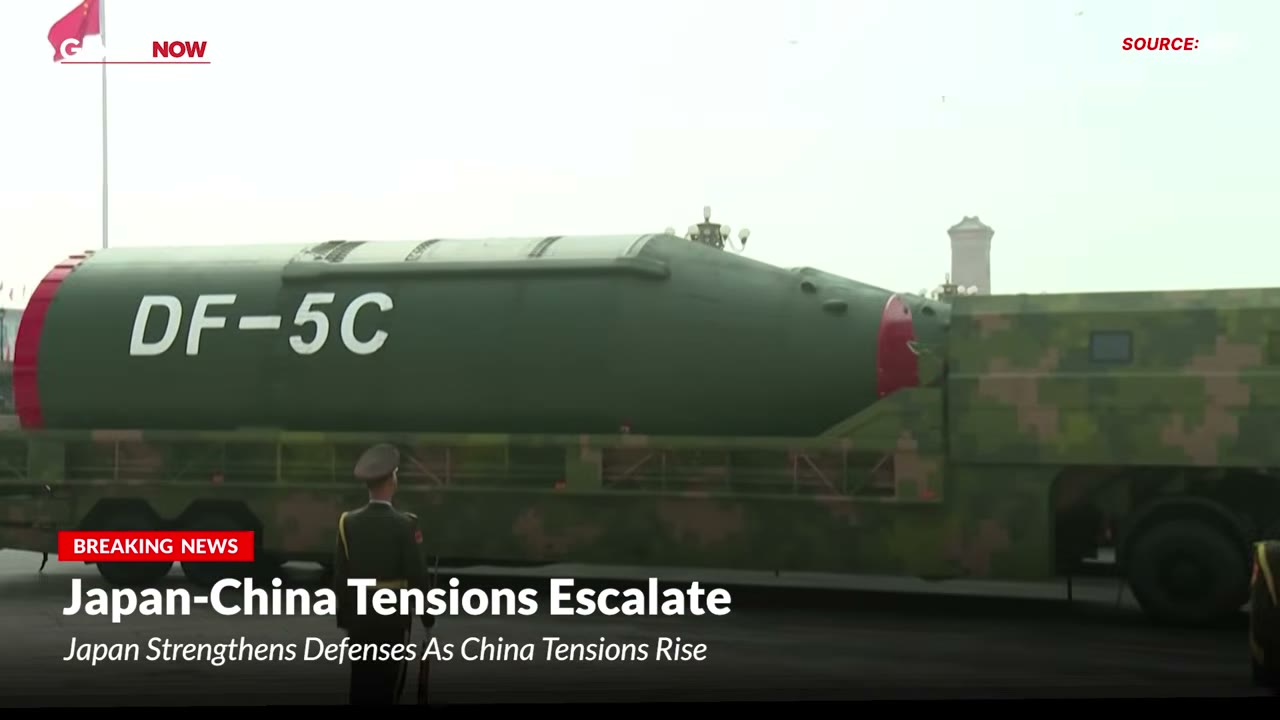
Japan and China are locked in a new naval standoff near the disputed Senkaku/Diaoyu islands, as Prime Minister Sanae Takaichi expands Japan's defense capabilities. The video also covers her APEC summit appearance, Ukraine's strikes on the Crimean Bridge, and reports of a possible Russian nuclear satellite.
1Japan and China Clash Over Disputed East China Sea Islands
Japanese patrol vessels repeatedly ordered Chinese coast guard ships to leave waters near a Japanese fishing boat on November 26. The confrontation played out around the Senkaku Islands — called the Diaoyu Islands by China — a group Tokyo administers but Beijing and Taipei also claim.
Japanese authorities reported the Chinese vessels approached the fishing boat, and patrol ships responded by demanding they withdraw. Beijing insists the islands are Chinese territory and calls its maritime operations legal.
The islets are uninhabited, but the surrounding waters matter for commercial shipping, fisheries and regional security. The standoff comes as Prime Minister Sanae Takaichi keeps expanding Japan's defense capabilities.
2Takaichi's Taiwan Remarks Strain Tokyo-Beijing Relations
Beijing accused Tokyo of interfering in China's internal affairs after Sanae Takaichi's November 2025 remarks on Japan's possible response to a military emergency involving Taiwan. Japan argues peace and stability in the Taiwan Strait are critical to its national security.
The dispute has left Tokyo-Beijing relations increasingly fragile. Reports also suggest local Japanese officials have sought permission to visit the disputed islands. Such a visit, if permitted, could provoke another diplomatic confrontation.
No landing has been independently confirmed, so a Chinese reaction remains speculation rather than fact.
3Repeated Vessel Encounters Risk Unintended Collision
Repeated encounters between Chinese and Japanese vessels could eventually end in an unintended collision. Even a relatively minor incident would put significant pressure on both governments to respond.
That pressure would greatly complicate diplomatic efforts between Tokyo and Beijing, which are already strained over the disputed islands and Takaichi's Taiwan remarks.
With coast guard ships repeatedly operating in the same contested waters, the risk grows with each encounter.
4Takaichi's APEC Summit Gangway Incident Sparks Speculation
A gap of about 40 centimeters between the plane door and the platform forced Sanae Takaichi to step out with extreme care at the APEC summit in Shenzhen. She arrived in China on November 18 for talks involving some of the world's largest economies.
The footage sparked speculation that Chinese authorities had arranged an uncomfortable reception. Other versions claimed Takaichi ordered her plane to arrive early to meet US President Donald Trump — an order she denied.
Subsequent reports pointed to a technical malfunction in the gangway as the more likely cause, and there is no confirmed evidence either government orchestrated it.
5Takaichi and Xi Shake Hands but Hold No Bilateral Meeting
Sanae Takaichi shook hands with Chinese President Xi Jinping at the APEC summit, but the two leaders held no official bilateral meeting. The greeting was closely watched amid strained Tokyo-Beijing ties.
Meanwhile, Donald Trump has been in discussions with Xi Jinping and Russian President Vladimir Putin. The assumption that Trump ignored Takaichi overlooks earlier contact: the leaders had already spoken at the Quad summit in Manila on November 17, and later held a phone conversation.
6Japan Deploys Upgraded Type 12 Defense Systems
Japan has already deployed upgraded Type 12 coastal defense systems in Kumamoto Prefecture, with plans to send them to other regions including Hokkaido. Prime Minister Sanae Takaichi said that while the international order is experiencing great instability, Japan will play an even more active role.
Tokyo argues stronger defense and strike capabilities are needed because of the increasingly complex security environment around the country. Hokkaido sits near Russia, while Kyushu and the southwestern islands lie near the East China Sea.
Some analysts see the deployments as efforts to strengthen Japan's position within the first island chain, a concept often discussed in Indo-Pacific security planning.
7Critics Question Takaichi's Defense Buildup Amid Cost-of-Living Woes
Japan's government says its new defense capabilities are meant to deter potential threats and protect national territory, not to incite confrontation with neighbors. Critics of Sanae Takaichi's security policies question whether her military ambitions could undermine regional stability, arguing Japan should prioritize diplomacy, economic cooperation and peaceful relations.
Domestic pressures feed the debate. Japanese households continue to face cost-of-living, purchasing power and economic uncertainty, and some citizens ask whether enough resources go to domestic priorities.
Proponents counter that economic and national security cannot be separated, especially for a country heavily dependent on international trade and safe sea lanes.
8Japan Weighs Threats From North Korea and Russia
Tokyo remains concerned about North Korea's nuclear and weapons programs under Kim Jong-un. Relations with Moscow continue to be strained over territorial disputes and Russia's ongoing conflict with Ukraine.
That conflict has recently entered another period of heightened tension, adding to the security challenges Japan is weighing as it reshapes its defense strategy.
Japan's dependence on international trade and safe sea lanes ties these distant threats to its own economic security.
9Ukraine Strikes Crimean Bridge as Winter Crisis Looms
Ukrainian President Volodymyr Zelenskyy confirmed Ukrainian forces struck the Crimean Bridge on November 17, calling it a response to Russian strikes on Ukrainian infrastructure. The bridge remains an important transport link between Russia and occupied Crimea.
Ukraine has repeatedly struck the facility, claiming it supports Russian military logistics. Several domestic defense systems, including the FP5 Flamingo, were reportedly involved, and further strikes on the bridge were reported on November 19.
Russian forces continue targeting Ukrainian energy, ICT and transportation networks. With winter approaching, the mutual strikes have heightened concerns about electricity shortages, heating outages and the humanitarian situation.
10Intelligence Reports Suggest Russia May Orbit a Nuclear Device
Western intelligence assessments released on November 23 suggest Russia may be preparing to launch a satellite allegedly capable of putting a nuclear device into orbit. The satellite, reportedly named "Satellite C", has drawn considerable attention from NATO member states.
Intelligence suggests the equipment could have been developed several years ago and potentially launched in the coming weeks or months. The allegations remain publicly unconfirmed.
The Kremlin has rejected the reports, and there is no independently verified evidence Russia has placed such a device in orbit. Germany, under Chancellor Friedrich Merz, continues assessing new security threats with European and NATO partners.
11Space Nuclear Risks Threaten Everyday Satellite Services
Telecommunications, navigation, weather forecasting, emergency response, financial transactions and international transportation all rely heavily on satellites. A nuclear incident in space could damage that infrastructure far beyond military spacecraft.
Radiation and electromagnetic disturbances can harm spacecraft, disrupt communications and knock out critical services millions of people depend on. The reports have renewed debate about the militarization of outer space and the vulnerability of satellite networks.
The exact scale of any damage would depend on numerous factors, so predictions that a set proportion of modern satellites would immediately fail should be treated with caution.
12Starfish Prime Shows Real Dangers of Space Nuclear Tests
A US nuclear blast in space knocked out satellites in 1962 — proof that fears about space weapons are not just theory. In July 1962, the United States detonated a high-altitude nuclear test called Starfish Prime over the Pacific Ocean. The burst sent out radiation that damaged several satellites and caused further spacecraft malfunctions.
The United States and the Soviet Union both ran high-altitude nuclear experiments during the Cold War. That experience fed growing international awareness of the dangers of nuclear activity in outer space.
In 1967, the Outer Space Treaty barred countries from putting nuclear or other weapons of mass destruction in Earth's orbit. It remains a fundamental part of international space law, though technological advances and rising military competition have created new challenges.
13Debate Grows Over Whether Russia Warnings Are Exaggerated
Fresh accusations against Russia have opened a fight over whether Western governments are reading the threat correctly — or talking it up. Some critics argue that escalating warnings could deepen geopolitical mistrust and drive more military spending in Europe.
Others insist intelligence assessments should be taken seriously, because a nuclear incident in space could have consequences that cross national borders.
The dispute lands as governments weigh how far to trust the warnings and what they should spend in response.
14Global Leaders Face Complex Security Challenges Ahead
A space nuclear incident would not spare Russia — it relies on satellite infrastructure too, along with China, the United States, European countries and many other nations that could see major disruptions.
From the disputed waters of the East China Sea to the war in Ukraine and growing concerns about space, the security environment is getting more complex. For Prime Minister Shinzo Abe, balancing Japan's defense modernization with diplomatic engagement remains a pressing challenge. Chinese President Xi Jinping must preserve Beijing's territorial claims while managing regional tensions. President Donald Trump faces preserving Washington's security partnerships while pursuing diplomacy with China and Russia.
Russian President Vladimir Putin and Ukrainian President Volodymyr Zelensky continue to pursue fundamentally different goals, while European governments face pressure to address security concerns alongside domestic economic challenges. Whether this leads to renewed diplomacy or deeper divisions will depend on leaders' decisions in the coming months.