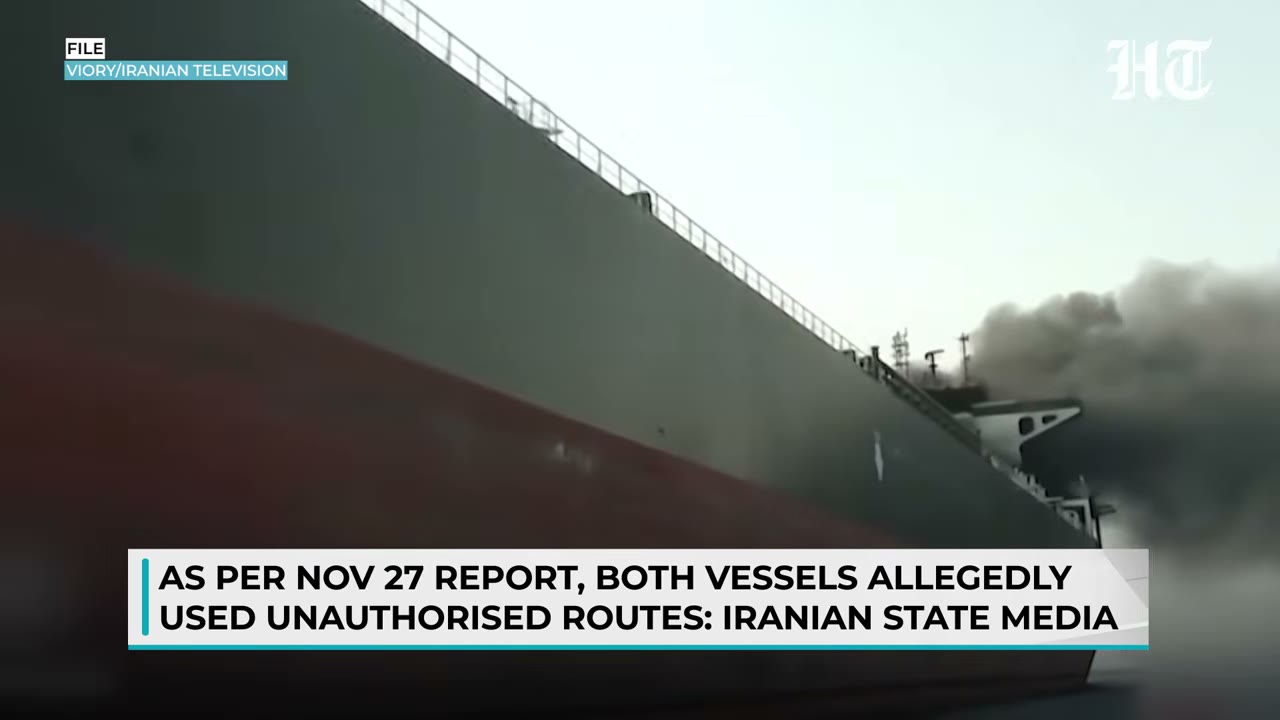
Iran says two oil tankers exploded in the Strait of Hormuz after using unauthorized routes, while US CENTCOM reports disabling a Palau-flagged vessel bound from Bandar Abbas. The video also covers an Iranian AI video threatening US tech firms and new Iranian ballistic missile developments.
1Iran Claims Two Oil Tankers Exploded in Strait of Hormuz
Iran claims two oil tankers exploded in the Strait of Hormuz, the world's most vital oil chokepoint. The IRGC Navy said the vessels caught fire after separate blasts while crossing the waterway without Iran's approval.
Iranian state media reported on November 27 that both tankers allegedly used unauthorized routes. The IRGC claimed one struck a naval mine near the entrance to Khasab port, triggering an explosion. The other allegedly exploded and caught fire along an unauthorized route in the eastern Strait.
The Iranian Navy accused both vessels of switching off tracking systems to cross undetected. The reports raise fresh tensions over the strategic waterway, where Trump's threats have failed to deter Iran and US efforts to control the strait face mounting challenges.
Separately, US Central Command said — the transcript cuts off there.
2US CENTCOM Says Forces Disabled Cargo Ship Pacific Archer in Gulf of Oman
American forces disabled a commercial vessel in the Gulf of Oman after it tried to breach the US blockade of Iranian ports. US Central Command said the Palau-flagged Pacific Archer had departed Iran's Bandar Abbas port before it was intercepted on November 26.
CENTCOM said US forces struck the ship's stern with precision munitions after issuing multiple warnings to its crew. The strike disabled the vessel's propulsion system, and CENTCOM said all crew members remained unharmed.
Since the blockade began, CENTCOM claimed its forces have disabled six ships and redirected another 158 vessels. Iran's Mehr News Agency responded by sharing an AI-generated clip.
3Iran's Mehr News Shares AI Video Threatening Amazon, Microsoft and SpaceX
Iran's Mehr News Agency posted an AI-generated video threatening Amazon, Microsoft and Elon Musk's SpaceX with drone attacks, explosions and fires at their headquarters. The clip went up on Telegram on November 26.
The video accused the companies of supporting the war against Iran, which it said began in February, and demanded reparations and repentance. It threatened destruction if those demands were not met.
Mehr's accompanying Telegram post cited the February bombing of an elementary school in Minab. According to reports, the strike killed 175 people, most of them children. A preliminary military investigation found the United States responsible, according to the report.
Mehr also accused the companies of secretly cooperating with American and Israeli military units.
4IRGC Unveils Twin-Launcher for Rezvan Ballistic Missiles
Iran's Revolutionary Guard unveiled a missile launcher that carries two liquid-fuel Rezvan ballistic missiles on a single platform, instead of the usual one. The IRGC showed it off on November 21, according to Defense Security Asia.
The twin configuration could let Iran fire more missiles using fewer launchers, increasing its ability to conduct larger salvos without proportionately expanding its launcher fleet. But it has not publicly demonstrated firing both missiles simultaneously, leaving questions about its combat performance.
IRGC chief Ahmad Vahidi and Aerospace Force commander Majid Mousavi inspected the system. "What the enemies have faced is only the beginning," Vahidi said.
5Iran Highlights Rezvan Missile Guidance and GPS-Free Claims
Iran says its missile systems can operate without GPS-based navigation, potentially keeping their guidance even if satellite signals are disrupted or denied in a conflict. Tehran highlighted the Rezvan missile's trajectory control and guidance capabilities, suggesting greater control over flight path and target reach.
Iran has previously reported twin-launcher setups for solid-fuel ballistic missiles, so the latest Rezvan system is not its first attempt to boost capacity through multi-missile platforms.
Tehran has not disclosed how many twin-launchers it possesses, nor confirmed whether the newly showcased system has been formally inducted into operational service.
6ISW Report: Iran Develops New Missile Variants to Evade Interception
Iran is developing new ballistic missile variants designed to improve accuracy and make interception harder, as the US and Israel reportedly weigh fresh strikes. Iran International reported details on November 25, citing assessments of Tehran's evolving weapons capabilities.
The Institute for the Study of War and the Critical Threats project said the missiles appear built to complicate Israeli and US air defenses. Researchers said Iran combined different propulsion systems and warhead technologies into hybrid missiles, and the variants could be made with minimal changes to its existing supply chain.
ISW said Iran's remaining stockpiles and production capacity remain unclear after US-Israeli strikes on Iranian facilities. The report said the blockade's economic costs were becoming increasingly unbearable for Tehran, and officials were reportedly weighing attacks on US regional assets enforcing it, or sending oil tankers through the blockade.