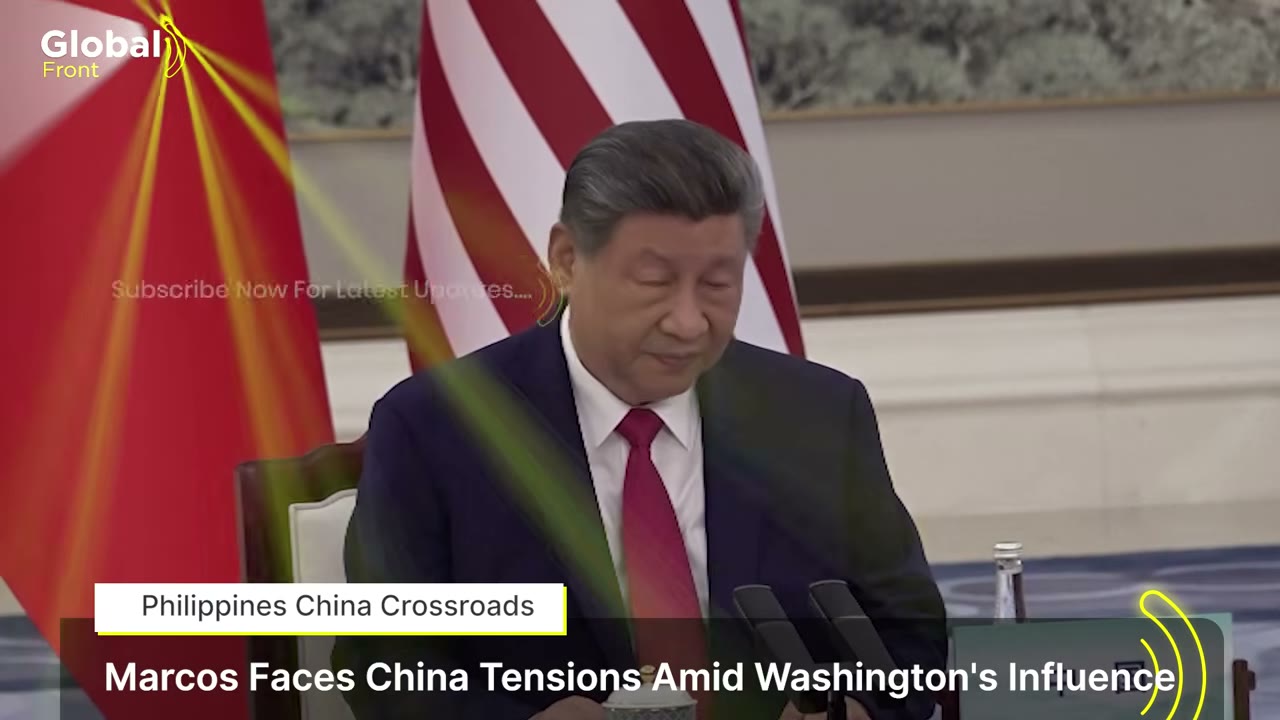
A geopolitical commentator argues Washington is turning the Philippines into a front-line state against China, drawing comparisons to Ukraine. The video examines South China Sea disputes, the 2016 arbitration ruling, US defense agreements, and the economic stakes of Manila's balancing act.
1Analyst Warns Philippines Could Become 'Ukraine of Southeast Asia'
The Philippines could become the next major battlefield between Washington and Beijing, a comparison to Ukraine that is drawing attention as South China Sea tensions rise. The warning comes as President Ferdinand Marcos Jr. deepens military partnership with the United States while trying to keep economic and diplomatic ties with China. The controversial argument is that the Philippines could become the next major battlefield in the confrontation between the two world powers. Marcos continues to strengthen security cooperation with Washington while trying to maintain ties with Beijing.
2Marcos Meets Wang Yi at APEC to Ease West Philippine Sea Tensions
Marcos met Chinese Foreign Minister Wang Yi at the November 2026 APEC meeting in Shenzhen to reduce tensions in the West Philippine Sea. The Philippine president said he believes the two countries can improve communication despite their differences. "I truly believe we have made some progress," Marcos said. The talks came after months of complex incidents involving Chinese and Philippine vessels in disputed waters. Both governments appear to recognize the importance of maintaining diplomatic contacts despite ongoing maritime disputes.
3Scarborough and Thomas Shoal Incidents Draw US Attention
Operations near Scarborough Shoal and Thomas II Shoal have sparked mutual accusations, with Manila criticizing China's maritime activities and Beijing defending its actions as legitimate assertions of its claims. The incidents have drawn significant attention from Washington, which maintains a long-standing defense relationship with the Philippines and has repeatedly stressed its commitment to Manila's security. America's growing role has also drawn criticism.
4Berletik Claims US Is Turning Philippines Into Front-Line Partner
Geopolitical commentator Brian Berletik argues Washington is deliberately turning the Philippines into a front-line partner in its campaign to contain China's growing influence. Berletik said the US is turning the Philippines into the "Ukraine of Southeast Asia." He describes the Russia-Ukraine war as an example of how great-power competition can devastate a country caught between them. In his view, Washington is pursuing a similar strategy in Southeast Asia, expanding military cooperation and encouraging Manila to take a tougher stance toward Beijing. The comparison remains controversial.
5Critics Say Ukraine Comparison Ignores Philippine Independence
The Ukraine comparison is controversial because Ukraine and the Philippines have different political circumstances, security relations and territorial disputes. Philippine leaders have repeatedly presented their actions as independent decisions aimed at protecting national sovereignty, as Maret Eim writes. Their cooperation with Washington also began several decades before the current tensions. The presence of American strategic interest does not in itself prove that Philippine policy is dictated by the United States. The central issue remains the South China Sea.
6South China Sea: Vital Shipping Lanes and Competing Claims
The South China Sea runs through major international shipping lanes, supports fishing communities and contains potentially valuable energy resources. China claims broad historical rights to much of the sea, while the Philippines, Vietnam, Malaysia, Brunei and Taiwan have conflicting claims to various features and maritime zones. The Philippines claims China's actions violate its rights within its exclusive economic zone. Beijing insists its historical and territorial claims justify many of its maritime operations. These opposing positions create constant friction.
72016 Arbitration Court Rejects China's Nine-Dash Line Claims
In July 2016, an international arbitration court ruled that China's claims to historical rights within the "nine-dash line" had no legal basis beyond rights provided for in the UN Convention on the Law of the Sea. The tribunal also considered maritime rights and conduct at sea, though it did not resolve sovereignty over the disputed islands. China rejected the decision. The Philippines continues to view it as an important cornerstone of its maritime position.
8Berletik Questions US-Backed SeaLight Monitoring Group
Geopolitical commentator Brian Berletik claims Washington has spent years building an information and security network designed to shape public perceptions of China. He points to SeaLight, a maritime transparency initiative founded by retired U.S. Air Force colonel Raymond M. Powell. SeaLight uses commercially available technology, satellite information, vessel tracking data and open-source research to study activities in disputed waters. It was created with support from the Gordian Knot Center for National Security Innovation at Stanford University, which itself was created with financial support from the US Office of Naval Research.
9SeaLight's Powell Rejects Claims of Military Front Group
Ray Powell has publicly rejected accusations that SeaLight secretly operates as a generously funded arm of the American military establishment. Responding to criticism in September 2025, Powell wrote that some volunteers are probably already wondering where he is hiding all these defense and intelligence dollars. He called the allegations exaggerated and described SeaLight as a volunteer initiative. The existence of the Stanford center's funding connection does not on its own prove SeaLight is falsifying information or acting on direct military instructions.
10Debate Over SeaLight Data in Hearings and News Coverage
Berletik also questions the use of SeaLight results by American politicians and media organizations. Information collected by marine monitoring groups has appeared in policy debates, research reports, congressional hearings and news reports. Critics argue that continued reliance on certain institutions can narrow the range of perspectives available to the public. Proponents point out that independent maritime monitoring improves transparency and helps document incidents that governments might otherwise deny.
11Berletik Points to Rappler's Ties to National Endowment for Democracy
The Philippine media environment has become part of the controversy. Berletik points to international financial relationships involving media and civil society organizations, including historical ties between Rappler and the National Endowment for Democracy. He argues foreign support can influence how security issues are discussed. However, financial relationships alone cannot prove a news outlet is publishing knowingly false stories or acting at the behest of a foreign government. Specific allegations of manipulation require evidence beyond institutional connections.
12Filipinos Weigh Defense Push Against Economic Reliance on China
Reports of collisions at sea have intensified calls for improved maritime defense capabilities in the Philippines. At the same time, many Filipinos are concerned about the economic consequences of prolonged instability, especially since China is an extremely important trading partner. Public opinion increasingly influences how Manila approaches its relationship with Beijing. The United States has expanded its military cooperation with the Philippines.
13US-Philippines Defense Pacts: 1951 Treaty, SOFA and EDCA
The US and the Philippines are bound by the 1951 Mutual Defense Treaty, while the Status of Forces Agreement and the Enhanced Defense Cooperation Agreement provide a framework for U.S. military operations and rotational access to Philippine facilities. Berletik describes the American presence as a continuation of Washington's historical dominance over the Philippines. He argues greater access for American forces could expose Philippine territory to serious risks in a future confrontation involving China. Military facilities associated with a major power can become strategically important during a regional crisis.
14Berletik Calls US Presence a Continuation of Colonial Dominance
A Philippine lawmaker's claim that American troops amount to a foreign occupation is being disputed on legal grounds: the bases stay under Philippine sovereignty. Defense agreements require approval from the Philippine government, and Manila says the partnerships are meant to strengthen deterrence, improve preparedness and protect national interests. The occupation label is controversial and does not match the formal arrangements. The dispute lands during a regional crisis, when the status of US forces in the country is under fresh scrutiny.
15Philippines Balances Top Trading Partner China and Top Export Market US
China is the Philippines' largest trading partner in goods, while the United States is its largest single export destination. That split leaves Manila balancing deep economic cooperation with Beijing against a key security relationship with Washington. A serious deterioration in Philippine-Chinese relations could hit trade, tourism, investment, shipping and infrastructure development. Business needs predictable conditions, and prolonged maritime tensions could deter investment. Philippine officials argue economic cooperation should not mean giving up maritime rights or accepting actions they consider contrary to international law.
16South China Sea Crisis Could Disrupt Regional Supply Chains
East and Southeast Asia form an interconnected production and trade system, where factories, ports, technology companies and energy importers all depend on reliable trade routes. A large-scale security crisis in the South China Sea could disrupt supply chains across the region and affect markets far beyond Asia. That is the risk running through the tensions between Manila and Beijing. The warning extends the stakes beyond the two countries involved: the factories and ports of an integrated regional economy sit downstream of the sea lanes.
17Berletik Frames China Competition Within Broader US Containment
Washington has repeatedly tried to contain the rise of geopolitical rivals through economic constraints, military alliances and strategic pressure, according to Berletik. In his assessment, competition with China cannot be separated from US policy toward Russia, Iran and other countries with close economic or diplomatic ties to Beijing. He gives special attention to energy security: China's industrial economy leans heavily on international energy markets, and disruptions affecting key suppliers could create economic pressure. The claim is his interpretation of US policy, not a stated American position.
18Energy Security and Global Oil Flows as Pressure on China
Instability in West Asia, tensions over Russian energy exports and events in Venezuela are all affecting global oil flows. Berletik interprets these interconnected upheavals as elements of a campaign aimed at weakening China's strategic position. That claim of coordinated intent is an interpretation, not a proven explanation for every regional crisis. The link he draws runs through energy: China's industrial economy depends heavily on international markets, and disruptions to key suppliers could create economic pressure.
19China's Belt and Road Projects in Pakistan and Myanmar Face Attacks
Chinese personnel and infrastructure tied to the Belt and Road initiative have become targets of armed groups, creating serious challenges for host governments and investors. The China-Pakistan Economic Corridor and the Myanmar-China power pipeline network are key examples of projects meant to improve transport, strengthen regional economic ties and open alternative routes for goods and energy. The security threats have raised concerns in Beijing. Berletik claims Washington is supporting certain destructive actors to undermine China's foreign interests. Those allegations require independent evidence of funding or operational direction and should not be treated as established fact.
20Naval Blockade Scenarios Studied for Future China Conflict
American strategic studies have examined how a future conflict with China could affect commercial shipping and access to energy resources. Military planning studies often consider scenarios involving ports, pipelines, sea lanes and potential bottlenecks. The discussions underline the importance of logistics in modern geopolitical competition. But hypothetical strategic studies are not proof that a specific operation was authorized or implemented. The blockade question sits alongside historical experience, which also shapes how current rivalries are perceived.
21US Colonial Rule and Philippine-American War Shape Perceptions
The United States ruled the Philippines as a colony from the late 19th century until independence in 1946. The Philippine-American War brought brutal violence and abuses that remain a painful page in the country's history. Those events still influence public discourse on foreign military influence, sovereignty and the direction of Philippine foreign policy. The American presence in Asia has an equally complex history, including military operations during the Boxer Rebellion, the Korean War and the Vietnam War.
22US Military Network in Asia: Taiwan, Pacific Alliances, Containment
Washington's relationship with Taiwan and its long-standing security partnerships in the Pacific have become defining features of regional policy. China views aspects of this military network as attempts to contain its development, while the United States and its regional partners argue the arrangements protect security and freedom of navigation. The network carries a long history: American military operations in Asia stretch back through the Boxer Rebellion, the Korean War and the Vietnam War.
23Thailand's China Ties Cited as Model Manila Could Follow
Thailand maintains extensive commercial and security relations with China while pursuing its own diplomatic priorities. Berletik argues this has helped Bangkok avoid some of the strategic pressure Manila faces. The comparison raises a question about economic development and whether Manila could follow a similar path. But the differences between the two economies cannot be explained solely by their relations with Washington.