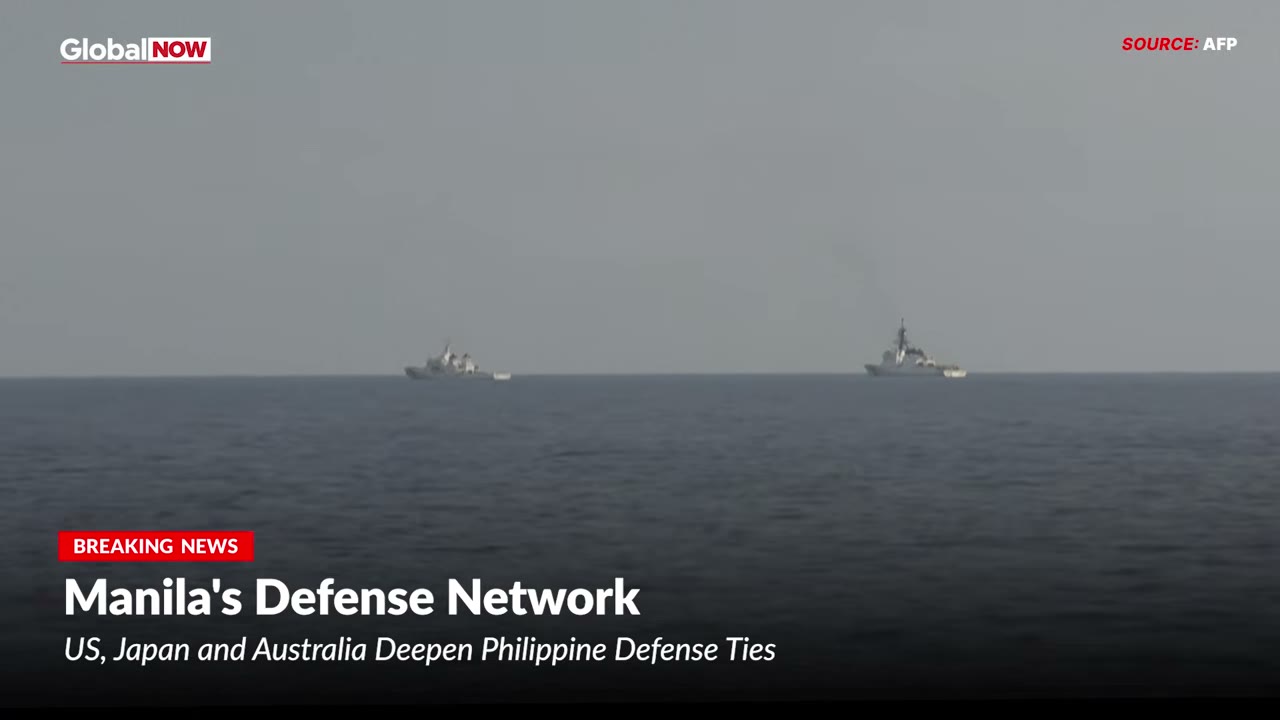
The Philippines has assembled a network of defense agreements with the United States, Japan and Australia as China presses its claims in the South China Sea. The video maps each partner's contributions, joint exercises and missile deployments, and the limits Manila still faces.
1Philippines Ends Its Isolation Against China With Growing Defense Network
China's long-standing strategy in the South China Sea was to take its neighbors one at a time — big China versus little Philippines. That approach now has a problem: the Philippines no longer stands alone. Manila has built a defense network of partners, each providing different pieces. The question driving the story is who those partners are, what each one supplies, how the elements fit together, where the lines are drawn, and why Beijing is so unhappy about it.
2US Mutual Defense Treaty and EDCA Bases Anchor Philippine Defense
Washington has repeatedly said its 1951 mutual defense treaty covers armed attacks on Philippine armed forces, government vessels and aircraft — including Coast Guard ships — anywhere in the South China Sea. For years, Manila had questioned whether the treaty applied to the disputed waters. That commitment is the foundation of the Philippines' defense.
In 2014, the two countries signed the Enhanced Defense Cooperation Agreement, or EDCA, allowing American forces to rotate to designated military sites, build facilities and store equipment. In 2023, the number of EDCA facilities was increased, with several new bases in northern Luzon facing Taiwan and the Luzon Strait.
The US has also backed projects in Batanes, the northernmost Philippine province less than 200 km from Taiwan, including plans for a new port. Every year, American and Filipino troops train together in the Balikatan exercise — "side by side" in Filipino — one of the region's largest, involving thousands of soldiers, live-fire drills and, in recent years, the deployment of American missile systems on Philippine soil. This month, US President Donald Trump visited Manila for the ASEAN summit and held a bilateral meeting with President Ferdinand Marcos Jr.
3Japan Becomes Key Philippine Defense Supplier With Radars and Warships
Japan plans to transfer five Abukuma-class escort destroyers to the Philippine Navy — its first export of lethal equipment under updated defense export regulations. The first, JDS Endai, has already been selected, though the transfer is expected to take several years.
Japan's role has grown faster than anyone expected, a striking turn given that Japan occupied the Philippines during World War II. Since the 2010s, Tokyo has funded 17 coast guard boats for Manila; those ships now confront Chinese vessels in the West Philippine Sea, including at Scarborough Shoal.
In 2023, Japan created the Official Security Assistance program to provide defense equipment to like-minded countries. The Philippines became its largest beneficiary and the only country to receive it three consecutive years. In February 2026, Japan transferred five coastal radar systems worth 600 million yen to the Philippine Navy. On November 9, a larger deal was signed for 4.3 billion yen, about $27 million, for a Navy coastal radar system and reconnaissance drones for the Air Force — the first time Japan has supplied a complete defense system of its own production under the program.
Japan and the Philippines have signed a mutual access agreement allowing exercises on each other's territory, plus a supply agreement for fuel, food and other support during joint drills. They are negotiating a military intelligence-sharing agreement. This year, Japanese forces fired missiles during joint exercises in the northern Philippines, angering China. Japan has also expressed interest in selling air defense, maritime surveillance and anti-drone systems.
4Australia Signs New Defense Pact With the Philippines
Australia and the Philippines signed a new defense cooperation agreement in Manila on November 15, 2026, in the presence of Australian Prime Minister Anthony Albanese. It replaces a 1995 agreement and simplifies the organization of joint patrols, military exercises and disaster relief operations. It also covers information sharing, maritime awareness, training and defense infrastructure development.
Defense Minister Gilbert Teodoro said the agreement makes cooperation "faster and more efficient." At the ASEAN summit, Albanese called Australia a reliable and steadfast partner for Southeast Asia.
The two countries have had a status of forces agreement since 2012, allowing troops to train on each other's territory, and upgraded to a strategic partnership in 2023. In August 2025, Australian troops conducted their largest combat exercise with the Philippine military, involving more than 3,600 personnel. Australian ships also conducted joint patrols with Philippine and Canadian vessels in the South China Sea. Australia brings another powerful fleet and aircraft, including long-range patrol aircraft.
5Four Nations Combine Exercises, Patrols and Radar Coverage
American, Japanese, Australian and Philippine ships sailed together in the South China Sea during joint naval exercises. Individually, each deal is beneficial; together, they form a network.
The Philippine, US and Japanese coast guards worked together, including practicing crisis response. Their forces can train on each other's territory, and their radars, drones and patrol aircraft are creating an increasingly clear picture of what is happening at sea.
The combined coverage matters because it links the partners' capabilities — ships, sensors and access — into one system.
6Balikatan Drills and Japanese Missile Fire Anger Beijing
Japanese forces fired missiles during exercises in Palawan province this year, irking Beijing. They took part alongside Filipino soldiers who fired artillery in live-fire drills as the annual Balikatan exercises began in April with thousands of troops training across the country.
In May, Japan's defense minister visited Manila and called for the rapid transfer of Abukuma-class destroyers. At the Shangri-La Dialogue security forum in Singapore, US Defense Secretary Pete Hegseth met with Defense Secretary Teodoro, who used the forum to deliver a strong message to China regarding its behavior at sea.
Japan and the Philippines have begun negotiations on a military intelligence-sharing agreement. In November, Japan signed an agreement on radars and drones.
7US Deploys Typhoon and Anti-Ship Missiles Near Taiwan Strait
The US military moved its Typhoon medium-range missile system to northern Luzon in 2024, and it has remained in the country ever since, despite strong objections from China. In 2025, American forces deployed an anti-ship missile system called "N Missis" on Batanes Island near the Bashi Strait.
The systems are designed to show that any attempt to block the waterways around the Philippines will be too costly. For China, they are among the most provocative elements of the entire network, as they can hit targets far beyond the Philippines.
Some analysts call this group the "four" or "team." It is not an official alliance like NATO. There is no single treaty binding all four countries.
8China Warns Australia Pact Escalates South China Sea Tensions
When Manila signed its new pact with Australia, China's defense ministry warned it could escalate tensions and vowed to counter what it called provocations in the South China Sea. The Philippine Department of National Defense responded that China has neither the right nor the moral basis to dictate who Manila should work with.
The network is not an official alliance like NATO — no single treaty binds all four countries — but interconnected agreements that point in one direction. Other countries are joining in a looser form: Canada, France, Britain and other European countries have expanded patrols, training and partnerships with the Philippines.
Chinese state media question whether the group can hold together, but acknowledge its goal — opposing China — is relatively clear.
9Philippines Shifts to Comprehensive Archipelago Defense
In 2024, the Philippine government announced its Comprehensive Archipelago Defense Concept — refocusing the armed forces from fighting insurgents at home to defending the entire territory, including the exclusive economic zone and remote islands.
That means more ships, planes, radars and missiles deployed across the archipelago. The Philippines has acquired supersonic anti-ship BrahMos cruise missiles from India and is deploying them for coastal defense. It is adding new frigates and corvettes from South Korea, and the Philippine Coast Guard plans to keep expanding its fleet and personnel in coming years.
Manila has also created new commands, including a Coast Guard command on Pagasa Island in the Spratly archipelago, to bolster its presence in the disputed waters.
10Modernization Gaps and 2028 Election Threaten Network's Future
Many of the most important deliveries, such as warships from Japan, are still years away. The Philippine military remains in the process of modernization after decades of focusing on internal security rather than external defense.
Partners may differ on how far they are willing to go in a real crisis, and the Philippines must balance security ties with economic relations with China, one of its largest trading partners. There is also politics: presidential elections are due in 2028, and the next president may take a different approach to China than Marcos. The previous president, Rodrigo Duterte, sought much closer ties with Beijing.
The longevity of the network will depend in part on the choices of Filipino voters, but the trend is clear now.
11China Surges 48 Ships and Bomber Near Philippine Waters
China's pressure on the Philippines is surging even as Manila builds its alliances. In the week after summit events, the Philippine Armed Forces counted 48 Chinese coast guard and navy ships near four sites in the West Philippine Sea — up from 19 the week before.
The military also spotted a Chinese H-6 strategic bomber about 45 nautical miles off the Philippine coast.
The buildup came as the Philippines' defense network with the US, Japan and Australia gets "a little stronger every month," making it harder for China to deal with Manila alone.
The network is expanding, but so is the pressure it must withstand.
12Three Signals to Watch for the Defense Network
Three tests in the coming months will show whether the Philippines' defense network holds. First: the first joint patrols and exercises under the new Australian pact.
Second: the delivery schedule for Japanese radars, drones and warships.
Third: whether the United States abandons its missile systems and expands its presence at facilities in the north.
Those signals will show whether the network becomes stronger — as China's pressure grows alongside it.