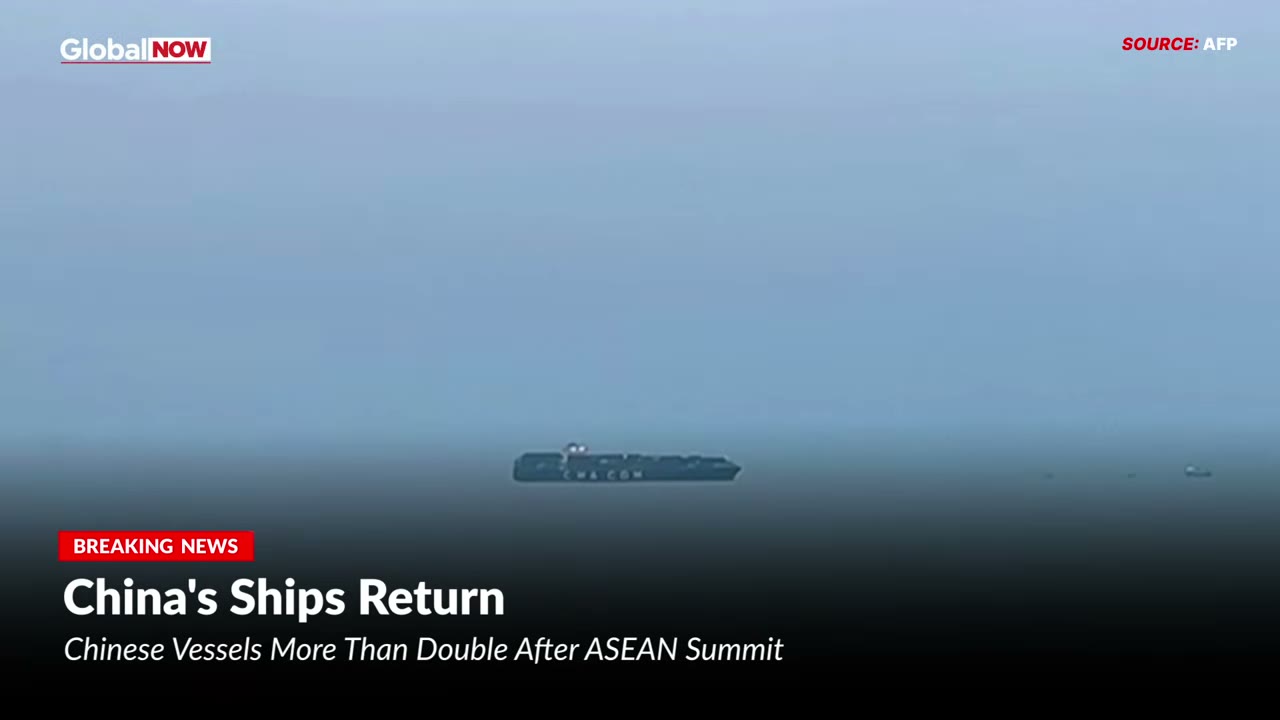
Chinese government vessels in the West Philippine Sea more than doubled to 48 in the week after the Philippines hosted the ASEAN Summit, up from 19 during the summit. The video examines the ship counts, the four flashpoint sites, China's coast guard and navy tactics, and Manila's transparency strategy.
1Chinese Ships in West Philippine Sea More Than Double to 48 After ASEAN Summit
Chinese government ships in the West Philippine Sea more than doubled in the week after the Philippines hosted the ASEAN summit, according to the Philippine Armed Forces. The military detected 48 Chinese Coast Guard and People's Liberation Army Navy vessels from November 17 to 23. A week earlier there were only 19.
Of the 48 ships, 31 belonged to the Chinese Coast Guard. The other 17 were PLA Navy warships. The count covers a stretch of the South China Sea inside the Philippines' exclusive economic zone.
The timing stands out: the number fell during the summit and jumped sharply once it ended. The military has not said why, and the transcript offers no explanation for the shift.
2Philippine Military Data Shows Ship Count Fell During Summit Week, Then Surged
The number of Chinese vessels tracked in the West Philippine Sea dropped to 19 during the week Manila hosted the 49th ASEAN Summit, then jumped to 48 the week after.
The data was released on November 25 by retired Rear Admiral Roy Vincent Trinidad, spokesman for the Philippine Armed Forces in the West Philippine Sea. From November 3 to 8, the military counted 29 Chinese vessels: 20 from the Coast Guard and nine from the Navy. From November 9 to 16, the week of the summit, that fell to 19. From November 17 to 23, it hit 48 — about two and a half times the previous week and 19 more ships than at the start of the month.
Trinidad suggested the temporary decline could be related to the regional meeting in Manila. The numbers cover only three weeks, so it is too early to call this an established pattern.
3Why China Likely Scaled Back Ships During the Manila ASEAN Summit
China had a reason to keep its ship numbers low while world leaders were in Manila. The ASEAN Summit is one of Southeast Asia's most important diplomatic events, and this year the Philippines chaired the bloc and hosted leaders from 10 member states plus partners including the United States, China, Japan and Australia.
For Beijing, the summit was an important stage. China has negotiated with ASEAN for over two decades on a code of conduct in the South China Sea, seeking to be seen as a responsible partner to its southeastern neighbors. A large, aggressive deployment in Philippine waters during the summit would undermine that message — and hand Manila the perfect opportunity to show China's actions to the leaders gathered in its capital.
So the ships left. As soon as the cameras left, they came back.
4Four Flashpoint Sites Where Chinese Ships Concentrate
The Philippine military tracked the Chinese ships around four flashpoints, each a source of tension on its own.
Ayungin Shoal, also called Second Thomas Shoal, is where the Philippines holds a small group of Marines aboard the BRP Sierra Madre, a World War II-era ship intentionally run aground in 1999. China claims the shoal and has repeatedly tried to block supply missions; its coast guard has used water cannons and dangerous maneuvers against Philippine supply vessels there.
Bajo de Masinloc, or Scarborough Shoal, has been under Chinese control of access since the 2012 standoff. It sits about 100 nautical miles west of Luzon, inside the Philippine exclusive economic zone, where Chinese coast guard ships have used water cannons against Philippine government vessels and pushed fishermen from waters their families fished for generations.
Escoda Shoal, or Sabine Shoal, near Palawan, saw a month-long standoff in 2024 when the Philippine Coast Guard kept its largest ship, the BRP Teresa Magbanua, there despite pressure from China. Bonilla said they are watching for signs China may try to start construction there, as it has elsewhere in the Spratly archipelago.
Pag-asa, or Titu, is the Philippines' largest facility in the Spratlys, home to a small civilian community, a military detachment and an airstrip. This year the Philippine Coast Guard opened a new command there. Chinese ships regularly gather in nearby waters.
5China's Coast Guard and Navy: Gray-Zone Tactics and the 12,000-Ton Monster Ship
The China Coast Guard is the largest coast guard in the world, and many of its boats are much larger than Philippine Coast Guard vessels. Its largest ship, CCG 5901, often called the "monster," has a displacement of about 12,000 tons — larger than many Navy destroyers — and has been spotted several times near the Philippines.
The Coast Guard is China's main tool in what analysts call "gray zone" tactics: actions meant to pressure an opponent without crossing into open military conflict. Coast Guard ships can block, harass and use water cannons, while Beijing describes their actions as law enforcement in what it considers its waters. That makes it hard for the Philippines and its allies to respond, since countering the Coast Guard with the Navy could be seen as escalation.
But 17 of the 48 ships were PLA Navy warships. Chinese frigates and destroyers often operate further afield, harassing Philippine vessels and supporting the coast guard from a distance. The military's count does not include the many Chinese maritime police vessels often seen in the area — boats that look like fishing vessels but that Filipino and Western officials say are organized and funded by the state to maintain a presence in disputed waters.
6Chinese H-6 Bomber Flew Within 45 Nautical Miles of Philippine Coast
A Chinese H-6 strategic bomber flew between Scarborough Shoal and Luzon Island the same week, coming within about 45 nautical miles of the Philippine coast at its closest point — about 170 nautical miles from the capital.
The Philippine Armed Forces confirmed the flight and called it a show of force, not a strike rehearsal. The military did not report any significant incidents during the last monitoring period: no clashes, no water cannon attacks. But a steady, growing presence is itself a form of pressure.
Trinidad said the People's Liberation Army was now showing its power and that Chinese patrols were coming closer to the Philippine coast than before. In one week, China increased pressure on the water and in the air at the same time.
7Filipino Fishermen and Japanese Radars Expand Philippine Surveillance
Filipino fishermen and sailors are helping the military fill gaps in surveillance, supplementing what its own ships, planes and radars can see with photos, videos and reports. In such a vast sea, every pair of eyes matters, Trinidad said.
The Philippine military is also getting new eyes of its own. Japan has supplied coastal radar systems to the Philippine Navy, and on November 9 signed a new agreement to provide another system and reconnaissance drones. That partly explains how the Philippines can now count and publish these numbers every week.
Such transparency is a conscious strategy. Under President Ferdinand Marcos Jr., Manila decided to make China's actions as visible as possible, with the Coast Guard and military regularly releasing photos, videos and ship counts to build international support.
8China and Philippines Clash Over Legal Basis for West Philippine Sea Claims
Beijing sharply criticized Manila's approach, accusing it of inflaming tensions and spreading false information. China says the waters belong to China, that its coast guard is conducting legitimate patrols, and that the Philippines is provoking tensions with the support of outside forces.
Manila points to a 2016 international arbitration ruling that found China's sweeping claims in the South China Sea had no legal basis. Beijing rejected that decision then, and still does.
The two sides are working from opposing legal foundations, and neither has moved.
9Four Takeaways: Diplomatic Timing, Flashpoints, Transparency and Code of Conduct
China appears to be adjusting its ship presence to the diplomatic calendar — retreating during important international events and returning as soon as the cameras disappear.
The four sites in the Armed Forces of the Philippines report are the most likely locations for incidents. Ayungin, Escoda and Pag-asa are places where Manila's supply missions, patrols and fishermen encounter Chinese ships week after week.
The Philippines is responding with information. It cannot match China ship for ship — China has the world's largest navy and coast guard — but it can count every ship, publish every number and let the world know.
And time is of the essence for Manila's diplomacy. The Philippines has made progress on the Code of Conduct in the South China Sea, one of the goals of its ASEAN chairmanship. The jump in Chinese ships immediately after the summit is a reminder of the gap between negotiations at the table and behavior at sea.
10Filipino Fishermen Bear the Human Cost of Chinese Harassment
Filipino fishermen near Scarborough Reef face Chinese vessels between them and their catch, and their families on the coasts of Zambales and Pangasinan feel the cost in lost income and added danger. The Philippine Coast Guard and the Bureau of Fisheries and Aquatic Resources regularly run missions there to deliver fuel and food to fishermen working nearby. During those missions, Philippine vessels were repeatedly harassed, blocked, and sometimes fired upon with water cannons by Chinese Coast Guard vessels, according to the report. For the fishermen, every Chinese vessel in the area means another obstacle between them and their catch.
11Philippines to Keep Monitoring as Next Weekly Ship Count Looms
The next weekly count of Chinese vessels will show whether 48 ships was a short-lived spike or the beginning of a new normal. The Philippine military says it will keep monitoring Chinese vessels and reporting their numbers. The Philippine Coast Guard is expected to continue patrolling these facilities, making further collisions with Chinese vessels likely, according to the report. The Armed Forces of the Philippines count is the number to watch.