A captured Russian manual reveals how assault detachments are organized and used to attack Ukrainian trenches and cities. The video traces the concept back to Soviet World War II assault engineer brigades and questions whether the units enable any real breakthrough.
1Ukrainian trench defenses pose daunting obstacle for Russian attackers
Ukrainian trench lines in the Donbas are built to bleed attackers. Even in the best case, casualties are expected, according to a Russian manual on assault operations.
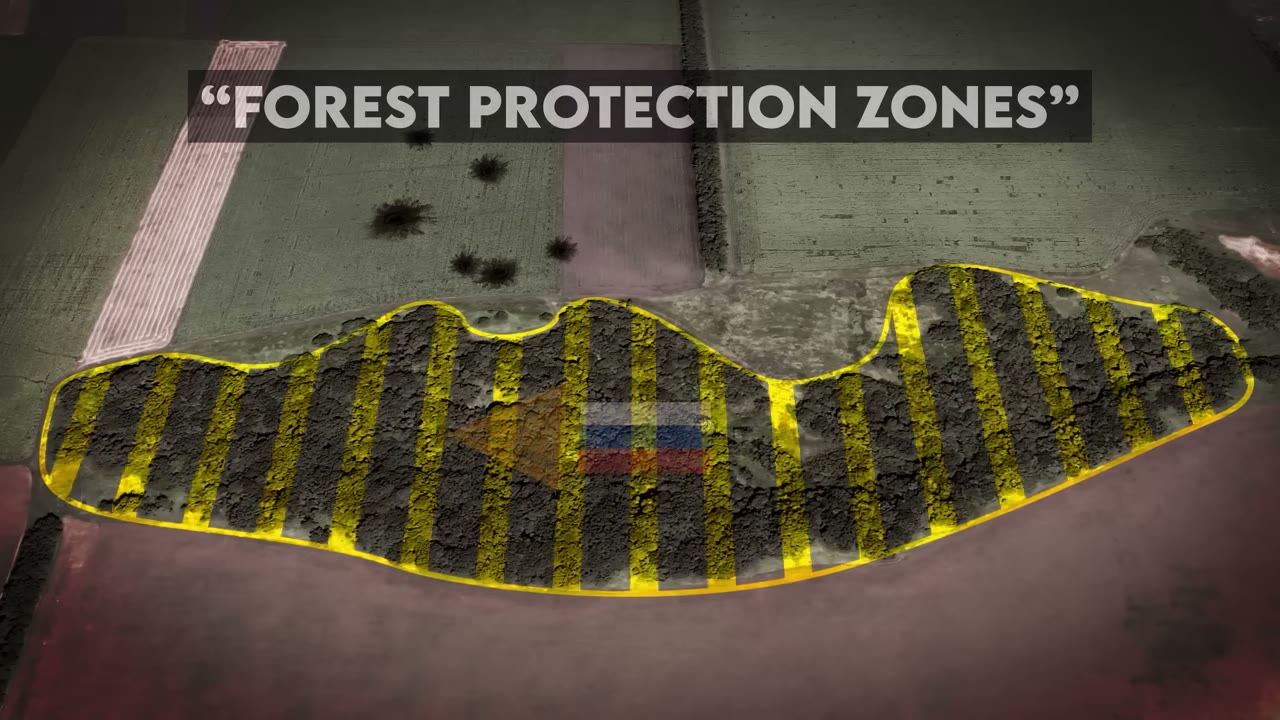
Open fields give defenders clear fields of fire. Russian movements can be observed and hit by artillery. The only cover comes from strips of woodland, called "forest protection zones" by the Russians.
Those woods are heavily defended. They often hold 2 to 3 trench lines, each with at least 2 fortified fighting positions with heavy weapons. Artillery sits 8 to 10 kilometers behind the frontline. Defenders also use tanks, mortars, direct-fire guns and ATGMs on the line of contact.
2Mobilization stabilized Russian lines but left force short on offensive power
Mobilization gave Russia more troops in eastern Ukraine, but not more offensive punch. The withdrawal from Kherson shortened the frontline and helped stabilize Russia's lines.
Attrition and the lower quality of the replacements mean the larger force lacks offensive potential. Russia is in a stronger position to hold ground than in autumn 2022.
Its ability to make gains is limited, according to the assessment.
3Russia formed small specialized assault detachments in late 2022
Russia began forming assault detachments in late 2022 to break through fortified Ukrainian positions. The units are smaller and more specialized than standard formations, built to assault trenches and city blocks ahead of main forces.
They have the trappings of an infantry battalion but are generally very small, with more anti-structure weapons. The speaker assumes they concentrate soldiers actually willing to carry out frontal attacks against a determined enemy.
They are "essentially uni-taskers," not general-purpose like a battalion tactical group. Some are temporary, some semi-permanent. When the concept was brought to attention by Tatarigami, some called it innovative. In reality, it shows some adaptation.
4Video examines assault detachment doctrine, tactics and Soviet origins
Russia's assault detachment doctrine is almost verbatim as old as the Soviet Union itself. The tactics are "old as dirt."
The concept was perhaps most famously embodied by a Soviet soldier in body armor. The doctrine is laid out in a recent Russian manual and other pre-war publications.
The tactics are recommended for assaulting trench lines and field fortifications, and for attacking enemy positions ahead of main forces.
5Assault detachments doctrinally battalions but smaller in Ukraine
In theory, Russian assault detachments are meant to be roughly equivalent to a battalion tactical group. Doctrinally, they are reinforced infantry battalions.
Applied in Ukraine, they are much smaller.
The units are organized to assault fortified positions and city blocks ahead of main forces, enabling a breakthrough.
6Assault detachment includes tanks, drones, thermobaric launchers and artillery
A Russian assault detachment packs a headquarters, two to three assault companies, a tank platoon, a reconnaissance group and a mobile electronic warfare group.
It also includes a flamethrower group with twelve RPO-A thermobaric rocket launchers, a UAV group, and air defense with two 23mm anti-aircraft cannons and three MANPADS.
Artillery in the VDV-centric case means 6 Nona-S self-propelled mortars and 6 D-30 towed howitzers. A fire support platoon brings 2 AGS-17 grenade launchers, Kord heavy machine guns, anti-tank missiles and sniper teams. An engineering assault group, armored recovery vehicle and medical evacuation group round it out.
7Assault companies close with enemy trenches and receive attached support
Assault companies are the units that actually close with enemy trenches, and they are expected to be reinforced. Tanks, reconnaissance, artillery, engineering assets, fire support and ambulances can be attached to companies as needed.
Reserves are maintained to make up for losses or reinforce success.
The missions they are meant for are short in duration, which may explain why they don't see certain support as necessary.
8Assault company organization includes IFVs, mortars and reserve squad
A Russian assault company consists of two assault platoons and an armored group with 4 infantry fighting vehicles and a tank.
It also has an artillery support platoon with 2 mortars and 1 D-30 122mm howitzer, plus an identical fire support platoon.
A medevac section and a reserve squad with at least one machine gun team complete the company.
9Assault platoons use four three-man troikas in diamond formation
Russian assault platoons are essentially squad-sized, built from four three-man teams called Troikas.
When maneuvering, the manual advises the troikas to form a diamond.
The fire support platoon can also be split up for platoon attacks.
10Platoon layout: head patrol, two troikas and rear HQ element
A Russian assault platoon moves behind a Head Patrol: a sapper, a machine gunner and an assistant machine gunner.
Troika 1 on the right has a spotter, an RPG and an assistant RPG. Troika 2 on the left has the senior rifleman, a medic and another sapper.
The HQ to the rear holds the platoon commander, a UAV operator and a radio operator. This likely varies in practice.
11Assault platoons can be reinforced with machine guns and armor
Russian assault platoons can be reinforced depending on mission needs. Examples in the manual include a 3-man machine gun team from the company's reserve squad.
Fire support assets, the armored group, a mortar, a flamethrower squad and medevac can also be added.
The reinforcements scale with the task, according to the manual.
12Officer-led squad-sized platoons reflect weak Russian NCO corps
A Russian assault "platoon" is roughly the equivalent of a U.S. Marine Corps squad, which is led by a sergeant rather than an officer.
One likely explanation: assaulting a well-defended, fortified trench line is a very difficult task. Lacking a well-developed NCO corps, it makes sense that Russia has an officer directly leading 3 fireteams.
The U.S. did similar things during World War II, when officers took direct command of squad-sized patrols.
13Platoon commanders juggle drones, mortars and separated armor support
A Russian assault platoon commander may lead only three fireteams, but he controls far more than that. He also directs his own drone operator, a mortar and various fire support weapons with different capabilities.
An armored group providing fire support might be physically separated from him.
It's a lot of stuff to handle, according to the assessment.
14Manpower shortage limits motivated troops for demanding assault role
Russia's most motivated assault troops have degraded in quality. The VDV, Naval Infantry and Wagner have been relied on as shock troops capable of going on the offensive successfully. But attrition and replacements have taken a toll on their quality. The problem is not overall manpower — mobilized personnel are available. It is the number of men motivated and skilled enough to fill this very demanding role.
15Assault units conduct detailed drone-aided reconnaissance before attack
Assault units scout the battlefield in detail before they attack. Once an objective is set, they conduct detailed reconnaissance aided by organic quadcopters, which reduce the danger of a leader's recon. They look for avenues of approach, enemy positions, structures and terrain features. Concealed ravines that the enemy could use to bring up reserves are of particular note. Ideally, a foot reconnaissance is also conducted the day before the offensive.
16Pre-planned artillery targets set and armor sectors of fire assigned
Artillery targets are picked before the assault begins. They are identified for pre-planned fire both on the frontline and in depth. Sectors of fire are then set for the armored group acting as direct fire support from the treeline. In the cases described, BMDs or BMP infantry fighting vehicles make up the bulk of that fire support.
17Preparatory artillery barrage can last multiple days before assault
A Russian assault opens with an artillery barrage that can last for multiple days. According to Tatarigami, a Ukrainian officer on Twitter who brought attention to this manual, the barrage can last that long. During this period, preferably at night, the assault force moves into position. BMP-2s also appear, replacing their small and fragile airborne BMDs.
18Artillery preparation relies on unobserved fire against planned targets
Artillery preparation lasts until what the manual calls "guaranteed fire defeat of the enemy". That is the calculated amount of shells needed to adequately suppress, neutralize or destroy an enemy unit. But the slide rules are not necessarily reflective of reality. This fire, especially against pre-planned targets in depth, is typically unobserved, uncorrected fire.
19Artillery shifts to second defense line within one minute of attack
Artillery must shift fast once the attack starts. Ideally the assault commander gives the command to move fire from the first to the second line of defenses within 1 minute of the actual attack. Lighter support weapons like AGS-17 and RPGs, as well as armored vehicles, then take over suppressing enemy defenses. The fire is also meant to isolate the objective from enemy reserves being brought up to reinforce.
20Assault troops seize trenches repeatedly until reaching stop position
The attack itself is fairly straightforward, if costly. Assault troops seize trenches with small arms, hand grenades and thermobaric rocket launchers, several times, until they reach their stop position. Once the last line is reached, a pre-planned artillery barrage commences in front of the newly captured trenches.
21Artillery firewall of 60-90 minutes protects troops digging in
A firewall of artillery protects the assault force while it digs in. The barrage in front of newly captured trenches lasts up to 60 to 90 minutes. Assault units are forbidden from occupying the old Ukrainian trenches because they could be booby-trapped and pre-sighted for artillery fire. Instead, 1 to 2 man foxholes dispersed in the treeline are recommended.
22Ammo and water delivered within 30-40 minutes; casualties evacuated
Ammunition and water should reach the assault unit within 30 to 40 minutes of the objective being captured. Casualties are evacuated on the outgoing vehicles. In general the assault unit should not evacuate its own casualties — it should focus on winning the fight and leave casualties to the evacuation units. The manual acknowledges this may seem inhumane, but says the sentiment is shared by western militaries.
23No follow-on exploitation mentioned, suggesting incremental gains only
Nothing in the manual describes what happens after the assault succeeds. The only mention of other units is a reserve introduced at the tipping point to achieve success or replace losses. There is no mention of follow-on actions, a forward passage of lines where a general-purpose force pours through the gap, or deep coordination with outside units. In isolation, it feels more like the unit is intended to make incremental gains, taking one trench system at a time without enabling a more decisive offensive.
24Russian forces often skip breaching steps, going straight to assault
Russian forces are often skipping the steps that make a breach work. The tactics in the manual are not complex, but in practice they fall short of a reasonable breaching doctrine. Theoretically they apply what Americans call SOSRA: suppress the position, obscure with smoke, secure reduction areas to isolate the breach, reduce obstacles if necessary, and assault. Video evidence shows Russian forces at numerous points failing or neglecting basically the first four steps and going straight into the assault, with predictable consequences.
25Training and unit cohesion vary wildly among assault detachments
Training and unit cohesion vary wildly between assault units. There have been successes as well, but high losses are expected with this sort of mission. That variation may explain many instances of bad tactics. The concept itself, though, is not new at all.
26Soviet WWII Assault Engineer Brigades served same breakthrough purpose
Soviet Assault Engineer Brigades of World War II were raised for basically the same purpose. As the Red Army transitioned to the offensive against Germany's echeloned field fortifications, their job was to penetrate the frontline trench system ahead of the main body of infantry and tanks. They also seized strongpoints the main force bypassed to keep up momentum, including fortifications in the enemy's depth and, more famously, cities. Held in the strategic reserve during the war, the brigades had their own assault battalions, and assault detachments could be formed by reinforcing rifle battalions with tanks, engineers and fire support to secure urban objectives.
27Soviet assault groups split into obstacle, fire, smoke and assault subgroups
Soviet assault groups broke the job of taking a position into five separate teams, each with one task. The units, platoon to company size, fielded an obstacle clearance subgroup to open lanes to the objective and a fire support subgroup to suppress enemy forces there and stop outside reserves from counterattacking.
A smoke and flame demolition subgroup laid smoke cover and destroyed buildings with flamethrowers. An assault subgroup did the actual attack, and a consolidation subgroup followed to mop up and repel counterattacks.
Splitting the work this way let each team specialize instead of one unit doing everything.
282010s Russian doctrine nearly identical with capture and support groups
Russian doctrine in the 2010s looked almost the same as the Soviet version, with only minor changes. Assault detachments were still reinforced battalions, and assault groups still split into specialized subgroups.
The capture subgroup was a motor rifle squad or platoon without its vehicles, reinforced by flamethrowers. A control and fire support group brought infantry fighting vehicles, tanks, guns, mortars, grenade launchers, anti-tank weapons and flamethrower units. An obstacle clearance subgroup added engineers.
The structure echoed the earlier model closely, keeping the same basic division of labor.
29Assault detachments lack main body able to exploit success
Russia has applied these assault detachment pieces in Eastern Ukraine, but in a more limited way, without a main body able to exploit any success. The overall conflict is large, yet the individual offensives are very small.
That mismatch has produced a slow, incremental approach, with units like these spearheading the attacks. Gains come piece by piece rather than in a breakthrough.
Without a force ready to push through and expand a breach, each small assault has to stand largely on its own.