Ukrainian drone strikes have knocked out nearly a third of Russia's oil refining capacity, forcing fuel rationing across at least seven regions. The video traces the energy war from the Kirishi refinery attack to the Ust-Luga port strike and the collapsing US-brokered ceasefire.
1Ukrainian Drones Hit Kirishi Refinery, One of Russia's Largest
Ukrainian drones hit one of Russia's biggest oil refineries, sparking a fire at a plant that supplies fuel to St. Petersburg and jet fuel to Pulkovo Airport.
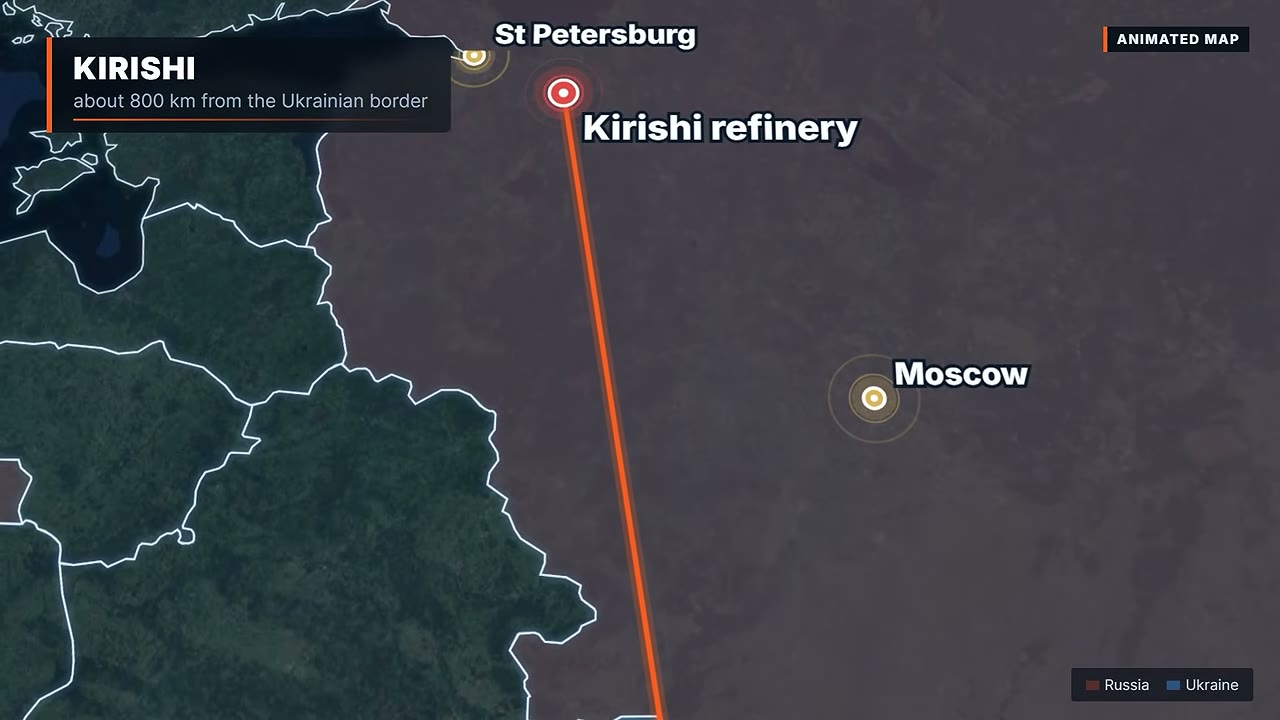
The strike came overnight on November 8th to 9th in Kirishi, a town in the Leningrad region near St. Petersburg, about 800 kilometers from the Ukrainian border. The plant, the Kirishinefteorgsintez refinery owned by Surgutneftegas, can process around 20 million tons of crude a year and accounts for more than 6% of all refined oil in Russia.
Regional governor Alexander Drozdenko first said 81 drones were shot down over his region, then raised the number to 113. He later confirmed drones hit the industrial zone and a fire broke out at the refinery. NASA's satellite system picked up multiple hotspots at the site.
Debris fell on an apartment in Kirishi and one family was evacuated. In nearby Vsevolozhsk, debris struck the roof of a residential building and a woman was killed.
It was the third major strike on the plant in six months. Earlier attacks on May 5th and August 30th had halted crude processing.
2Strikes Cut Russia's Refining Capacity by About 30 Percent
Renewed Ukrainian drone attacks since late October cut Russia's oil refining capacity by about 30%, according to two industry sources cited by Reuters on November 10th.
Russia has a total primary refining capacity of about 930,000 tons per day. At the end of October, it was processing about 700,000 tons of crude per day.
In a single week, nine of Russia's 35 major refineries suffered disruptions or emergencies. Together those nine sites have a capacity of about 300,000 tons per day, or 2.2 million barrels.
According to Reuters sources, the actual drop in crude processing could reach 200,000 tons per day.
The figure landed as a blow to the Kremlin: not a year, not a month, but one week of strikes.
3Wave of Drone Attacks Hits Refineries Across Industrial Russia
Ukraine hit roughly 10% of Russia's refining capacity in just 72 hours at the start of November, by one count, with strikes stretching from the Samara region to Ufa and Ryazan.
On October 30th, the Novokuibyshevsk refinery in the Samara region was hit. Ukrainian defense company Firepoint said its own drones struck it. That same day, Russian deputy prime minister Alexander Novak acknowledged attacks on three refineries and a gas chemical complex.
On October 31st, the Bashneft Novoile refinery in Ufa was hit. On November 5th, the Ryazan refinery operated by Rosneft, which processes around 17 to 18 million tons of crude a year and produces aviation fuel, was struck. Yaroslavl sites in the Volga region were also hit, followed by Kirishi.
The wave came as Russia's refining sector was already reeling.
4Ukrainian Intelligence Claims 15 of 38 Refineries Suspended
Ukraine's military intelligence, the HUR, estimated damage to Russia's refining sector at more than $23.2 billion — approaching an entire year of revenue.
According to the HUR, by the end of September 15 of Russia's 38 major refineries had suspended operations and 12 more had reduced output. Combined production at the affected sites had reportedly dropped 55.4% compared with the start of the year.
For comparison, the sector generated $26.6 billion in revenue in 2025. Replacing destroyed equipment could cost more than $20 billion, and Western sanctions make much of it extremely hard to get.
The figures come from a Ukrainian source with every reason to present things favorably, so they should be treated with caution.
Some refineries are still running — Omsk, Achinsk, Khabarovsk and Venino, mostly in remote regions — and in September they increased output. But they are far from Russia's main consumption centers.
5Putin Signs Decree 686 Restricting Refining Data Publication
Vladimir Putin signed decree number 686 on September 28th restricting the publication of refining data — a detail very few people noticed.
The move came as Russia's refining sector faced mounting pressure, with maintenance work scheduled for 2026 pushed back to 2027, which could drag output down further next year.
Moving fuel also depends on rail tank cars and tanker trucks, and Russia is short on both.
When things are going well, countries publish their numbers. When they start hiding them, it usually means the numbers are bad.
6Fuel Rationing Spreads to at Least Seven Russian Regions
Drivers in at least seven Russian regions can now buy only 30 liters of fuel per customer at city stations, with signs declaring no more fuel sold into canisters.
On November 9th, the same day Kirishi was hit, Rosneft began limiting fuel sales at its gas stations. According to the Economic Development Ministry of Zabaykalsky Krai, drivers can buy 30 liters per customer in cities and 50 liters along highways, with no end date given.
In Krasnoyarsk in Siberia, the limits are 30 liters of AI-95 gasoline, 50 liters of AI-92 and 100 liters of diesel per customer. In Karelia, governor Artur Parfenchikov confirmed on November 8th limits of 30 liters of gasoline in cities, 50 on highways, 50 liters of diesel, and up to 200 liters only for freight trucks.
The restrictions have been confirmed in Zabaykalsky Krai, Arkhangelsk, Buryatia, Karelia, Krasnoyarsk, Novosibirsk and Penza. In Nizhny Novgorod, after a drone attack on a Lukoil refinery, media reported shortages and long lines.
In Zabaykalsky Krai, Rosneft had lifted the limits on October 23rd. They were reinstated about two weeks later.
7Rosneft Faces Financial Strain as Fuel Limits Return
A country sitting on some of the largest oil reserves on the planet is telling its own citizens not to fill up their tanks.
Russia has been imposing gasoline sales restrictions in many regions since June, when Ukraine ramped up its long-range strikes. In July, it banned diesel exports.
According to Bloomberg, Rosneft is facing mounting financial difficulties and believes a few more months of war could do long-term damage to its business.
It is not certain whether the strikes directly pushed Rosneft into its decision to limit sales. But the context speaks for itself.
8Trump Asked Zelensky to Stop Striking Russian Diesel Refineries
Donald Trump told reporters that Volodymyr Zelensky had to stop knocking out diesel fuel in Russia, saying Ukraine could hit plenty of other targets instead.
Trump made the statement on September 13th at his golf club in Doonbeg, Ireland, during the Irish Open. He said the strikes were causing a shortage and hurting the world, and that the problem was not the Middle East but what was happening between Russia and Ukraine.
The context complicates that claim. At that point, according to press reports, the US war against Iran had knocked out more than 20% of Middle Eastern refining capacity and effectively closed the Strait of Hormuz, a route that used to carry roughly a fifth of the world's oil supply. In the United States, the average price of diesel had topped $6 a gallon, an all-time record. Energy analysts said the main driver of the spike was the Hormuz crisis, not Ukrainian drones.
The timing was crucial: US midterm elections were set for November 3rd, and an AP and University of Chicago poll published on October 1st showed 65% of American adults blamed the White House for the high cost of living.
9Trump Deal Allows Russian Diesel Exports to the United States
A tanker carrying about 40,000 tons of Russian diesel set course for the United States on October 22nd, after Trump announced a deal with Vladimir Putin allowing the exports.
Trump announced the deal on October 9th. According to an analysis published a few days later, it called for an initial shipment of 300,000 tons, then 500,000 tons in November, then a million tons after that.
On October 17th, Trump suspended new sanctions and tariffs targeting Russia and the major buyers of its oil.
Even in the US, the move did not go down well. Lawmakers from both major parties said the diesel decision appeared to violate US law.
10Lawmakers and Zelensky Condemn the Russian Diesel Deal
Lawmakers from both major US parties said the decision to allow Russian diesel imports appeared to violate US law, with some Republicans saying it undercut a law Trump himself had signed to tighten restrictions on Moscow.
In Kyiv, Zelensky slammed the move, saying it undid years of Western efforts to isolate Russia's economy and would embolden Putin.
Then on October 11th, Trump announced an energy ceasefire between Russia and Ukraine. Kyiv and its European allies said they were blindsided.
11Energy Ceasefire Announced, Then Collapses Within Weeks
Trump claimed both sides had agreed to stop attacking energy sites because he told them to — then conceded there had been violations on both sides, as Russia struck at least six Ukrainian energy facilities after the truce was announced.
Kyiv and its European allies said they were blindsided by the October 11th announcement. According to Zelensky, the Russian strikes wounded 33 people across Ukraine. Russian Foreign Minister Sergey Lavrov rejected any pause in the fighting and said Zelensky did not deserve a respite.
Zelensky gave his own version of the truce in an interview with ABC News: "Don't attack us, don't kill our children, and we'll stop attacking your diesel." He called it reciprocity or nothing.
On October 15th, in an interview with Newsmax, Trump called Ukraine's renewed strikes on Russian refineries a disgrace and said he found Zelensky more difficult to deal with than Putin. Zelensky's answer in the Financial Times came down to a few words: the block is out, we're done.
At the end of October, the energy ceasefire collapsed completely — exactly when the wave of strikes began that cost Russia nearly a third of its refining capacity.
12Trump Blames Voting Machines After Midterm Election Loss
Democrats won their largest House majority in decades and took back control of the Senate on November 3rd — and less than a week later, Trump blamed the voting machines.
On election night, Trump congratulated them, explaining that he didn't consider it a defeat since he wasn't on the ballot himself. On November 9th, the very day Kirishi was burning, he posted on social media asking whether anybody really believed the election was honest and blamed the voting machines. Conservative commentator Megyn Kelly answered him with two words: just stop.
It capped a sequence: Russian diesel to bring prices down before the election, a truce that never held, an election loss anyway, and a Ukraine that never stopped striking.
13Zelensky Says Putin Approved Wider Winter Infrastructure Attacks
Ukrainian intelligence obtained documents indicating Vladimir Putin had approved a new winter strategy widening attacks on infrastructure — including roads, schools and hospitals — to put pressure on civilians, Zelensky said.
Zelensky revealed the documents in an interview with Reuters in early October. He made clear Ukraine would not respond the way Russia does by targeting civilian sites, but would keep hitting the facilities that finance the war.
He summed up his logic in one sentence: "With their attacks on our energy, we have to respond on their energy."
Russia's attacks have not slowed down.
14Russia Strikes Kyiv Power Plants, Data Center and Substations
All three of Kyiv's combined heat and power plants — the facilities that make both electricity and heat — were hit in a single missile attack on October 14. Six days later, a Russian strike destroyed a large data center in the city, declared beyond repair.
Russia has not slowed its campaign. Overnight from November 10 to 11, for the second night in a row, strikes hit six major power substations across four regions: Vinnytsia, Kirovohrad, Zhytomyr and Cherkasy.
Outages were reported in at least eight regions, including Kyiv, Kharkiv, Odesa and Dnipropetrovsk. In Kryvyi Rih, a district heating facility was hit, cutting heat to residential buildings, and Kyiv temporarily switched off its street lights to save power for essential services.
All of it lands as winter approaches, when demand for electricity and heating explodes.
15Zelensky Vows Response as Russia Rejects De-escalation
Russia has rejected the de-escalation steps Ukraine's partners had discussed, Zelensky said on November 6 after briefing his commanders.
He said Ukraine's power plants, power grids, heating systems, water facilities and civilian logistics were under constant attack by Shahed drones and missiles.
Kyiv had determined its next responses, he added. Five days later, those responses became visible.
16Ukrainian Drones Strike Ust-Luga Baltic Oil Port
Ukrainian drones struck Ust-Luga, a Baltic Sea port in Russia's Leningrad region that handled about 1.15 million barrels per day of oil and oil products in 2025 — roughly 20% of Russia's seaborne oil exports.
Ukraine's General Staff said the November 11 strike damaged five oil product storage tanks with a combined capacity of 150,000 cubic meters, a hydrocracking unit, an air cooling unit, a pumping station and a tanker loading berth.
The SBU said several 30,000-ton tanks at the Novatech terminal were hit and an oil product spill was reported. Governor Drozdenko claimed 150 drones were shot down but admitted several hit the area, causing a fire and injuring three workers.
Ust-Luga is sanctioned by the EU, Canada, the UK, the US and Switzerland, and according to the European Commission it is used by the so-called shadow fleet.
17Ust-Luga Hit Repeatedly as Ukraine Targets Oil Revenue
Loaded tankers leaving Ust-Luga dropped from 16 or 17 a week to just two after spring strikes on the port, according to a Kyiv School of Economics study.
The study, covering March 23 to April 5, put the cost to Russia at about 1.76 billion dollars in export revenue. Crude exports reportedly fell from about 725,000 barrels per day to between 101,000 and 155,000.
The November 11 strike was far from the first. Before mid-August, the port had already been hit at least six times this year, including March 25, March 27, April 7, July 6 and August 14, when 54 drones flew over roughly four hours. On September 1, the Novatech complex caught fire.
Ukraine's General Staff summed up the strategy: every damaged tank, installation or pier reduces oil revenues to the aggressor's budget.
18Drones Reach Omsk, 2,500 Kilometers From Ukraine
Drones were reported over Omsk in Siberia, about 2,500 kilometers from the Ukrainian border, on the same night Ust-Luga was struck.
Omsk is Russia's largest refinery, owned by Gazprom Neft, with a capacity of 22 million tons a year, and it supplies fuel to the military. Residents reported explosions lasting more than two hours. The governor confirmed a drone attack, mobile internet was restricted and the airport temporarily suspended flights.
The reach keeps growing. In 2022, Ukraine's deep-strike range was about 390 miles; in 2026 it is approaching 1,100 miles.
19Putin Decree 604 Lets State Seize Refineries Over Drone Defense
Vladimir Putin signed presidential decree number 604 on August 24, letting the state temporarily take control of private companies whose owners are judged to have failed to protect facilities from drones or been too slow to rebuild after a strike.
It covers energy, fuel, industry, communications and transport, and the state-appointed manager gets almost total control. The Kremlin insists it is not nationalization, and Deputy Prime Minister Denis Manturov said the mechanism would not be used widely.
Speaking at the Eastern Economic Forum in Vladivostok on September 3, Putin said refinery owners previously had no obligation to fund their defense and now those obligations had appeared.
Former Putin speechwriter Abbas Gallyamov read the decree as an ultimatum: "If you don't pay to restore the refineries, we'll take them away from you."
20Russian Firms Rush to Buy Anti-Drone Systems as Economy Weakens
Commercial purchases of anti-drone systems in Russia hit 441.3 million rubles in the first half of 2026 — about six times the same period in 2025.
Lukoil posted a Moscow job opening for a chief specialist in protection against drones, paying over 290,000 rubles a month.
Ukraine's Foreign Intelligence Service, citing Russia's own Ministry of Economic Development, says industrial production is expected to fall 0.2% in 2026, against earlier forecasts of 0.6% growth — the first industrial decline in five years. Metallurgy is down 5.2%, chemicals 3%, elevator production 20% and freight rail car production 30%.
The same source says 65 Russian regions now depend on subsidies from Moscow, with only 24 net contributors to the federal budget. Russia's budget deficit grew 40% in the first half of the year, reaching 2.8% of GDP against a 1.6% target for the whole year, and the Central Bank's key rate stood at 14%.
21Ukrainian Drones Strike Yandex and Russian Data Centers
Yandex's platform was running in emergency mode after Ukrainian drones hit its data centers, disrupting more than 80 cloud services along with the Alice voice assistant and Yandex Music.
Within days in October, strikes hit a facility in Sosovo in the Ryazan region, home to two of the three supercomputers Yandex uses for artificial intelligence; then Kaluga on October 9, one of its largest data centers; then Vladimir on October 11, where operations were completely suspended. About 5,000 residents in the Vladimir region lost power.
A Sberbank data center in Balakovo was hit on October 14 and a VKontakte facility near St. Petersburg on October 18. Russians reported problems paying for goods, ordering taxis and using navigation.
The Sosovo supercomputer once ranked 19th in the world and has dropped out of the top 100. Repairing it requires Nvidia A100 processors Russia cannot legally import. Asked about the strike, Zelensky said Ukraine always responds in a mirror-like fashion.
22Abu Dhabi Talks Open With No Mandate on Energy De-escalation
Three-way talks between Ukraine, the United States and Russia opened in Abu Dhabi on November 10 — the first since February — but Russia's delegation said it had no mandate to discuss de-escalation on energy infrastructure or in the Black Sea.
Zelensky revealed the refusal on November 12. According to him, the Russians said they had no mandate to discuss measures that could ease the horrors of this war, and his delegation's report said Putin is furious and wants to keep the attacks going.
Ukraine's delegation was led by Rustam Umerov; the US side by envoys Steve Witkoff and Jared Kushner. The front line runs about 1,200 km and has barely moved in months, and Russia holds about 20% of Ukrainian territory.
A large prisoner exchange was agreed, and a Witkoff and Kushner visit to Moscow was announced to be followed by a meeting with Zelensky. A day earlier, Trump said at the White House the US was seeing a very strong inclination to end the war and that both sides were tired of fighting.
23Energy War Becomes a Contest of Who Can Hold Out Longer
Russia is hitting Ukraine's substations, power plants and heating systems as winter closes in, hoping to break the population's morale. Ukraine is hitting Russia's refineries, ports and data centers, hoping to drain the Kremlin's war budget.
In the middle, Washington is asking Ukraine to spare Russian diesel while buying that very same diesel.
The real question is no longer who hits harder, but who can hold out longer. If Russia loses nearly a third of its refining capacity, if its oil ports and sea exports collapse, if its gas stations ration fuel and its industry shrinks for the first time in five years, then time may no longer be on the Kremlin's side.
Zelensky put it his own way: "If Putin decides to stop the war, the guns can fall silent." He added that Russia needs to understand the time for war has run out.