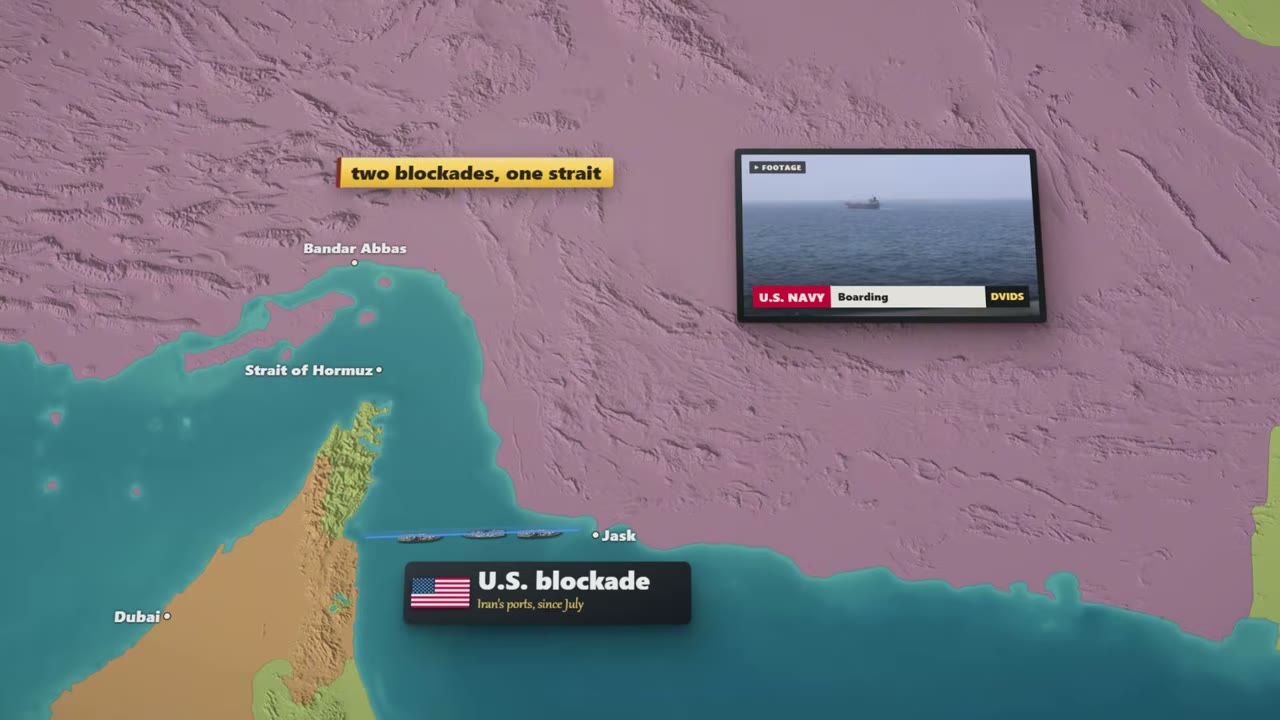
The US Navy has blockaded Iran's ports since July, while Iran's Revolutionary Guards are attacking ships that use Gulf shipping lanes near Oman. Both sides claim success, but tracking data, mine reports and traffic counts contradict key claims from Washington and Tehran.
1US Navy blockades Iranian ports while IRGC controls strait passage
Two rival blockades are squeezing the world's most important oil chokepoint at the same time. Since July, the US Navy has stopped ships from sailing in or out of Iran's ports. Iran's Revolutionary Guards are running their own version, deciding which ships may use the strait at all. Ships in the lanes Iran calls unauthorized keep getting hit. At the White House Turkey pardon, Donald Trump gave his account: "It's a blockade, the greatest naval blockade in history," he said, adding that not one ship from Iran has gotten through.
2300 ships and 6,000 sailors stranded as Hormuz traffic collapses
Around 300 merchant ships and 6,000 sailors are stranded in the Persian Gulf, and only 8 to 15 ships a day are getting through. Before the war, about a fifth of the world's oil and a fifth of its liquefied natural gas passed through the strait. The Pacific Archer had left an Iranian port, made it through the strait, and was stopped on the far side in the Gulf of Oman. The ship lost its propulsion. Nobody on board was hurt. Both governments say they're winning, and both made claims this week that don't survive the tracking data.
3Iran's 14 tankers: convoy rumors, fake AI videos and a called-off sail
A tanker called Kat Shakhan — Persian for "line breaker" — was said to have crossed the blockade on Saturday. The tracking firm Tanker Trackers checked the satellite imagery and found empty water. "This tanker does not even exist," it said. Some of the images were made with artificial intelligence. A gas tanker that appeared on tracking maps the next day turned out to be a fake signal, too. Al Monitor had reported more than 14 Iranian tankers gathered near Kar Island, Iran's main oil terminal, most with tracking signals switched off. Asked on Fox News whether Iran would test the blockade, Trump said: "I hope they do. They'll all be at the bottom of the sea like the rest of the Navy."
4Iranian state media walks back convoy reports as no ships sail
Iranian state media started walking the whole thing back. The state news agency said no convoy was moving. Tasnim, which is close to the Guards, said reports of an operation had no basis in reality. A newspaper in the Emirates reported that Iran's Supreme National Security Council met and called the tankers off. Nobody has confirmed that. As far as anyone can confirm, no convoy has sailed. Iran hasn't dropped the idea: a news site close to that security council told readers to prepare for the coming "zero hour." Outside the strait, the American line was waiting.
5US blockade timeline: February war, April ceasefire, July return
The United States and Israel went to war with Iran on February 28th. In April, after a ceasefire, the US Navy began blockading Iran's ports. It stopped in June when the two sides signed a memorandum — most likely the pause Trump mentioned at the Turkey pardon, when he added: "We learned that you can't trust them." The deal fell apart and on July 14th the blockade came back. It covers every Iranian port and the whole coastline for ships of every flag. Under the law of naval warfare, a blockade must be declared, effective, and applied to all countries alike.
6Three US carriers briefly in region before dropping back to two
Trump told troops on a Thanksgiving call: "We sent an extra aircraft carrier there. We're loaded up." The carrier Theodore Roosevelt did arrive in mid-November, and for a few days there were three in the region. Then the George Washington left, and the count went back to two. The boast is partly true — briefly. The Pacific Archer, a ship flying the flag of Palau, gets the same treatment as an Iranian one under the blockade rules.
7CENTCOM counts 158 ships turned around and six disabled since July
Since the blockade came back in July, Central Command says 158 ships have turned around when ordered and six were disabled for refusing. That's a little more than one ship stopped every day for four and a half months. One trade paper puts the total at 15 or more ships disabled since the war began. The Pacific Archer was the sixth disabled since July: a 25-year-old bulk carrier that had sailed under its current identity only since last year. Central Command says it left Bandar Abbas, Iran's biggest port on the strait, ignored several warnings, and was disabled at the American line in the Gulf of Oman. Trackers listed its destination as Singapore.
8US widens blockade to ship-to-ship transfers and Iraq border crossings
On November 18th, Central Command warned the shipping industry that a ship taking on Iranian cargo from another ship at sea may be considered to be evading the blockade, even if it has never entered an Iranian port. Such ships may be stopped, boarded, diverted, captured, or directed to the Iranian port where the cargo originated, the notice said. Iran has spent years moving oil between tankers at sea to hide its origin; Bloomberg recently reported Iranian crude being moved between two tankers near Kar. The US is pressing Iraq on land, too. Iraq's foreign minister said the US Treasury had asked Baghdad to close all but two border crossings with Iran. "Closing all of them would be difficult and would affect our economy," he said. Those talks are still going.
9Tanker Trackers says no Iranian crude has left by sea since July
The tracking firm Tanker Trackers said last week that Iran hadn't gotten a single cargo of crude out by sea since the middle of July. Crude is what keeps its economy running. But not one ship is harder to defend. The maritime intelligence firm Windward tracked a sanctioned tanker called the Voyager Haven out of the Gulf of Oman this week, heading for Djibouti under a false flag claiming it was from Mali. Windward believes it ran the blockade. That's one small tanker and an apparent breach — not proof that Iranian crude is getting out, but it shows the line has gaps.
10IRGC runs its own northern route and charges ships for passage
Since March, the Revolutionary Guards have run their own route through the Strait of Hormuz, hugging the Iranian coast between the islands of Qeshm and Larak. At its narrowest, the strait is about 21 nautical miles wide; the internationally recognized shipping lanes run along Oman's Musandam Peninsula on the southern side. Gulf governments accused Iran of charging ships for safe passage, and industry experts said some ships were paying in Chinese yuan. An Iranian lawmaker put it plainly at the time: "We provided security and it is natural that ships and oil tankers should pay such fees." Today the Guards call it the traffic control center.
11IRGC claims mines hit multiple tankers on unauthorized routes
On Monday, the Guards said three offending tankers suffered a severe explosion and fire after hitting naval mines, all while under American air cover. On Wednesday, they claimed two more. On Friday, they said a tanker trying to pass covertly north of Ganm Island had hit a mine, and later claimed two more. The Guards held the result up as proof their system works, saying tankers using unauthorized routes had decreased significantly over the past few days. Their statement carried a line aimed at Washington: "US military cover and escort will not replace compliance with maritime regulations and instructions from the IRGC Navy Traffic Control Center."
12Iran navy chief claims recaptured tankers; CENTCOM calls it false
Iran's Navy commander, Admiral Shahram Irani, went further on state television. "Breaking through the enemy blockade is underway and our ports are active today," he said. He also said Iran had taken back two tankers the United States had seized: "The US Navy is a pirate that stole two of our oil tankers, but we recaptured them in the midst of the war." On Saturday, Central Command called that false, said Iran no longer has an effective navy, and noted that the carrier Abraham Lincoln — which Iran claims to have hit with a missile — has finished its mission and gone home. Iran has also said its terms through Qatari mediators, offering to reopen the strait within 48 hours if Washington lifts the blockade.
13Independent monitors find no substantiation for Iran's mine claims
None of Iran's mine claims has been independently confirmed. Iran has been announcing mine strikes since July, often without naming the ships. In August, Central Command said flatly: "No ships have hit mines in the Strait of Hormuz." In October, after Iran said two super tankers had hit mines, the regional maritime information center wrote: "There is no substantiation to these claims." That center, the Joint Maritime Information Center, is run by the US-led naval coalition based in Bahrain. It works alongside the United Kingdom Maritime Trade Operations office, which publishes warnings about incidents reported by ships and other maritime sources.
14Maritime log records 17 tankers hit in the strait since November 1
Seven tankers were attacked in six days in the Strait of Hormuz, all hit by unknown projectiles. Between November 16 and 21, the center counted seven attacks on tankers. On November 20, a tanker heading out was struck about 8 nautical miles north of Casab, the Omani port at the tip of the Musandam Peninsula. The next day, a tanker called the Tqual was hit in the stern about 11 nautical miles north of the town and caught fire. About 50 minutes later, the arena was hit in its engine room about 17 nautical miles east of Casab. On November 22, three more tankers heading out were struck within about 17 minutes of each other. All three kept going and every crew was accounted for. On November 25, UK MTO reported another about 18 nautical miles east of Casab. Shipping reports named it as the Hong Kong flagged Kunpang. In all, the center counts 17 tankers hit in the strait since November 1. In each report, the weapon is listed as an unknown projectile. The center rates the threat as severe and says more attacks are highly likely.
15Attack map shows strikes clustered in the lanes near Oman
The tanker strikes cluster in the lanes near Oman, the exact routes Iran calls unauthorized. The center warns that ships crossing with their tracking switched on can expect a higher risk of being targeted and radio calls telling them to divert to the northern route Iran controls. Some of Iran's mine claims may describe these same strikes with the blame put on the ship for being in the wrong lane. Others may be separate incidents nobody has confirmed. Either way, the message to shipping is the one Iran once sent: stay in Iran's lane or take your chances in Oman's.
16Trump's claim of more oil moving than pre-war fails the data
Trump said more oil is moving through the Strait of Hormuz than before the war, but trackers show traffic far below pre-war levels. In 2025, about 138 ships a day went through the strait by the Joint Maritime Information Center's count. In the four days to November 25, the center counted 128 crossings that the US Navy helped along, about 32 a day. Separately, S&P's tracking data, which only sees ships broadcasting their position, picked up just three other cargo ships in those four days, all tankers heading in. The IMO's estimate, counted differently, is 8 to 15 ships a day. On one day in mid-November, Windward counted nine crossings, every one with its transponder switched off. Some ships have reasons to go dark: tankers carrying Iranian oil may not want the US Navy to find them.
17Gulf crude exports recover to 90% but Hormuz flows stay a third down
Gulf crude exports were back to about 90% of pre-war levels by mid-November, but only about 60% of that oil was crossing Hormuz by tanker, down from about 80% before the war. Run the numbers and crude going through the strait is still about a third below normal. The rest goes around: Saudi Arabia pumps its oil across the desert to the Red Sea, and the Emirates pipe theirs to Fujira, a port outside the strait. Kepler's early figures even put Saudi and Emirati exports above pre-war levels. Kuwait and Qatar don't have pipelines like that, and they're still below. On Tuesday, even with the strait badly disrupted, Brent crude dipped below $89 a barrel, near a three-month low.
18IMO urges crews out of Hormuz as 300 ships remain stuck
About 300 ships are stuck in the Gulf, and some sailors have been trapped there since the war began nine months ago. This week, IMO Secretary General Arcenio Dominguez said the situation in the strait remains dangerous. His organization said shipping must not be used as a pressure card, and he urged ship owners to keep their crews out of the strait. The IMO's figures work out to about 20 people on each of those 300 ships. Outside the strait, the Joint Maritime Information Center counted about 218 more ships waiting at the anchorages of Fuji, Corfakan, Sohar, and Musandam. It expects that backlog to last.
19Drone strike in Kuwait kills two Italian technicians
Two Italian technicians were killed on Thanksgiving Day when drones targeted a military site in Kuwait. Antonio Sako, 65, and Emanuel Loruso, 36, died while servicing an air defense system. Kuwait's army said falling missile debris killed them. Italy's foreign minister said the drones were of Iranian origin. Iran's foreign minister called him to say Iran had nothing to do with it.
20Trump says he may resume strikes on Iran after the new year
Trump told Fox News he is inclined to resume strikes on Iran after the new year if there's no deal. On Thanksgiving night, he told PBS that victory would come whenever I want it to be. On his call with the troops, he said, "We are giving them every chance to make a deal and save a lot of lives, but I am not sure if they are going to take advantage of that."
21Iran warns Gulf oil facilities could explode if tankers are disrupted
A FARS report warned that any disruption to a tanker's voyage would mean explosions at oil facilities in the Emirates, Saudi Arabia, Qatar, Kuwait, Oman, and Bahrain. The warning came when the convoy idea was at its height. An adviser close to the head of Iran's security council wrote that the Supreme Leader wanted an end to the state of neither war nor peace and that the military option is also on the agenda.
22China stays quiet as the third player in the Hormuz standoff
China buys most of Iran's oil when Iran can sell it, but Beijing mostly stays quiet on the strait. In May, the White House said Xi Jinping opposed Iran charging ships to pass through the strait. China's account of the same meeting didn't say so. When Trump met Xi and Vladimir Putin in Shenzhen on November 19, the final statement didn't mention Iran at all. Two days later, Treasury Secretary Scott Bessent said Xi and Putin had both agreed that the strait should be open to free and open navigation.
23One ship or captain could trigger a shooting war in the strait
A single captain who ignores warnings could push one of the two navies into sinking a ship, and there's no taking that back. Iran's terms are still on the table: the strait reopens within 48 hours if the blockade ends and the war stops. Washington hasn't taken them until there's a deal. If nobody tests the line, both chokeholds roll into winter, squeezing Iran's economy and 6,000 sailors who just want to go home. On Friday, Iran said it would neither reopen the strait nor let the blockade stand. On Saturday, Central Command said Iran no longer has an effective navy.