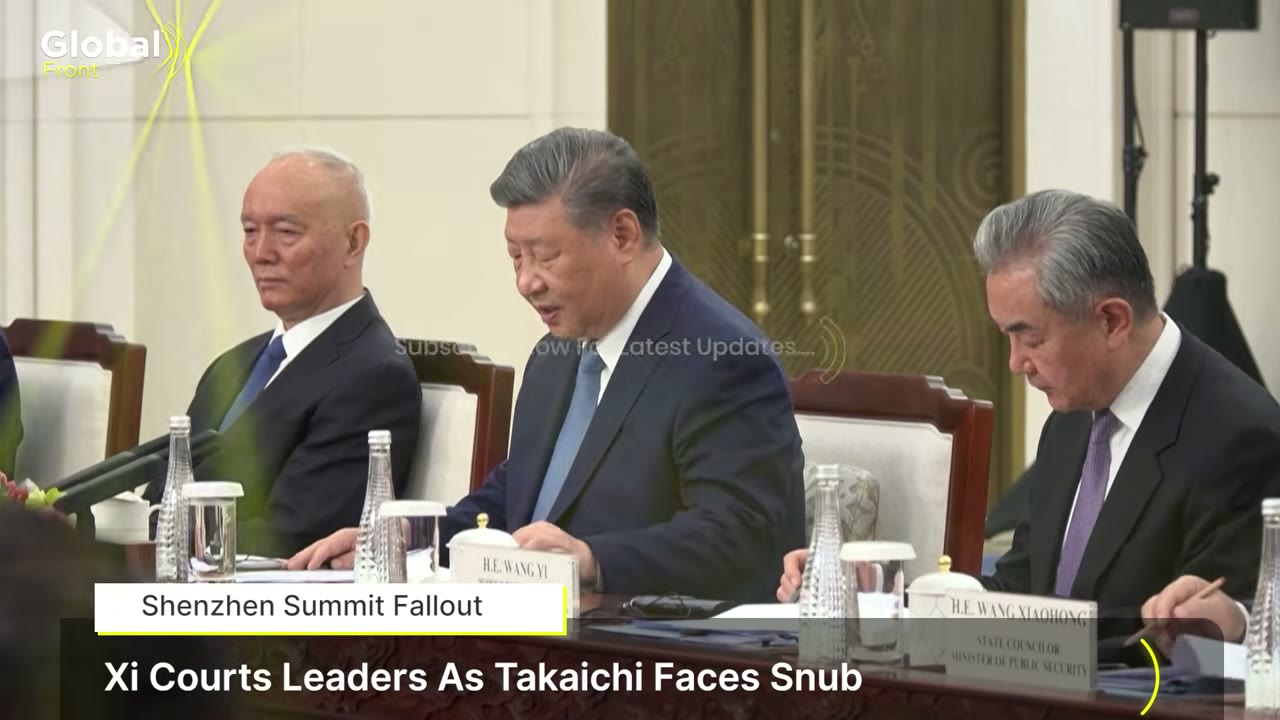
A remarkable week of diplomacy in Shenzhen saw Xi Jinping meet Trump and Putin in an unprecedented trilateral summit, while Japan's PM Sanae Takaichi faced a low-key reception amid a Taiwan dispute. The video also covers China's bilateral deals, South Korea's exam-cheating crackdown and stalled COP31 climate talks.
1Xi Strengthens Regional Ties at APEC Shenzhen Summit
Xi Jinping hosted Donald Trump and Vladimir Putin at the APEC summit in Shenzhen, then kept meeting regional leaders the next day. The summit ended November 19; on November 20 Xi held separate talks with Australia's Anthony Albanese, Indonesia's Prabowo Subianto, Malaysia's Anwar Ibrahim and Singapore's Lawrence Wong. The week left serious questions about global relations as tensions with Japan rose. Japanese Prime Minister Takaichi found herself at the center of a diplomatic scandal that overshadowed much of her visit.
2Xi, Trump and Putin Hold Unprecedented Trilateral Meeting
Xi Jinping, Donald Trump and Vladimir Putin sat down together on November 19 — an unprecedented trilateral meeting. They discussed global stability, energy security and major international disputes. The meeting produced a joint declaration covering UN reform, stable energy supplies, legal protection for government officials and measures to reduce nuclear risks. It was presented as a significant diplomatic moment, though its practical achievements remained limited.
3Trilateral Declaration Falls Short of Concrete Breakthroughs
The joint declaration from Xi, Trump and Putin left out the biggest issues. It did not envisage a new nuclear arms reduction treaty, a settlement of the Ukraine issue, or a breakthrough in the confrontation involving Iran. Instead, it offered broad commitments to support communication and prevent international instability. Trump, despite everything, expressed enthusiasm about the results.
4Trump Rates Summit Talks 12 Out of 10
Donald Trump gave the summit talks a score of 12 on a scale of zero to 10. "On a scale of zero to 10, I think it was a 12," the US president said after the meeting. His assessment reflected the importance he placed on direct interaction with both the Chinese and Russian presidents. Observers questioned whether the discussions would lead to lasting political change.
5Beijing Uses Trilateral Image to Cement Diplomatic Role
For Beijing, holding the meeting was itself a significant diplomatic achievement. The image of Xi sitting next to the American and Russian presidents demonstrated China's ability to unite major powers despite their differences. Analysts saw the gathering as an opportunity for Beijing to present itself as a central player in international diplomacy. Observers had questioned whether the discussions would lead to lasting political change.
6Xi Personally Greets Trump at Airport in Rare Gesture
Xi Jinping personally met Donald Trump at the airport in Shenzhen — an unusually high-profile gesture that attracted considerable attention. The ceremonial arrival featured carefully orchestrated events and warm interactions between the two presidents, creating an atmosphere of cooperation despite long-standing differences on trade, technology and security. The friendly public appearance did not erase the hidden competition between Washington and Beijing.
7US-China Tech and Military Rivalry Persists Behind Warmth
Restrictions on the export of advanced semiconductors stayed in place after the warm public appearances. Concerns about sensitive technologies and competing economic interests remained unresolved between Washington and Beijing. The military relationship also continued to attract attention, as officials sought working-level engagement even despite strategic mistrust.
8APEC Adopts Shenzhen Perspective on Open Trade
APEC adopted the Shenzhen Perspective, emphasizing openness, connectivity, innovation and development. China used the summit to promote a broader economic vision for the Asia-Pacific region. Beijing presented artificial intelligence, digital trade and modern infrastructure as important drivers of future regional growth.
9China Pledges $20 Million and New APEC Research Center
China will provide $20 million to support practical cooperation within APEC, Xi Jinping announced at the summit. "I announce that China will provide 20 million US dollars to support practical cooperation within APEC," he said. China also announced plans to establish an Asia-Pacific Community Research Center in Shenzhen to support research, policy exchange and regional cooperation. The initiatives were designed to show China's APEC leadership can provide more than ceremonial meetings.
10China Demands Takaichi Retract Taiwan Military Comments
Beijing continues to demand that Japanese Prime Minister Takaichi retract comments made in November 2025 suggesting a Chinese military operation against Taiwan could create conditions for a Japanese military response. China considers Taiwan part of its territory and opposes foreign interference in what it describes as its internal affairs. Taiwan is self-governing, and its political future remains one of East Asia's most sensitive security issues. Takaichi insists Japan's long-standing position on Taiwan has not changed.
11Taiwan Dispute Strains Japan-China Relations
The Taiwan dispute has damaged diplomatic relations between Asia's two largest economies. During a visit to Shenzhen, Takaichi reaffirmed Tokyo's position while emphasizing the importance of stable relations with China. The differences also raised concerns about the implications of a possible confrontation in the Taiwan Strait, especially given Japan's proximity to Taiwan and its security alliance with the United States.
12Takaichi Given Low-Key Reception in Shenzhen
Takaichi's airport reception in Shenzhen was noticeably low-key compared to the elaborate receptions for other leaders. She was met by Zhang Qihua, a former Chinese ambassador, rather than a high-ranking current official. Footage showed an unusually large gap between the plane's door and the mobile stairs, prompting criticism from Japanese politicians who raised safety concerns. Some observers interpreted the exception as a deliberate diplomatic signal from Beijing, but no evidence was found that the stairs' placement was deliberately planned to create inconvenience. Takaichi exchanged greetings and shook hands with Xi during the summit; their interactions provided limited opportunity for contact, and no formal bilateral meeting took place.
13Xi and Albanese Focus on Trade and Stability
Xi Jinping's talks with Australian Prime Minister Anthony Albanese focused on improving economic cooperation and maintaining stability in bilateral relations. China remains Australia's key trading partner, particularly in exports of raw materials and agricultural goods. Relations have seen serious disagreements in recent years, but both governments have worked to restore high-level communication and improve commercial ties. "We share a common interest in open, rules-based trade," Albanese said, stressing the importance of upholding the envisaged economic arrangements. He also pointed to the availability of Australian goods in Chinese stores as evidence of the practical benefits of closer cooperation.
14Xi and Prabowo Discuss Investment and South China Sea
Indonesia's president came to Xi Jinping's table with two goals that pull in opposite directions: Chinese investment money and protected maritime rights. Prabowo Subianto met Xi to discuss investment, economic development and maritime cooperation, including issues related to the South China Sea.
Indonesia wants to expand infrastructure and industrial development, but also says it will protect its national maritime interests. Cooperation with China offers economic opportunities, while maritime territories require careful diplomatic resolution.
For Canberra, the same balancing act is on display: Australia keeps security ties with Washington while treating stronger commercial ties with Beijing as an economic priority.
15Anwar Ibrahim Courts Chinese Investment in High-Tech
Malaysia's prime minister used his meeting with Xi Jinping to push for Chinese money in high-tech factories, not just more trade. Anwar Ibrahim encouraged investment, expanded trade and stronger bilateral cooperation.
Malaysia is trying to attract investment in high-tech manufacturing and other high-value-added industries as regional economies compete for new industrial opportunities.
The pitch comes as maritime territory issues in the region require careful diplomatic resolution — a reminder that economic courtship and sea disputes are running on parallel tracks.
16Singapore and China Agree to Renew Free Trade Agreement
Singapore and China will start negotiating to renew their free trade agreement, with digital economy and government procurement on the table. Prime Minister Lawrence Wong met Xi Jinping on November 20, and the two leaders agreed to deepen cooperation in trade, artificial intelligence, innovation and emerging technologies.
Wong said: "We enjoy a long-standing friendship and close partnership, and the relationship has deepened, even as the international environment has become more challenging."
The proposed changes reflect the growing importance of technology in bilateral trade.
17China-Singapore Trade Upgrade Targets Digital Economy
The China-Singapore free trade agreement has been in force since 2009 and has already gone through several rounds of improvement. The latest proposed update aims to make it easier to do business, encourage investment and create new opportunities for companies in both markets.
The changes include cooperation in the digital economy and government procurement, reflecting how technology is reshaping bilateral trade.
Singapore and China are also backing cooperation through major government projects in Tianjin, Suzhou and Chongqing — partnerships that stretch beyond traditional trade into urban planning, logistics, industrial development and technological innovation.
18Singapore Ties China Ahead of ASEAN Chairmanship
Singapore is tightening its China ties just as it prepares to chair ASEAN in 2027. Prime Minister Lawrence Wong emphasized regional integration, stronger supply chains and energy cooperation as priorities for the coming year.
The relationship has moved beyond traditional trade into urban planning, logistics, industrial development and technological innovation, supported by government-backed projects in Tianjin, Suzhou and Chongqing.
For Singapore, strengthening ties with China is particularly important ahead of the ASEAN role — even as positive diplomatic rhetoric around the region's forums has not quieted concerns about their long-term effectiveness.
19APEC Commitments Are Voluntary and Non-Binding
Many commitments made within APEC are voluntary and not binding — a fact that has not allayed concerns about the forum's long-term effectiveness. Governments can agree on common goals while keeping national policies that sometimes conflict with those goals.
The gap between signed pledges and enforced action is the core doubt hanging over the forum.
Business representatives who attended the APEC CEO Summit also weighed in, stressing the importance of anticipated regulation and arguing that technological innovation, including artificial intelligence, requires international cooperation, clear rules and an environment that encourages investment.
20Business Leaders Call for Clear AI Rules
Business leaders at the APEC CEO Summit argued that artificial intelligence needs international cooperation, clear rules and an environment that encourages investment. Their call came as governments struggle to balance national security with economic competitiveness.
The debate is becoming more relevant as AI spreads across economies and regulators try to keep pace.
The business push for predictable regulation lands in the middle of that tension — security concerns on one side, the race for economic advantage on the other.
21South Korea Reports 111 Exam Device Violations
Hidden mobile phones beeped during South Korea's national university entrance exam — and that is how 54 of 111 device violations were caught. Authorities reported the 111 cases involving devices during the exam on November 19.
The annual College Academic Aptitude Test is one of the country's most important exams. Its results can significantly affect university admissions, career opportunities and the expectations placed on young people.
President Lee Jae-moon has called for a radical overhaul of the national examination system amid widespread concerns about artificial intelligence and hidden electronic devices during important tests.
22South Korean President Calls for Exam System Overhaul
South Korea's president says the national examination system should be completely overhauled from A to Z to reflect a changing environment. The government has discussed tougher penalties and enhanced security to stop modern technology from undermining exam integrity.
Proposed consequences for serious cheating include long-term restrictions on taking future exams and possible criminal punishment.
But detecting unauthorized devices is only part of the problem. Educators are considering expanding written assignments or essays that require candidates to explain their own reasoning, arguing this better assesses true understanding than simply choosing the right answer.
23COP31 Talks Run Overtime Over Fossil Fuel Wording
Talks at the UN climate summit COP31 in Antalya, Turkey ran past their scheduled time on November 20 after countries failed to overcome serious differences on fossil fuels, climate finance and clean energy development.
One of the most controversial issues was the removal of direct references to fossil fuels from the draft agreement.
Environmental activists and governments demanding stronger climate commitments argue that significant progress will not be possible without abandoning the continued use of coal, oil and natural gas.
24Climate Finance Gap Blocks Developing Country Targets
Developing countries say they cannot meet ambitious international climate targets without more money, affordable technology and help building infrastructure. Financial support has become another major obstacle at COP31 in Antalya.
Many governments support cleaner energy systems but say the funding gap blocks them from committing to ambitious targets.
The dispute sits alongside the fight over fossil fuel wording, which kept talks running past schedule on November 20. China has an ambiguous position in this debate.
25China's Ambiguous Role as Top Emitter and Clean Tech Producer
China is the world's largest annual emitter of carbon dioxide — and at the same time a major producer of solar panels, electric vehicles and batteries. That dual role gives it an ambiguous position in the COP31 debate.
Beijing's support for electrification and renewable energy has expanded its influence in global energy markets.
In negotiations, Chinese representatives typically highlight the concerns of developing countries when discussing new international commitments — a stance that shapes how the finance and fossil fuel fights play out.
26Japan Faces Scrutiny Over Fossil Fuel Dependence
Japan is facing questions at COP31 over its dependence on fossil fuels, particularly liquefied natural gas and coal. Tokyo has promoted climate change adaptation, early warning systems and regional disaster preparedness.
Environmental activists argue those initiatives cannot replace a sustainable energy transition.
The scrutiny puts Japan alongside the broader fight over fossil fuel wording that kept talks in Antalya running past schedule on November 20.