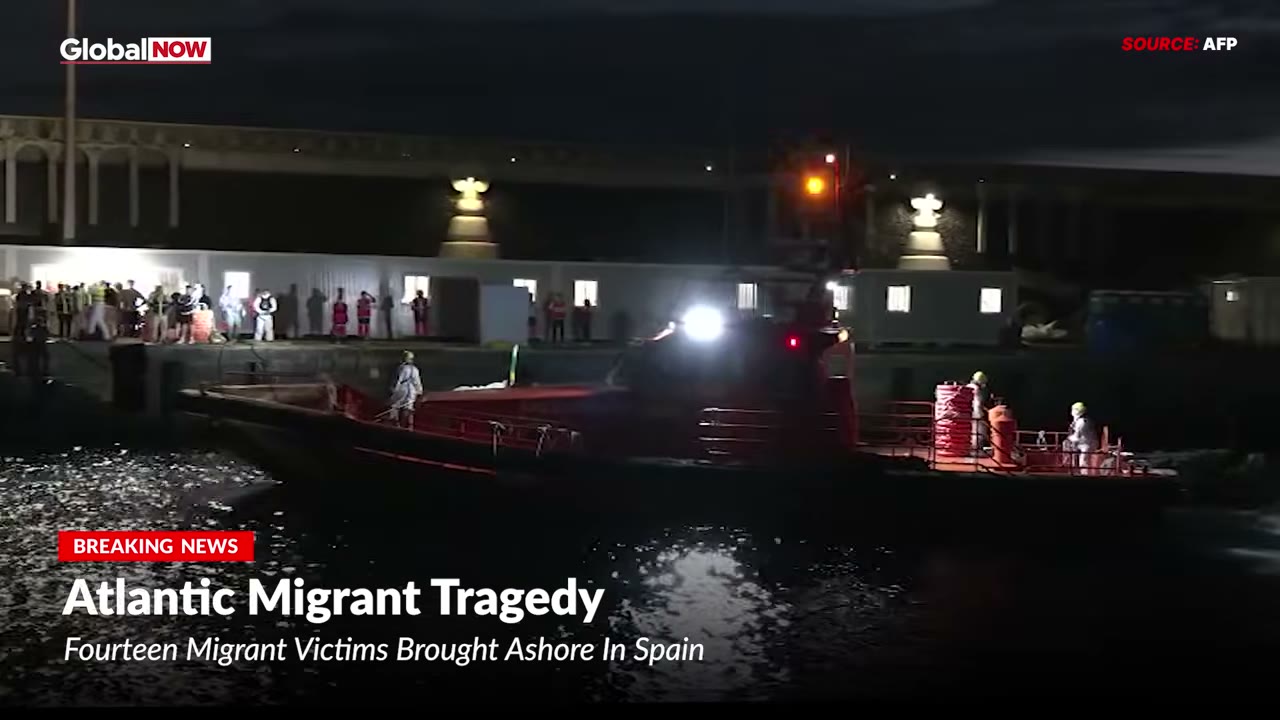
Rescuers brought 14 bodies ashore after a boat from Gambia was found drifting near El Hierro in the Canary Islands. The tragedy comes as sea arrivals surge, prompting a level two emergency and extra Spanish military medical support.
1Rescuers bring 14 dead migrants ashore on El Hierro
Rescue crews brought 14 bodies ashore on El Hierro, the deadliest scene in an emergency that keeps pulling Spain's Canary Islands into the Atlantic's migrant route.
The migrants died trying to cross the Atlantic Ocean to reach European territory. Spanish authorities are working under constant pressure to rescue people arriving in overcrowded boats.
El Hierro has become the epicenter of what the transcript calls an increasingly serious humanitarian emergency. The route connects West Africa to Europe, and the deaths have renewed global concern about how dangerous it is.
Fourteen families will not get the news they hoped for. The rescues themselves continue.
2Boat found drifting 72 km from El Hierro with exhausted passengers
A boat carrying migrants was found drifting about 72 km from El Hierro, its passengers severely exhausted and dehydrated.
Maritime rescue authorities responded to a report of the drifting boat on Friday, November 27. Rescuers found numerous passengers suffering from severe exhaustion, dehydration and other serious health problems.
Not everyone survived the journey. The ship was taken to the port of La Restinga, where rescuers carried out a complex operation to recover the bodies of the deceased.
Medics and other emergency teams were waiting on shore.
3Six survivors evacuated by helicopter as officer injured in rescue
Six passengers in serious condition were airlifted by helicopter for emergency medical care during the El Hierro rescue.
Medics, marine rescue officers and security forces were mobilized for the emergency. Other survivors were taken to the island, where medical professionals assessed their condition and provided emergency care.
Several Spanish maritime rescue vessels, helicopters and Civil Guard personnel took part. A Civil Guard officer was injured during the operation and needed medical evacuation.
For the survivors, reaching European territory ended an extremely difficult journey. It also revealed a devastating reality: many who traveled with them would never reach their destination.
4Survivors say boat left Gambia's capital about 10 days earlier
Survivors say the boat left Banjul, the capital of Gambia, about 10 days before it was found off El Hierro.
Ten days at sea exposes passengers to unpredictable weather, shortages of drinking water and food, and prolonged exposure to harsh ocean conditions. Even simple mechanical malfunctions can turn life-threatening far from land.
With no immediate access to professional medical care or reliable communications, passengers depend entirely on outside help.
The survivors' physical condition showed how serious the emergency was. Some needed help getting off the lifeboats; others needed more serious medical attention.
The tragedy comes amid a significant increase in sea arrivals to the Canary Islands.
5Surge in sea arrivals strains tiny El Hierro's services
Thousands of people reached the Canary Islands in November, pushing a small island's hospitals and shelters to their limits.
El Hierro, the westernmost island of the Spanish archipelago, has become the main arrival point for migrants from ECOWAS countries in West Africa. Its permanent population is relatively small and its healthcare infrastructure limited.
A sudden increase in arrivals can strain emergency services, accommodation facilities and medical staff. Rescue teams have responded to several vessels approaching the island in recent days.
Regional authorities have requested additional resources. The scale of the situation has raised questions about whether reception facilities can cope without reducing the quality of assistance to migrants and local residents.
On November 25, the Canary Islands government acted.
6Canary Islands declares level two emergency on El Hierro
The Canary Islands government declared a level two emergency on El Hierro on November 25, covering health, social assistance and public safety.
The declaration created a framework to mobilize additional resources and coordinate the actions of various government agencies.
The regional administration says the island needs permanent assistance, not temporary measures that may prove insufficient as sea arrivals increase.
Clavijo, the president of the Canary Islands, has repeatedly voiced concern about the growing strain on local infrastructure. After the latest maritime tragedy, he asked what else needs to happen before the island receives the support it needs.
7Clavijo demands more aid and European involvement
Canary Islands president Fernando Clavijo has renewed his call for European bodies, particularly Frontex, to get more involved.
Speaking separately to reporters, Clavijo said his remarks, in Spanish, reflected frustration with the prolonged state of emergency and the regional government's previous requests for additional aid.
His administration claims the migration situation cannot be effectively resolved by the Canary Islands alone. It requires cooperation between Spanish authorities, European institutions and countries along the migration route.
The demand follows the latest tragedy at sea and the level two emergency declared on El Hierro.
8Spanish military sets up field hospital near San Andrés
Spain's military emergency unit has set up a field hospital near the migrant reception point in San Andrés to relieve pressure on El Hierro's main hospital.
The Spanish government mobilized additional emergency personnel to strengthen medical operations on the island. The field hospital lets medics provide assistance without overloading existing hospital infrastructure.
The extra capacity matters when several vessels arrive in a short period. Many migrants reach the island without needing hospitalization, but others arrive with serious complications requiring immediate intervention — dehydration, hypothermia, exhaustion and other conditions linked to prolonged exposure at sea.
Authorities must also arrange accommodation, registration, translation services and other humanitarian assistance. For those who endured a traumatic journey, psychological support can be equally important.
9Psychological support activated for survivors and rescuers
The Spanish Maritime Rescue Service has activated specialized psychological assistance for personnel affected by the latest incident.
Rescuers themselves can face significant psychological pressure after particularly difficult operations. The service stepped in after this one.
The tragedy highlights the responsibility borne by people working on this migration route. Every maritime emergency requires coordination between rescue vessels, medical professionals, security agencies and the authorities who receive survivors on land.
The task becomes even harder when several vessels need help at the same time.
10Atlantic route among the deadliest, with 168 dead or missing
The International Organization for Migration recorded 168 people dead or missing on the Atlantic route to the Canary Islands in the first half of 2026 alone.
The route has long been recognized as one of the most dangerous sea routes to Europe. Unlike shorter crossings elsewhere, trips to the Canary Islands can mean extended periods on the high seas, where changeable weather and strong ocean currents create significant uncertainty.
The figures demonstrate the humanitarian risks tied to these crossings. The task for rescuers grows even harder when several vessels need assistance at the same time.
11Migrants' varied motives complicate government response
Some of the people who died on this Atlantic route were chasing work. Others were fleeing danger, instability or hard living conditions — and the full toll of the tragedy may never be known, because ships can vanish unnoticed.
Every passenger's circumstances are different, and individual motivations cannot be determined solely by the route they have chosen.
For governments, that mix of motives complicates the response: they must balance border management, international protection obligations, humanitarian responsibilities and the practical limits of local infrastructure.
12Tragedy lands amid Spain's election campaign
Spain will hold general elections on November 29, 2026 — and the latest migrant tragedy has landed in the middle of the campaign.
Prime Minister Pedro Sanchez announced the date. Immigration has become an important campaign issue, with parties debating how Spain should manage arrivals by sea and cooperate with European institutions.
The events in El Hierro have brought new attention to the practical implications of those discussions, especially for communities directly involved in receiving migrants.