Ukraine hit six Russian refineries in about a week, knocking out roughly a fifth of refining capacity and forcing fuel away from the front. Crimea faces blackouts, recruitment bonuses are collapsing, and a pro-war blogger was arrested for counting buses.
1Ukraine knocks out six Russian refineries in about a week
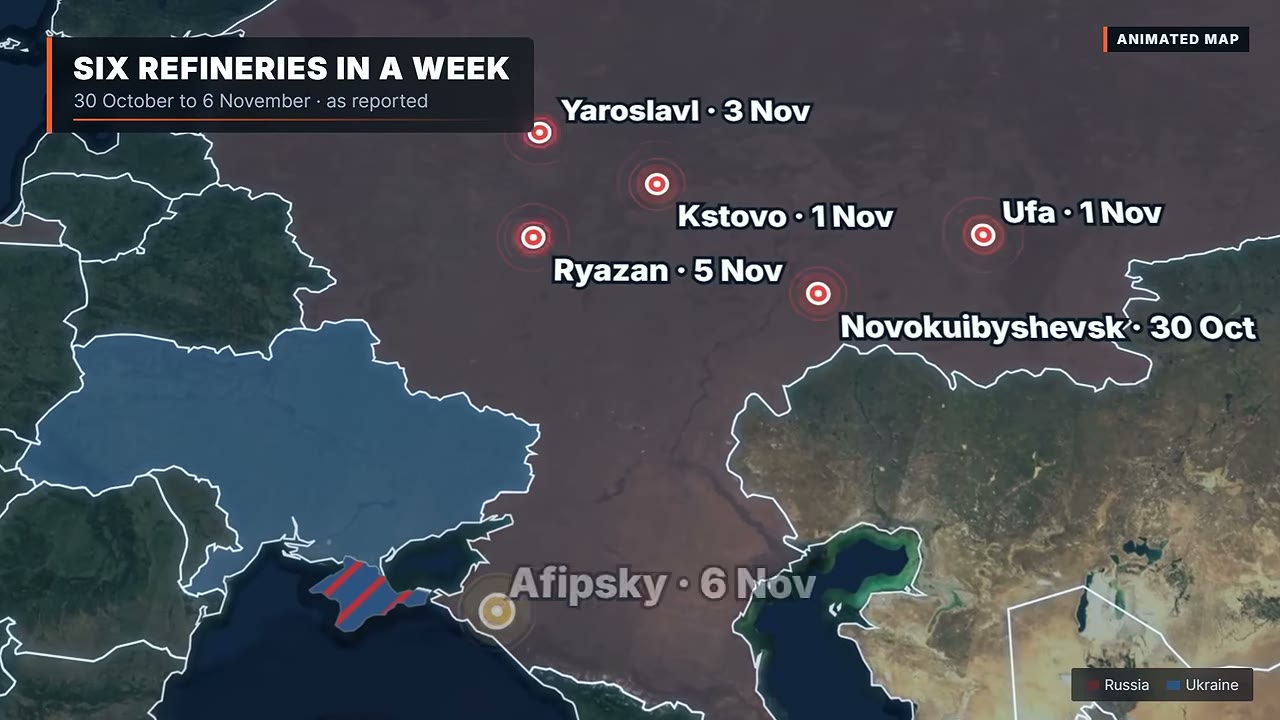
Six Russian refineries were hit in roughly eight days, and the strikes kept coming through the first week of November. On October 30th, Ukraine struck the Novokuybyshevsk refinery. Two more went down on November 1st — the Ufa and Kstovo plants. Yaroslavl was hit on November 3rd, Ryazan on the 5th. Then, on November 6th, reports said a drone attack had hit the Afipsky refinery in the Krasnodar region, one of the biggest refining facilities in southern Russia, able to process 6 million tons of crude a year. It makes diesel — the fuel Russia's military needs for its trucks, armor and supply chain — along with gasoline and fuel oil. That is six refineries in about a week.
2Strikes hit about 1.6 million barrels per day of Russian refining capacity
Together, the plants hit in that week have a daily capacity of around 1.6 million barrels of oil — roughly one fifth of everything Russia can refine. Not all of that capacity is necessarily dead: some facilities were probably only partly damaged. But several burned for days, and the damage is suspected to run deep in at least some cases. Russia has been here before. This past summer, according to Ukrainian officials, about 15 of Russia's 38 major refineries were fully shut down by attacks and another 12 ran at reduced output, erasing almost all the oil income Moscow had counted on for 2025. Russia poured money, time and manpower into repairs; two months ago, about 15% of capacity was offline, a figure that had improved a little. Now the cycle has restarted.
3Fuel diverted from Donbas offensive to Moscow and St. Petersburg
Fuel meant for Russia's offensive in the Donbas has been pulled back to Moscow, according to Bill Browder, a longtime critic of Putin. Browder said General Gerasimov apparently had to redirect that fuel to the capital — a sign the shortage is already forcing Russia to slow attacks it had planned. "If Ukraine has already hit half of Russia's refineries," Browder said, it is quite likely it could eventually disable all of them. The fuel is being pointed at Moscow and St. Petersburg, where the elite live; Putin will make sure the people who matter to him don't feel the consequences. If you live anywhere else in Russia, it is a very different story — and one place is suffering more than any other.
4Crimea suffers blackouts and cold as fuel and power prioritized elsewhere
Crimea, the so-called crown jewel of Putin's ambitions, is struggling badly: Ukraine keeps striking power plants there, and when fuel supplies get stretched, the peninsula is no longer first in line the way Moscow is. Residents have started to speak up. One person wrote on November 4th that the street lights were off and the blackout continued outside. Another said there had been no electricity and no internet since the night before, and that anyone who bought a power station got a bit lucky. Another said their apartment was getting cold because there was no heating either. One local said Crimea had been without power for barely two days when neighborhood chats began breaking down — people insulting and trashing each other. "We should support each other instead of tearing each other down," the person wrote. Two days was all it took for neighbors to turn on neighbors.
5War blogger Vladimir Romanov arrested after reporting bus counts
Vladimir Romanov, one of Russia's most popular war bloggers, was arrested after reporting a single number. He runs a Telegram channel with around 150,000 subscribers, backs the invasion fully, visits the front and criticizes decisions only from the standpoint of wanting Russia to win. Last week, journalists were taken into the besieged Ukrainian town of Oleshky under a ceasefire arranged through the White House, the First Lady and with the Pope involved; civilians had not been resupplied since May. When the ceasefire began, civilians could leave for Ukraine or for Russia. Romanov counted the buses: 17 headed to Ukraine, only four to Russia. He deleted the post, but reporters from around the world, including the United States, reported the same conclusion — the exact counts varied, some said 13 or 14 buses, but the vast majority went to Ukraine. According to Russian Telegram channels and other media, he was detained in Sevastopol in occupied Crimea and can face up to 15 years in prison.
6Russia criminalizes VPNs, disappearing messages and war criticism
Under a new Russian law, publishing unapproved material on the Russian internet is now a serious crime. Organizing a protest, discussing the war in a way the government dislikes, or criticizing the army or Putin's decisions could bring up to six years in prison over a single comment. A law passed about two weeks ago says that if police or anyone working for the state stops you, checks your phone and finds a VPN or a messaging app with disappearing messages, that alone could get you arrested. It is not clear how much jail time that carries, but it is enough to take you off the street. The crackdown traces back to February 2022, when Putin launched what he promised would be a three-day special military operation; by March, Russia had made it illegal to discredit the army.
7St. Petersburg slashes soldier signing bonus from $43,000 to $5,000
St. Petersburg has slashed the signing bonus for new soldiers by almost ninefold, and it is the second cut in just two weeks. Before the cuts, a person who signed up in the city received 3.5 million rubles, around $43,000. The payment then dropped to 1 million rubles, and then again to 400,000 — about $5,000. In two weeks, the bonus fell from $43,000 to $5,000. Russia built its supply of fresh troops largely by buying them, and the cuts come because of budget cuts. There are two ways to read the move: Russia is struggling financially and cannot pay big amounts, or Russia is getting plenty of volunteers and does not need to pay as much.
8Russian regions cut death payments to soldiers' families
Some Russian families now receive roughly $600 when a son dies at the front. According to Russian war bloggers, regional authorities are sharply reducing death payments, and some regions have canceled them entirely, citing a difficult financial situation. Federal payments — the presidential insurance for a soldier killed in action — remain unchanged; only the regional ones are being cut. Every region has a recruit quota and fills it its own way, usually with money, plus extras like a death payment, college for the kids or compensation for wounds — promises made when someone signs the contract. In one region, the death payment dropped from 1 million rubles to 500,000 and then to just 50,000. In Saratov, it fell from 1 million to 100,000. In another region, from 3 million to 1 million. It comes right after October, when Russia suffered a record casualty month: 54,500 in 30 days.
9Russian press starts calling the war a war as Shoigu casts Russia as victim
The word "war" is being used more and more in the Russian press, not just "special military operation," according to Steve Rosenberg of the BBC. Rosenberg quoted a military expert predicting coming strikes will include energy infrastructure, at least in regions near the front — and the question that comes back is, what did you expect? There is a war on. He also played comments from Sergey Shoigu, secretary of Russia's Security Council, who tried to cast Russia as the victim and the West as the aggressor. Shoigu said there have been repeated attempts to seize Russian land and enslave its people, and that the closer Russia gets to victory, the more aggressive those attempts become; the West, he said, always needs an enemy. Rosenberg's reply: this is being said more than four years and eight months after Russia launched a massive invasion of Ukraine. It was not Europe that invaded Russia.
10NATO defense plan includes deep strikes inside Russia
NATO's new defense plan would strike targets hundreds of miles inside Russia if Moscow starts a war. The Wall Street Journal reported the plan, which builds on a Warsaw speech by NATO's Supreme Allied Commander, General Alexis Grinkevich, who laid out what he called his theory of victory.
NATO says it has no plans to launch an aggressive war. The plan is a response if Russia does — and it is very different from two years ago. Until now, NATO's approach centered on denial: stop an invasion by hitting soldiers as they cross the border.
Now denial means going after military bases, supply depots, command posts and even industrial facilities far behind the front lines. The logic, NATO argues, is that this is the infrastructure that would carry a Russian invasion, so hitting it is justified.
The general said the alliance will take apart the war fighting system used against it by striking both the advancing forces and everything that supports, supplies or controls them. A Polish general said on the record that defense also means striking back, and that in a war with Russia NATO would certainly want to hit its defense industry.
The plan blends high-end missiles with cheaper weapons: Tomahawk cruise missiles, ATACMS — the American missiles Ukraine has already used — and Storm Shadow and Scalp missiles. Nearly every NATO country, including the United States, is investing heavily in cheaper alternatives to those expensive missiles.
There is no stated limit on how deep. Even a target hundreds of miles behind the front is on the list if it supports the war.
11Historian's deterrence logic explains why NATO went public
Deterrence only works if the other side knows exactly what you have and that you are willing to use it. That argument, drawn from historian Victor Davis Hanson's reading of World War II, helps explain why NATO made its plan public.
Hanson's argument is that WWII might never have happened if Germany had understood how strong the Western countries really were and how much political will they had. France and Britain together had capabilities that may have exceeded Germany's, and the United States was a sleeping giant, not flexing. Hitler read that as weakness.
Hanson did not make this argument about the NATO announcement; the logic is being applied to it. If it holds, it is a good thing that Russia knows precisely how hard NATO is prepared to hit back.
There are echoes. Germany was economically weaker than the West, and Russia is economically weaker too — though maybe not as weak as some claim, because a ruble buys more in Russia than the same amount would here. Russia spends something like 30 to 40% of its government budget on the military, more than any country except Ukraine.
Russia is stronger than many people realize, but still weaker than NATO as a whole. That only matters if Russia believes NATO has the will to use what it has.