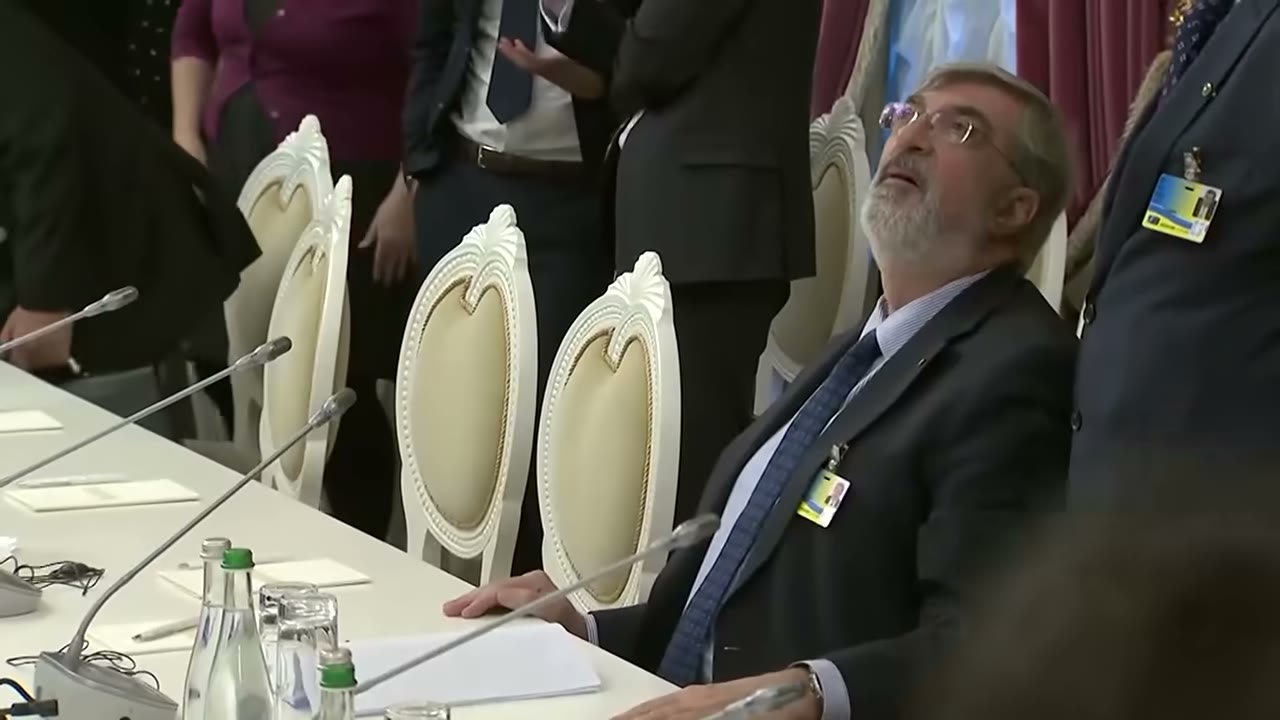
US negotiators asked Zelensky whether Ukraine would cede the Donbas in exchange for NATO membership, he revealed on November 13. The question caps Abu Dhabi talks that yielded only a prisoner-swap deal in principle, while Moscow tells lawmakers to prepare for victory.
1Zelensky Reveals US Asked Ukraine to Trade Donbas for NATO
American negotiators asked Volodymyr Zelenskyy whether Ukraine would give up the Donbas in exchange for NATO membership, he revealed on November 13th. It is the first time the two issues have been tied together, he said.
Zelenskyy disclosed the question himself. Land for an alliance, soil for protection — a trade nobody had put on the table publicly before.
Around the same time, a senior Kremlin official told a room of Russian lawmakers something that may say more about Moscow's intentions than any official statement. Kyiv says a deal is possible before the new year. Moscow vows to take back every inch of what it calls its land. Washington is searching for a formula that satisfies both.
2Abu Dhabi Talks Open With Territory as the Central Wall
Russians and Ukrainians sat at the same table with the United States for the first time since February, in Abu Dhabi on November 10th and 11th. Two days of talks, one stated goal: ending the war.
Steve Whitkoff and Jared Kushner represented the American side. Rustem Umerov led the Ukrainian delegation, Vladimir Medinsky the Russian one.
Territory quickly became the wall in the room. Kushner called the territorial question the hardest. Medinsky was blunt: "every inch of our land will be returned to Russia." Not some of it. Every single inch.
3Russia and Ukraine Agree in Principle on Major Prisoner Swap
Russia and Ukraine agreed in principle on a new large-scale prisoner exchange — possibly one of the biggest of the entire war.
David Arakhamia, a member of the Ukrainian delegation, said it could be "possibly even the largest overall." For thousands of families, it is an enormous glimmer of hope — mothers, wives and children who have waited months, sometimes years.
The exact terms of the swap have not been announced. Moscow says the details will come in the near future, a phrase people in this war have learned to treat with suspicion.
4Vague Claims of Progress on Ukraine Security Guarantees
Jared Kushner reported significant progress on security guarantees for Ukraine. Rustem Umerov went further, describing huge progress — but neither offered a single detail.
That silence is where doubt creeps in. If the progress was so huge, why can no one say one word about it?
The prisoner exchange remains the one concrete result to come out of Abu Dhabi. On security guarantees, the public record so far is claims without specifics.
5US Negotiators Admit There Is No Trust Between Sides
The American negotiators themselves concluded there is no trust between the two sides — none, according to press reports.
Picture a negotiation where the mediator openly admits the two parties don't believe a word the other says. That is the starting point for everything that follows.
The assessment came as talks in Abu Dhabi continued. The most disturbing part of the session, however, was not what was said about Ukraine but what Vladimir Medinsky said about Europe.
6Medinsky Says Talks Are About Europe's Whole Security Order
Russia's lead negotiator told the room the real subject was not Ukraine but the entire European security system. Vladimir Medinsky said the two sides found mutual understanding in some areas but not in others.
Then came the medical metaphor: the whole organism is essentially sick, and in Ukraine an abscess has simply burst. A band-aid won't fix this, he said.
For Moscow, in other words, Ukraine is a symptom, not the problem — the real issue is the security architecture of the whole continent. Yet Medinsky said the Russian delegation did not speak to the Europeans who were in Abu Dhabi. He added that Russia doesn't understand in what capacity they were there at all.
7Witkoff and Kushner Meet Putin; Europe Seat Hopes Rise
Steve Witkoff and Jared Kushner spent about two hours face-to-face with Vladimir Putin in Moscow on November 12th.
On his way out, Witkoff announced that Europeans could get a seat at the table in the next round — a possible breakthrough for a continent that had spent months on the sidelines of a war on its border.
Moscow poured cold water on it almost immediately. Yuri Ushakov, Putin's foreign policy aide, refused to confirm it and described Europe's current stance as a recipe for endless war.
8The Donbas-for-NATO Question and What Each Side Weighs
On November 13th, Zelenskyy revealed that American negotiators asked whether Ukraine would withdraw from the Donbas in exchange for NATO membership.
The Donbas is Ukraine's industrial east, made up of the Donetsk and Luhansk regions — mines, factories, entire cities, where fighting started in 2014. According to several international outlets, Moscow has long wanted Ukraine out of the part of the Donbas it still controls, roughly 10% of the region. Behind that number are fortified cities and defensive lines built over years at staggering cost.
NATO's Article 5 treats an attack on one member as an attack on all. According to Zelenskyy, this was not a formal offer — no proposal written in black and white, and Washington has not publicly put forward any plan. He said Ukraine will not give up territory, and that he would only put the idea to Ukrainian society if the US and other NATO allies confirmed it officially, with real security guarantees involving both NATO and the EU. He cannot make such a decision alone, he said.
9Zelensky Reverses Course, Puts NATO Back in Negotiations
Less than a year ago, Zelenskyy offered to set aside NATO membership in exchange for Western security guarantees. In December 2025, the alliance looked off the table for good. Now, by his account, it is back — as a trade.
The obstacle has a name: Moscow's red line. For years the Kremlin has called Ukraine joining NATO unacceptable, one of the arguments used to justify its invasion.
Washington is floating giving Ukraine exactly what Russia refuses to accept, in exchange for exactly what Russia demands. On paper, a compromise. In reality, a minefield.
10Kremlin Aide Tells Lawmakers to Prepare for Victory
At the Senezh Training Centre for Managers in the Moscow region on November 13th and 14th, Sergey Kiriyenko told United Russia lawmakers to prepare for victory.
According to a source cited by Vedomosti, the First Deputy Chief of Staff of the Presidential Administration stressed the need to work with war veterans: "Everyone needs to be ready for victory for when combat participants return from the special military operation all at once."
The word victory, not compromise. And "all at once" suggests Moscow anticipates hundreds of thousands of soldiers coming home together. Back in December 2024, Kommersant reported, the administration gathered deputy governors at the same centre to discuss building an image of victory for after the war.
11Moscow Shuts Europe Out of the Negotiating Room
Yuri Ushakov crushed the hope Steve Witkoff had created. On November 16th, Putin's foreign policy aide said of expanding the talks: "some people are talking about expanding the format, but that hasn't been cleared with us."
He added that much work is needed before Europe can be included, and that at least one more round must take place with just three countries — the United States, Russia and Ukraine.
Kremlin spokesman Dmitry Peskov softened it slightly, saying Moscow isn't opposed to European participation in principle, but a decision will come only once the Kremlin understands Europe's true intentions. Russia's Foreign Ministry said European participation didn't even come up during Putin's meeting — contradicting Witkoff's account.
12Europe Names Six Negotiators While Moscow Keeps Door Shut
Europe has already named six representatives for the talks: the national security advisors of Germany, France, the United Kingdom, Italy and Poland, plus the European Union's own national security advisor. Six people ready to sit down — and a door that stays shut.
Moscow has reasons to keep Europe out. If Russia wants to renegotiate Europe's security order, it has every reason to do it one-on-one with Washington rather than with capitals that overwhelmingly back Ukraine. In a three-way format, Ukraine sits alone facing two great powers; with four or more, it has allies at the table.
On November 15th, Zelenskyy called for a robust, unified European stance, one he described as 100% geared toward victory, and said the format must evolve beyond a quadrilateral into something significantly stronger.
13Missiles Hit Kyiv Bridges as Both Sides Strike During Talks
On the night of November 17th, Russian missiles struck both of Kyiv's major bridges over the Dnipro. According to local authorities, Russian attacks killed 14 people and injured 78 across Ukraine in 24 hours.
Hours later, Ukraine brought down a section of the Crimean Bridge.
Each side negotiates with one hand and strikes with the other, both seeking to walk into the next round from a position of strength. On this battlefield, what happens on the ground often weighs more than anything said around the table.
14What Each Leader Would Gain and Lose From the Trade
Ukraine would have to hand over the Donbas — cities, people and defensive lines — while Russia would have to accept Ukraine in NATO. That is the trade now being floated, and it forces each side to abandon something it has called sacred.
For President Zelenskyy, NATO membership is the only guarantee many Ukrainians consider truly solid. Article 5 is the promise that the next invasion won't be faced alone. Giving up the Donbas means accepting that force paid off and aggression was rewarded with territory.
For Putin, taking the Donbas would let him proclaim the victory the Kremlin has prepared for two years. Accepting Ukraine in NATO would mean dropping one of the war's central justifications — explaining to Russians why hundreds of thousands of men were sent to the front only for NATO to settle permanently at the country's door.
The deal is dizzying because it makes each side surrender something it has presented as sacred. For now, it exists only as a question.
15France and UK Plan Multinational Force for Post-War Ukraine
France would supply about 1,100 troops — the largest contingent — as part of a multinational force led by France and the United Kingdom, according to the Kyiv Post. The force is being planned as the military arm of a coalition that would guarantee Ukraine's security in the event of a ceasefire.
About 2,800 personnel would be spread across four sites: a training area in Poland, a force headquarters in Paris, and a maritime command in Istanbul.
That detail matters. Whatever the final formula looks like — NATO or no NATO — Europe is getting ready to play a real military role after the war.
It may also be exactly what Moscow fears most, and the real reason it wants Europeans kept far away from the table.
16Where the Talks Stand: Prisoners, Guarantees, Territory Deadlock
A prisoner swap of historic scale has been agreed in principle — but it hasn't happened yet. That is where the talks stand: claims without details, and a deadlock on territory.
Progress is claimed on security guarantees, but nobody has revealed what they contain. Territory remains completely deadlocked, with Russia demanding every inch and Ukraine refusing to give any of it away.
Americans themselves say there is no trust between the two sides. Europe is being kept at the door, and the date of the next round is still unknown.
Russia, Ukraine and the United States have all confirmed the talks will continue, but no one knows when. In Kyiv, they say a deal could be reached before the new year. In Moscow, lawmakers are told to get ready for victory and for soldiers to come home all at once.
17The Real Question Is Who Gets to Sell the Deal as Victory
Both sentences could turn out to be true: a deal before the end of the year, and a Moscow victory. If a deal comes, the real question won't be whether there is one — it will be who gets to sell it as a victory.
Right now, the only trade being floated — giving up the Donbas — looks a lot like what Moscow has been demanding from the very start.
That could change. It changes if NATO tips the scale. It changes if the Europeans force their way through the door. It changes if the battlefield changes everything before the next round.
Over the coming weeks, there are three things to watch.
18Three Things to Watch in the Coming Weeks
Watch the date and format of the next round first: three countries, or finally with Europe. Then watch what the security guarantees actually contain, if they are ever made public.
Above all, watch Washington's official reaction to the idea of trading the Donbas for NATO. Until the United States confirms it publicly, it remains a question asked in a closed room.
Those three signals will show whether the floated trade becomes a real deal — or stays a question behind a door.