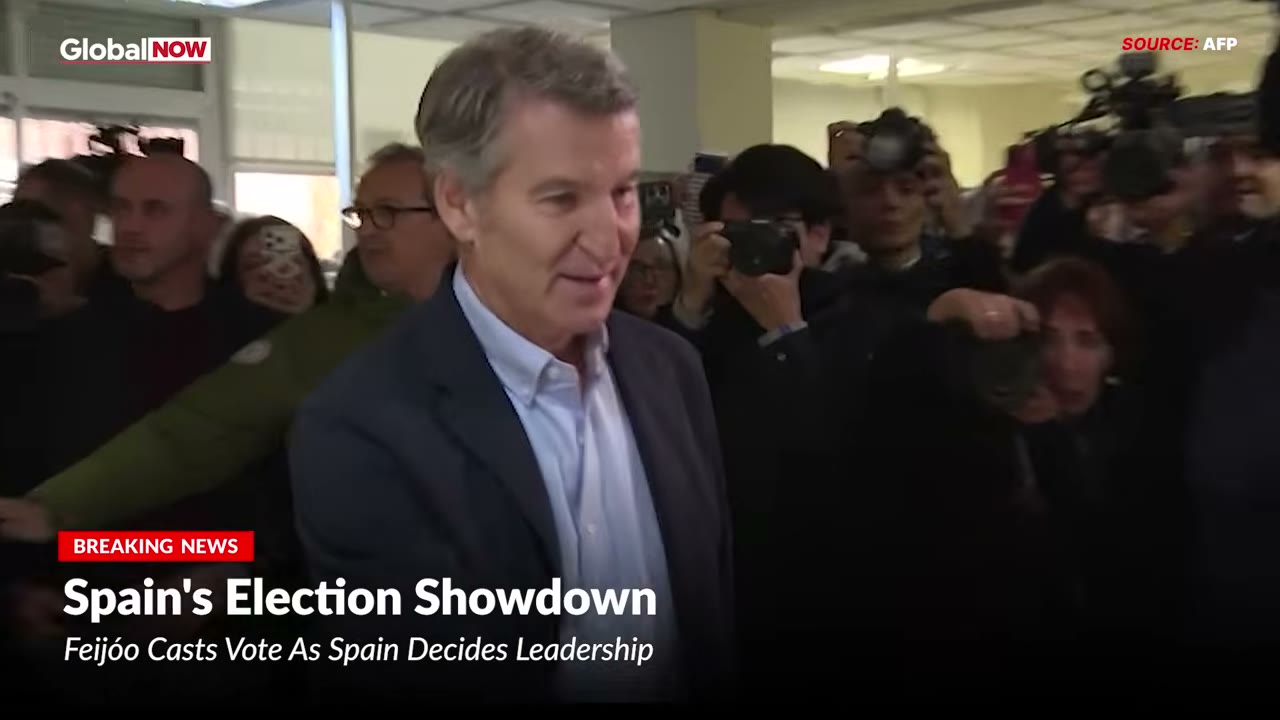
Spain holds a general election that could change the balance of power in one of Europe's largest economies. Opposition leader Alberto Feijóo's People's Party hopes to unseat Prime Minister Pedro Sánchez, but forming a government may require difficult negotiations with Vox and regional parties.
1Spanish voters head to polls in election that could shift balance of power
Spanish voters are being urged to cast ballots in an election that could change the balance of power in one of Europe's largest economies. Opposition leader Feijóo called on citizens to exercise their democratic rights, telling Spaniards to vote "sin miedo y con memoria" — without fear and with memory. His appeal framed the vote as a choice about the country's future leadership. Polls opened across Spain, with the outcome set to shape who governs a major European economy.
2Polls suggest People's Party could become largest force but majority uncertain
The People's Party could become Spain's largest political force, according to several opinion polls on election day — but that may not be enough to govern. Spain's system requires a candidate to win sufficient parliamentary support to become prime minister. With 350 seats in the Congress of Deputies, parties are watching whether any alliance can reach the absolute majority threshold of 176 seats. The D'Hondt method of allocating seats could prove decisive, especially if the People's Party falls short of an absolute majority.
3Feijóo's 13 years as Galicia president shape his leadership pitch
Before leading the Popular Party in 2022, Feijóo served as regional president of Galicia for approximately 13 years. He spent much of his national political career presenting himself as an experienced administrator capable of ensuring institutional stability. That regional experience became an important part of his political identity. During the campaign, he sought to show he had the administrative experience needed to lead Spain at the national level.
4Popular Party campaigns on economy, tax cuts and housing crisis
The Popular Party campaigned as an alternative to the socialist administration, emphasizing economic competitiveness, reduced taxation and more efficient public administration. The opposition also raised concern about Spanish families struggling with rising housing costs and financial uncertainty. The housing issue has become one of the country's most pressing internal problems. Throughout the campaign, the party sought to show it had the administrative experience to lead Spain nationally.
5Young Spaniards and city residents struggle with affordable housing
Young Spaniards, working families and residents of large cities are finding it increasingly difficult to secure affordable housing. Spain has recorded strong economic growth, yet concerns about household purchasing power and access to housing continue to shape public debate. The election presents voters with competing approaches to solving these problems. Housing has become one of the country's most pressing internal issues.
6Sánchez seeks another term defending progressive record and economy
Pedro Sánchez, Spain's prime minister since 2018, is seeking to keep his leadership despite growing political pressure and difficulties securing parliamentary support. His administration promoted progressive social policies and defended its economic record. Supporters argue the socialist government helped boost employment, protect workers and maintain Spain's economic momentum. Opposition parties, however, questioned whether those achievements had led to sufficient improvements in living conditions.
7Early election called after budget and legislative deadlock
Early elections were called after the government struggled to advance legislation and approve a new national budget. Disagreements in parliament over housing measures further exposed the problems facing the administration. Those events gave Feijóo an opening to strengthen his argument that Spain needed a government capable of providing reliable parliamentary support. The deadlock turned a policy fight into a national vote.
8Feijóo faces dilemma over relying on Vox for majority
The People's Party faces its own challenge: its relationship with Vox, the right-wing party led by Santiago Abascal. If the conservatives cannot win an independent majority, Vox's support could be crucial to Feijóo forming a government. Such an arrangement would carry significant implications for domestic politics, including regional autonomy, environmental policy and social legislation. Supporters of closer cooperation argue a conservative alliance could secure a decisive majority; critics worry about Vox's influence. Feijóo must balance attracting moderate and undecided voters with the possibility of negotiating with a party further to the right.
9Fragmented parliament gives smaller and regional parties leverage
Spain's traditional contest between the Popular Party and the Spanish Socialist Workers' Party has evolved into a more complex landscape that includes several national and regional movements. These smaller parties could once again determine which bloc forms the government. The 2023 general election remains relevant: the Popular Party led the Socialists but failed to secure the parliamentary support to become prime minister, and Sánchez later won another term through agreements with other parties. For the People's Party, avoiding a repeat of that outcome will likely be a central consideration.
10Feijóo's polling station appearance marks decision passing to voters
After weeks of campaigning and political exchanges, Feijóo's appearance at the polling station marked the moment the decision passed entirely to voters. Across Spain, citizens are taking part in a democratic process that will determine the composition of the legislature and lay the groundwork for negotiations on the next administration. The opposition leader has reached the point where the outcome is out of his hands.
11Voter turnout in key regions could decide parliamentary balance
Voter turnout may prove particularly important. Strong turnout among conservative supporters could improve the Popular Party's standing, while broad mobilization among progressive voters could strengthen Sánchez's chances of staying in office. Both blocs understand that relatively small changes in voting patterns in individual districts can affect the final distribution of parliamentary seats. Madrid remains an important battleground, but the outcome will also depend on Andalusia, Catalonia, Galicia, Valencia and other regions.
12European Union watches Spanish election for policy impact
The election is being closely watched across Europe. Spain plays an important role in the European Union, contributing to discussions on economic development, energy security, migration, international cooperation and European defense. A change in national leadership could affect Madrid's priorities in European institutions. Economic observers will also watch whether the results produce a government capable of advancing national budgets, investment initiatives and long-term reforms. Businesses generally benefit from a predictable regulatory environment, while protracted negotiations can create uncertainty.
13Daily concerns like housing, jobs and healthcare dominate voter priorities
For ordinary Spaniards, the priorities remain close to daily life: housing affordability, employment opportunities, healthcare, education, taxation and retirement. Feijóo sought to convince voters that a change of government could deliver a more effective response to these problems. Sánchez defended his administration's record and presented continued socialist leadership as a chance to protect existing social and economic reforms. The campaign highlighted significant differences over the role of government and the management of public resources.
14Immigration emerges as prominent campaign issue across parties
Immigration has moved to the front of Spain's election campaign, with parties offering competing plans on border management, integration and labor market requirements. The proposals differ, and the debate reflects a wider challenge across Europe: governments trying to balance economic needs, humanitarian obligations and domestic political concerns. Whatever the election outcome, these issues are unlikely to disappear from Spain's political agenda, according to the reporting.
15Feijóo's second bid for prime minister is defining career moment
For Alberto Feijóo, this election is a defining moment in his national political career. After years of regional races and a previous failed attempt to secure the prime ministership, he now has another opportunity to reach Spain's top executive post. The outcome will shape whether the People's Party leader finally takes the country's highest office.
16Final result hinges on vote count and post-election negotiations
Polls are predictions, not results. The final outcome will depend on the votes cast by millions of citizens and the subsequent distribution of parliamentary seats. Even if the People's Party becomes the largest parliamentary group, negotiations with potential partners could determine whether Feijóo can form a government. An absolute majority would provide a clearer path to office, while a fragmented result could lead to lengthy discussions between competing parties.
17Spain awaits official count as Feijóo leaves fate to electorate
Feijóo has finished voting, leaving the future of his political ambitions in the hands of the Spanish electorate. Attention now turns to the official vote count and the parliamentary balance forming after the elections. The results will show whether voters back a conservative change of leadership, another term for Pedro Sánchez, or a more complex arrangement requiring negotiations between several parties. Until results are officially confirmed, the race for leadership in Spain remains open.