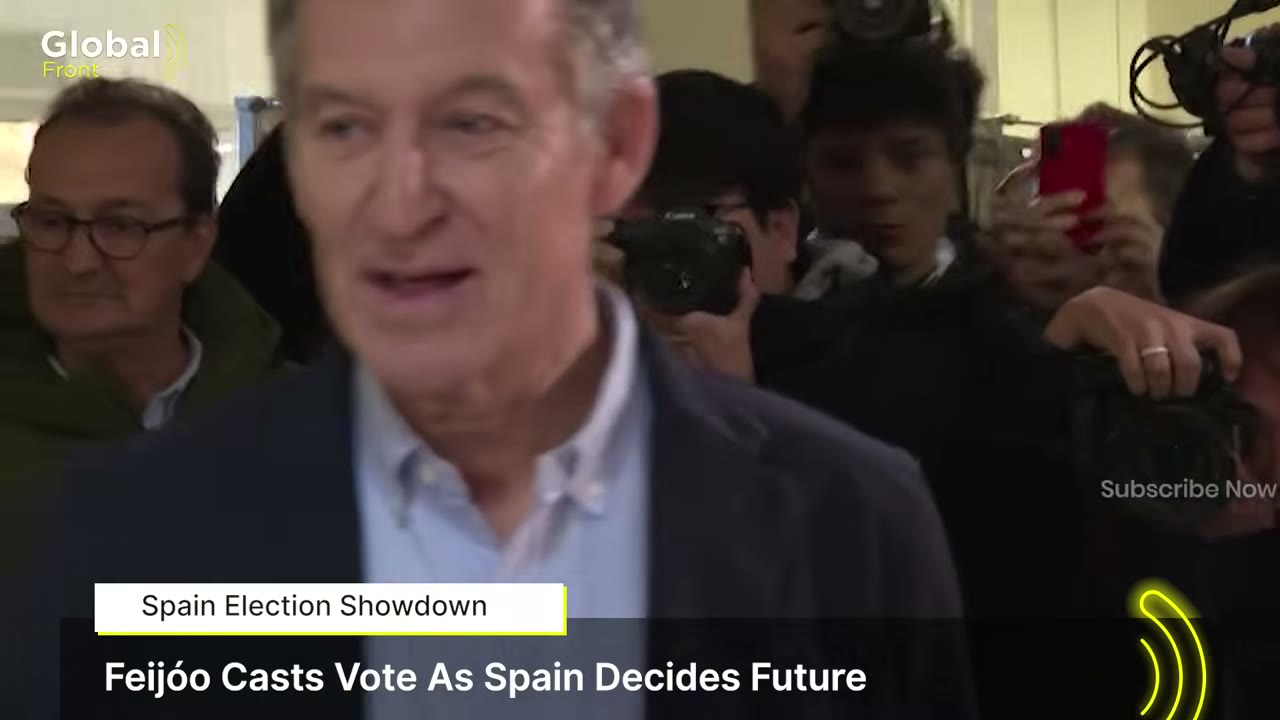
Alberto Núñez Feijóo has cast his vote in Spain's November 29 general election, seeking to end Pedro Sánchez's more than eight years in power. With 38.7 million voters eligible and all 350 seats contested, housing, the economy, immigration and possible Vox support dominate the race.
1Feijóo Votes in Madrid as Spain Holds General Election
Alberto Núñez Feijóo voted at a Madrid polling station on November 29, 2026, aiming to end more than eight years of Prime Minister Pedro Sánchez's rule. The Popular Party leader arrived at the Ramiro de Maestu polling station with his wife, Eva Cárdenas, and was surrounded by journalists and photographers.
He urged Spaniards to vote "not with fear, but with memory," stressing that decisions at the polls could affect the country's course for the next decade.
More than 38.7 million people are eligible to vote, including roughly 2.77 million Spaniards living abroad. All 350 seats in the Congress of Deputies are contested. For Feijóo, the vote is another chance at a position that eluded him after the July 2023 general election.
2Feijóo's Uphill Path: Winning Most Seats May Not Bring Power
Winning the most seats did not hand Feijóo power last time — and it may not again. The People's Party became the largest parliamentary force in July 2023 but failed to gather enough support to form a government, and Pedro Sánchez secured another term through agreements with several parties.
Feijóo must now either secure an outright parliamentary majority or win sufficient backing from other political forces to become prime minister.
Throughout the campaign he pitched himself as an alternative to Sánchez, arguing Spain needed greater institutional stability, effective economic management and predictable public policy. At the polling station he expressed confidence in Spain's democratic institutions and the electoral process.
3Feijóo Urges Spaniards to Accept Election Results
Feijóo said every political leader, himself included, has a responsibility to accept the election results. His message: everyone should accept the decision made by the Spanish people.
The pledge came in a contest marked by fierce political competition and growing divisions between parties.
Despite those differences, the opposition leader stressed his confidence in the members of the electoral commissions, the representatives at polling stations and the vote counting process.
He also expressed confidence in Spain's democratic institutions and the electoral process, emphasizing the importance of respecting the voters' decision.
4Early Election Called After Sánchez's Housing Defeat
Spain's election was called early after Prime Minister Pedro Sánchez hit parliamentary trouble over proposed housing measures. His minority administration has struggled to consistently gather legislative support, relying on cooperation with several smaller parties.
The vote offers Sánchez a chance to seek a stronger mandate.
For Feijóo, it is a chance to show the People's Party can turn voter support into an effective majority to govern the country.
The government's difficulty winning legislative backing has exposed the challenges of running a minority administration that depends on deals with smaller parties.
5Housing Crisis Dominates Campaign as Rents Soar
Rising rents and property values are squeezing households across Spain, especially young people trying to live independently. In Madrid and Barcelona, affordable housing has become a serious problem for families, students and working professionals.
The Socialists defended measures to strengthen tenant protections and improve access to housing. The People's Party is pushing a different approach: increasing housing supply, encouraging construction and improving conditions for investment.
Feijóo's party pledged to make housing more affordable while removing regulatory barriers it believes contribute to the shortage.
Neither approach offers an immediate fix — but the election could decide which measures get prioritized in the coming years.
6Economy and Cost of Living Shape Voter Choices
Spain has posted periods of economic growth, yet many households still feel squeezed by everyday costs — food, energy, transport and housing.
Feijóo courted voters who believe positive economic indicators have not improved their personal finances. The People's Party proposed tax cuts and measures to stimulate investment, business activity and employment.
Sánchez emphasized social protection, workers' rights and improving public services as his government's main achievements and priorities.
The competing messages fuel the broader confrontation between center-right and center-left. For many voters, the real question is whether the next government can improve living standards rather than simply hand out promises.
7Immigration Splits Parties; Vox's Role Could Be Decisive
Immigration has become a major campaign issue, with parties offering sharply opposing approaches. The People's Party called for strengthened migration management and border control. The Socialist government defends a policy combining migration regulation with humanitarian obligations and economic considerations.
The issue has boosted the political relevance of Vox, led by Santiago Abascal, which advocates a tougher immigration policy and positions itself as a national-conservative alternative to both the Socialists and the PP.
Vox's results could be decisive in government negotiations. If the PP falls short of an absolute majority, Vox support could potentially give Feijóo a path to power — though such a deal would raise questions over the distribution of political influence.
8Polls Show Right-Wing Gains but 2023 Offers Cautionary Tale
Pre-election opinion polls generally indicated conservative and far-right parties could perform well — but Spain's 2023 election shows why forecasts are not results.
In 2023, expectations of a conservative government did not translate into sufficient parliamentary support for Feijóo. The People's Party won 137 seats after the final distribution, the Socialist Party won 121 and Vox won 33.
Even with additional parliamentary support, Feijóo was unable to secure the necessary votes to become prime minister.
Both the PP and Vox oppose continuing the Sánchez administration, but they differ on several policy priorities and on the nature of any potential government deal.
9176-Seat Threshold Looms Over Coalition Negotiations
To obtain an absolute majority, a party needs 176 seats in the Congress of Deputies. If no party reaches that figure alone, Spain could enter another period of difficult political negotiations.
That history explains why this race is about more than who finishes first. The distribution of seats, the performance of smaller parties and leaders' willingness to cooperate may ultimately matter more than national vote share.
Sánchez previously formed a government through negotiations involving regional and other political parties.
The outcome will determine whether Spain gets a new government relatively quickly or faces prolonged uncertainty.
10Feijóo's Record: Galicia Premier From 2009 to 2022
Feijóo brought significant political and administrative experience to the national stage: he served as president of the Regional Government of Galicia from 2009 to 2022, before leading the People's Party in 2022.
That regional record became an important part of his national political identity, and he sought to present himself as a politician who combines conservative policies with administrative experience.
Supporters argue such a background lets him tackle Spain's economic and institutional challenges. Opponents question whether his policies will adequately protect vulnerable groups — and whether cooperation with Vox would shift the future government further to the right.
11Sánchez Fights for a New Mandate After Years of Deals
Pedro Sánchez has served as Spain's prime minister since 2018 and has repeatedly shown he can conduct complex parliamentary negotiations — his survival after the 2023 elections highlighted his deal-making even when the Socialists were not first.
Now he is calling on supporters to mobilize, arguing the election could have serious consequences for Spain's social policy and democratic course. He warned of the potential consequences of a government involving Vox.
Feijóo rejected the idea that voters should base their decisions largely on such warnings, urging them instead to weigh the government's achievements and their expectations for the future.
12Europe Watches Spain's Election for Wider Political Shift
Spain's election is being watched well beyond its borders. As one of the largest economies in the European Union, Spain plays an important role in discussions on migration, energy security, economic policy and international relations.
A change of government in Madrid could affect Spain's approach to a number of European political debates. The People's Party's positions on economic regulation, energy and migration differ significantly from the current socialist administration's.
Spain's EU and NATO membership will continue to provide a stable basis for its international commitments.
The vote comes amid broader competition between conservative, progressive and nationalist movements across Europe. A strong showing by the Spanish right could encourage similar movements elsewhere; another Sánchez success could strengthen the European center-left.
13Catalan and Basque Parties Could Again Decide Government
Parties from Catalonia and the Basque Country could once again decide who governs Spain. Regional organizations have played a key role in forming parliamentary majorities before, and their demands and willingness to negotiate may shape the next national government.
The question of Catalan autonomy, and the government's earlier agreements with independence supporters, remains contested. Feijóo has criticized several of those agreements, while Sánchez defends political dialogue as a way to resolve long-standing territorial disputes.
The vote therefore carries implications beyond the economy, reaching the relationship between Spain's central government and its autonomous regions.
14High Stakes for Feijóo After His 2023 Failure
Feijóo already tried and failed to become prime minister in 2023. Now the Popular Party leader has another chance at the head of Spain's government.
A strong result, followed by successful parliamentary negotiations, could mark a turning point in his political career.
Another uncertain outcome, however, could once again raise questions about his party's strategy and its ability to gather support for governing.
15Turnout and Seat Distribution Decide Spain's Course
Millions of Spaniards are voting on decisions that reach far past the ambitions of their leaders — housing policy, taxes, employment, immigration, public services and relations with European institutions.
Attention is fixed on turnout and how seats will be distributed. Feijóo's appearance in Madrid capped his push to convince voters of the need for a change of government, while Sánchez is seeking a new mandate to continue his agenda. Abascal and smaller parties are competing for influence that could prove decisive.
Feijóo has already voted, expressing confidence in Spain's democratic system and leaving his political future to voters. "Until the official results are released, the outcome remains uncertain," the race now turns on whether voters give Feijóo enough support to form an administration or hand Sánchez another term — answers that may only come through party negotiations.