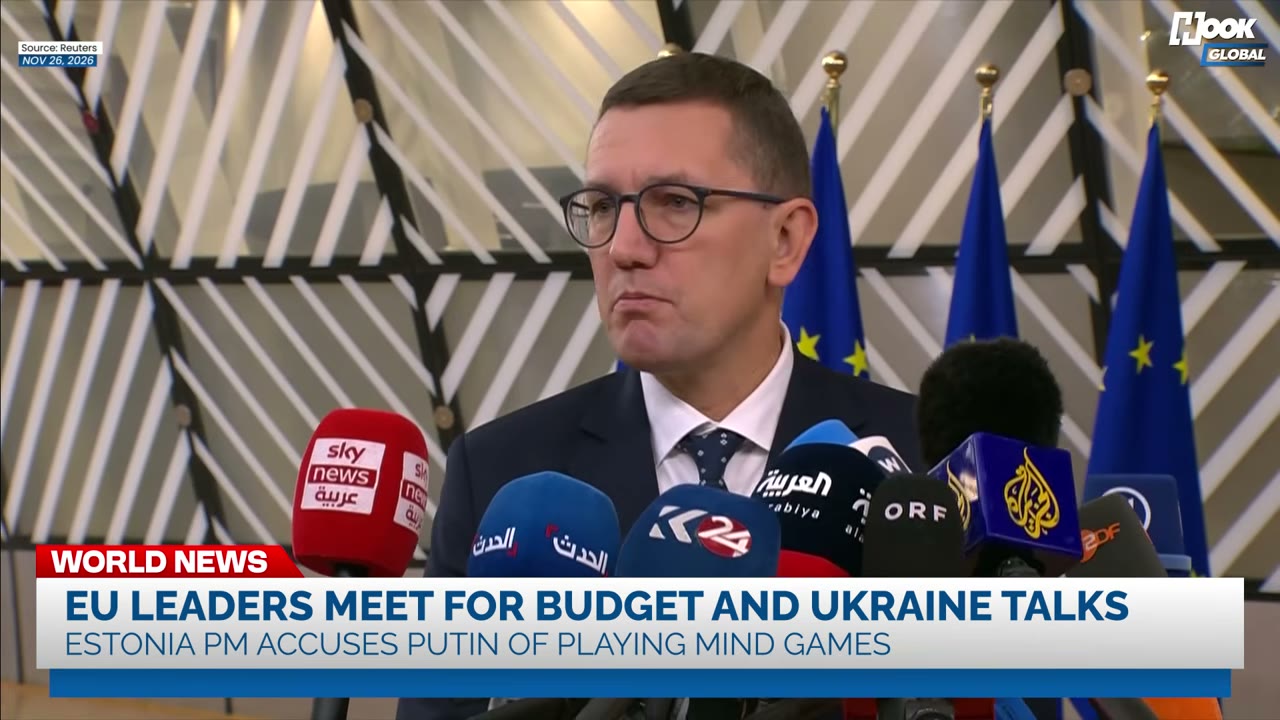
Estonia's prime minister says Russia has ordered about 12 attacks on Estonian soil and explains why the border with Russia is closing. She also urges EU leaders to agree a long-term budget, boost defense and keep national contributions reasonable.
1Estonia PM Says Europe Is Not a Threat and Putin Is Playing Mind Games
Europe is not a threat to Russia, Estonia's prime minister said, rejecting Vladimir Putin's talk of a European security architecture as a mind game. Speaking after weeks of debate over that architecture, she said Europe's conventional military capabilities do not make it a danger to Moscow. "Europe is not a threat to anyone," she said, adding that it might mostly be a threat to itself.
Her argument: that architecture was fine until Putin attacked Ukraine. She said Putin claims he wants peace while steering talks toward European security, and she praised efforts to reach a ceasefire or peace.
Her condition: pressure on Russia must remain.
2Estonia PM Cites About 12 Russia-Ordered Attacks, Defends Border Closure
About 12 attacks ordered by Russia inside Estonia in recent years can be attributed to Moscow, Estonia's prime minister said, explaining why her country is now closing its border with Russia.
She said Estonia had been patient and calm, taking gradual steps, and that closing the border signals that attacks on NATO territory against the defense industry cannot be tolerated.
She also said Russia's intelligence services check everyone who crosses the border and use that information. Closing the border increases Europe's security, she said, and has the biggest effect on Russia and on the region.
3EU Leaders Weigh Long-Term Budget to Fund Defense and Competitiveness
The European Union's next long-term budget must fund defense, farmers and citizens at once, while keeping national contributions at a reasonable level, leaders were told as they met to discuss it.
The budget was the most important item on the agenda. The priorities listed: support for farmers, citizens and regions, more investment in security and defense, and higher competitiveness. Energy prices and housing were also named as expectations the budget must meet.
The stated goal was to bring leaders closer to agreement, with national contributions kept reasonable.
4Estonia PM Seeks Deal on Budget Priorities and New Own Resources
Leaders must agree on three points to pass the EU's next long-term budget: the overall deal, how funding is split between priorities, and a balanced basket of new own resources to keep national contributions reasonable.
The prime minister set that goal for the talks and called on every leader to join with an open mind, a constructive approach and a sense of compromise.
The deadline is tight: the budget must pass by the end of this year.
5EU Budget Needs Unanimity and Must Pass by End of Year
Passing the EU's budget by the end of this year requires unanimity — every leader's backing, not a majority.
The prime minister drew the contrast with national budgets, where a majority is enough. "We need unanimity here," she said.
The deadline and the unanimity rule together set the test for the talks.