Spain holds a general election on November 29, 2026, with Prime Minister Pedro Sánchez seeking another term against Alberto Núñez Feijóo's Popular Party. Polls suggest the far-right Vox could enter government for the first time since democracy returned, with housing, migration and the economy dominating the campaign.
1Sánchez Votes in Madrid and Predicts Huge Turnout
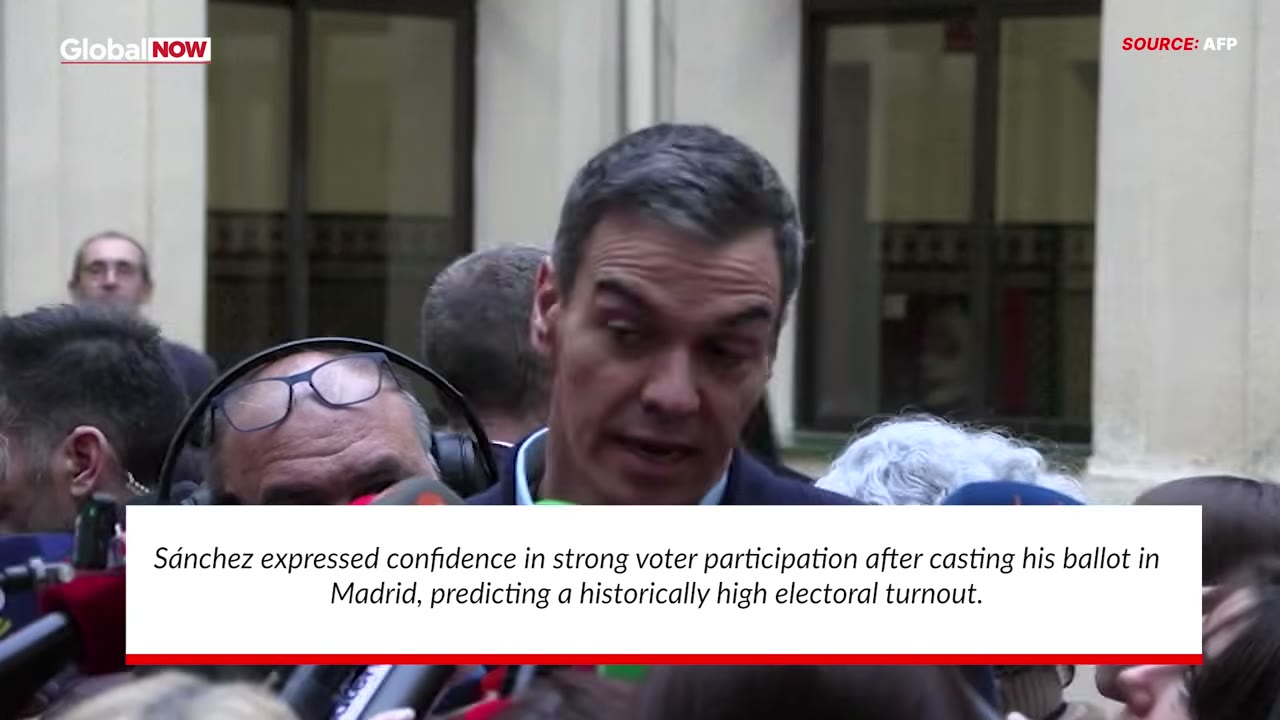
Pedro Sánchez cast his ballot in Madrid on Sunday and immediately claimed an "epic mobilization" was underway. The Spanish prime minister voted at the Nuestra Señora del Buen Consejo polling station in Madrid's Moncloa-Aravaca district shortly after polls opened. He called the November 29, 2026 general election one of the biggest political challenges of his leadership. Speaking after voting, Sánchez said Spain could see one of the highest turnouts in recent democratic history. "The only thing I can say is that there is an epic mobilization taking place," he said. He urged citizens to vote, saying broad participation gives the next government a stronger democratic mandate.
238.7 Million Spaniards Vote for 350-Seat Congress
More than 38.7 million Spaniards are eligible to vote in Sunday's election, including about 2.7 million living abroad. They are choosing representatives to the Spanish parliament, with attention centered on the 350-seat Congress of Deputies. A party needs 176 seats for an absolute majority. For Sánchez, in power since 2018, the vote is a test of his popularity and his ability to overcome resistance from conservative and right-wing parties. Another fragmented parliament could mean the outcome depends on negotiations between parties after results are announced.
3Sánchez Faces Feijóo as Polls Put Opposition Ahead
Several pre-election polls put Alberto Núñez Feijóo's conservative Popular Party ahead of Sánchez's ruling Socialists. Feijóo, the PP leader, campaigned on political stability, better economic management and a change in national leadership. The People's Party emerged as the main contender throughout the campaign. But Sánchez has overcome difficult political circumstances in previous elections, and his supporters hope high turnout could produce a result that casts doubt on the polls. Sánchez is seeking another term.
4Early Election Called After Housing Measures Defeated
Sánchez called the early general election after his government failed to secure parliamentary support for key housing measures. The vote is set for November 29, following mounting difficulties in parliament. The decision intensified political competition as the prime minister seeks a renewed mandate to continue his government's economic and social reforms. Housing has become one of the most important issues for Spanish voters.
5Housing Costs Dominate Voters' Concerns in Big Cities
Rising rents and scarce affordable housing have made housing one of the most important issues for Spanish voters, especially young people and families. Madrid and Barcelona are under significant pressure, with many residents expressing dissatisfaction over rising living costs. Public protests have highlighted concerns about the shortage of affordable housing, evictions and the financial burden on ordinary households. Sánchez argues stronger parliamentary support is needed to implement further reforms. The opposition accuses the socialist administration of failing to deliver meaningful changes during its years in power.
6Economic Growth Record Clashes With Household Cost Worries
Spain has shown relatively strong economic growth compared to other European countries under Sánchez, whose administration introduced labor reforms, raised the minimum wage and strengthened social protection. Supporters say these achievements show the government can manage the economy while protecting workers and vulnerable populations. But rising housing and household expenses have led many voters to question whether they are benefiting from that growth. For millions of Spaniards, Sunday's election is not simply a choice between political leaders.
7Vox Could Enter National Government for First Time
Vox, the right-wing nationalist party led by Santiago Abascal, could enter Spain's national government for the first time since the country's transition to democracy. Several pre-election polls suggest the People's Party may need Vox's support if it cannot win an absolute majority on its own. Vox has proposed stricter migration controls, expanded central government powers and changes to social and environmental policies. An official coalition is not the only scenario — Vox could also back a minority PP government without joining the cabinet. Much depends on the final seat distribution and leaders' willingness to negotiate.
8Sánchez Warns Vox-Backed Government Would Undo Reforms
Sánchez has repeatedly warned that a conservative government backed by Vox could undo important social reforms introduced during his term. The People's Party and Vox, meanwhile, presented their proposals as necessary alternatives to the current government's approach. Migration became another topic that divided society throughout the campaign. The exchange sets up a clear choice for voters on the direction of social policy.
9Migration Divides Campaign as Parties Clash on Borders
Migration divided society throughout the campaign, with Sánchez emphasizing migrants' economic contribution and backing policies to promote their integration. His opponents called for tighter immigration restrictions, arguing the government must address pressures on public services, housing affordability and border management. The clash reflects a broader debate across Europe, where governments are trying to balance labor market needs, humanitarian obligations and domestic politics.
10Spain's Election Watched Abroad Over EU and NATO Stance
Spain's election is being closely watched abroad because of the country's importance in the European Union and its role in key global diplomatic discussions. Sánchez has established himself as a leading European advocate for progressive politics, international cooperation and Palestinian statehood. His positions on the Middle East and NATO defense spending have exposed differences between Madrid and Washington under US President Donald Trump. A change of government could lead to an adjustment in the country's diplomatic priorities, depending on the next administration's policies.
11Scandals and Corruption Allegations Test Public Trust
Sánchez faces the challenge of restoring public trust after political scandals and corruption allegations involving individuals in his administration and close circle. Opposition parties used the controversies to question the government's credibility. Socialist supporters emphasized the difference between individual allegations and the broader activities of the administration. The issue has become another test of the prime minister's standing with voters.
12Catalan and Basque Parties May Hold Balance of Power
Catalan and Basque parties could again decide who governs Spain. Regional parties have previously wielded significant influence in Spain's fragmented parliament when no large party won an absolute majority. After the 2023 general election, the People's Party became the largest parliamentary force with 137 seats to the Socialists' 121 — yet Sánchez still secured enough support to remain prime minister. A similar situation may arise if neither bloc wins a clear majority this time, leaving smaller progressive parties in a pivotal role.
13Polls Close at 8pm as Counting Begins
Polling stations across mainland Spain close at 8:00pm local time, and the count that follows will begin to reveal the country's political future. Until then, the outlook for the next government remains uncertain.
Attention is fixed on voter turnout and whether Prime Minister Pedro Sánchez's call for mass mobilization translates into stronger support for his party. A clear majority is still the question hanging over the result.
Smaller progressive parties, including the Frente Amplio alliance represented by Ada Colau, could become important partners in any attempt by Sánchez to hold on to power. Preliminary results will gradually provide a clearer picture as counting proceeds.
14Eight Years of Sánchez at Stake in Tight Race
After eight years in power, Pedro Sánchez is asking voters to reaffirm their confidence in his administration. His appearance at a polling station in Madrid marked the end of a tense campaign in which rival parties offered radically different visions of Spain's future.
Alberto Núñez Feijóo and Santiago Abascal are seeking political changes that could fundamentally alter the balance of power in Madrid. Whether Sánchez secures another term or Spain moves toward a conservative-led government depends on the decisions of millions of voters.
The country's economic course, social policy, international relations and political stability are at stake. For Sánchez, this is more than just another election.