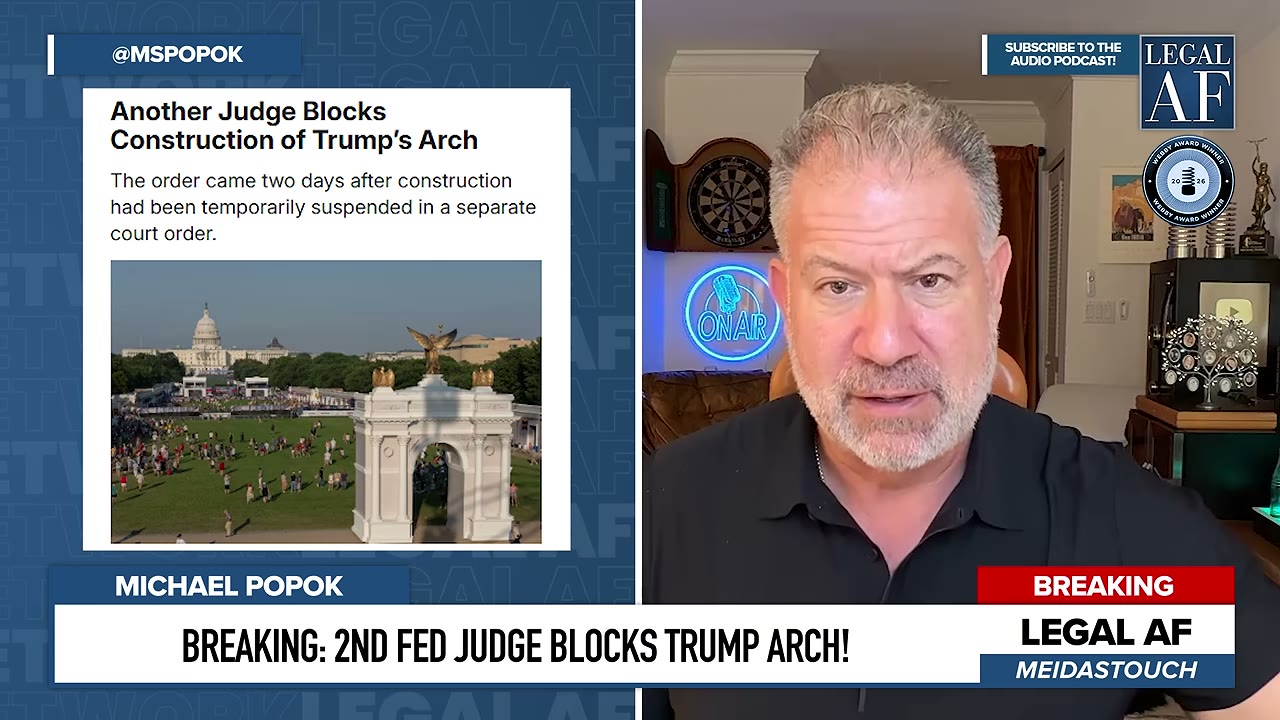
A second federal judge, Leonie Brinkema, issued a preliminary injunction halting Trump's planned 250-foot arch at Memorial Circle in Virginia. She found the project likely violates the Monuments Act and lacks congressional approval, and refused to stay her order so the government could appeal.
1Judge Brinkema Issues Preliminary Injunction Blocking Trump's Arch
A second federal judge has now blocked Donald Trump's planned 250-foot arch, issuing a preliminary injunction that bars the project for the duration of the case. Judge Brinkema of the Eastern District of Virginia overruled Judge Chutkan and went further than a temporary restraining order — a preliminary injunction is a level higher.
The order prevents Trump from even approaching the Memorial Ring, let alone preparing to build the arch, which sits in the traffic circle in Washington, D.C., and Virginia.
Brinkema is the second of three judges hearing the case, but she has emerged as the leader in stopping construction.
2Judge Brinkema's Record Closing the January 6 Fund
The judge now leading the fight against Trump's arch is the same judge who shut down his January 6 fund — a $1.776 billion pot Trump wanted to give to people who attacked the Capitol.
Judge Leonie Brinkema of the Eastern District of Virginia closed that fund and ordered the money not be used. She was appointed by President Clinton and holds senior judge status.
She does not tolerate nonsense in her courtroom, according to Michael Popok.
3Brinkema Grills DOJ Over Breakneck Speed and Standing
Judge Brinkema told a Justice Department attorney he was moving at breakneck speed for no reason — and questioned whether the government had any approval at all.
At a tense Friday hearing, she pressed Assistant U.S. Attorney Ben Hayes, saying: "You were moving at breakneck speed for no reason."
She noted the project lacks congressional approval. The lawsuit was filed by Arlington County in Virginia, and she found the county has the right to sue because construction and transportation issues will hit Virginia, especially Arlington County.
4Judge Rejects 1925 Authorization as Clearance for Arch
The 1925 congressional authorization Trump's team keeps citing only allowed two 165-foot columns — not a 250-foot arch, the judge said.
Brinkema told Hayes his "clearance ticket" argument was backfiring: "The more you talk about that 1925 case, the weaker your position becomes, Mr. Hayes."
She said the 1925 permit covered construction of the Memorial Bridge and a park at its end, allowing two ceremonial, commemorative columns of 165 feet. It did not allow a 250-foot mast, she said, or the 325-foot crane that would be used to build it.
Her key finding: the plan does not comply with the Monuments Act.
5Brinkema Reads Ruling Finding Arch Violates Monuments Act
The arch was planned and built arbitrarily, without congressional approval, in violation of the Monuments Act, Judge Brinkema wrote in her ruling.
In her memorandum on pages five and six, she said the county will likely succeed in its lawsuits "for many reasons," especially because the record shows the arch was planned and built arbitrarily and without reason, in violation of the Monuments Act and the National Park Service Organic Act.
The government argued the arch is not a memorial, but the Park Service's own statement calls it "the main memorial" and a landmark monumental structure to commemorate the nation's 250th anniversary. Trump said on Veterans Day he was considering having it honor veterans.
6Explaining Competing Injunctions and the Portfolio Litigation Strategy
Two federal judges in two different courts are now weighing the same arch — and that overlap is deliberate.
Judge Chutkan's temporary injunction has been extended until December 3 to give her time to rule on a preliminary injunction in a lawsuit filed by the state of Virginia, a veterans group and architectural historians. If she converts it, two competing preliminary injunctions will stand.
The split exists because Arlington County sued in its home jurisdiction, the Eastern District of Virginia, while Virginia and veterans groups sued where the monument is located, in Washington, D.C.
Different courts mean different appeals courts: the Fourth Circuit for Brinkema, the D.C. Circuit for Chutkan.
7Brinkema's Order Bars Site Work and Denies Stay Request
Judge Brinkema refused to pause her own order, telling the government to go straight to the Fourth Circuit if it wants relief.
Her injunction prohibits the National Park Service, the Interior Department, Secretary Doug Burgum and Comptroller Jessica Bourne from starting or continuing any site preparation, testing, land disturbance, excavation, demolition, equipment placement, utility installation, road closures, path blockages or barriers on or near Memorial Circle for the arch.
She found the government acted arbitrarily and capriciously under the Administrative Procedure Act and that the plaintiffs are likely to win.
She denied the government's request for a stay.
8Three Separate Lawsuits Target the Arch From Different Courts
Three separate lawsuits, three courts, three judges and two appeals courts are now aimed at Trump's arch.
One case is before Judge Chutkan, filed by a veterans group and a historical group joined by the Commonwealth of Virginia and others. Arlington County brought another. The Kennedy family filed a third, because Kennedy is honored at Arlington National Cemetery with an eternal flame.
Trump plans to install an eternal flame on the arch, according to the account. The Fourth Circuit, which would hear an appeal of Brinkema's order, is the same court where Trump consistently lost the Kilmer Abrego case.