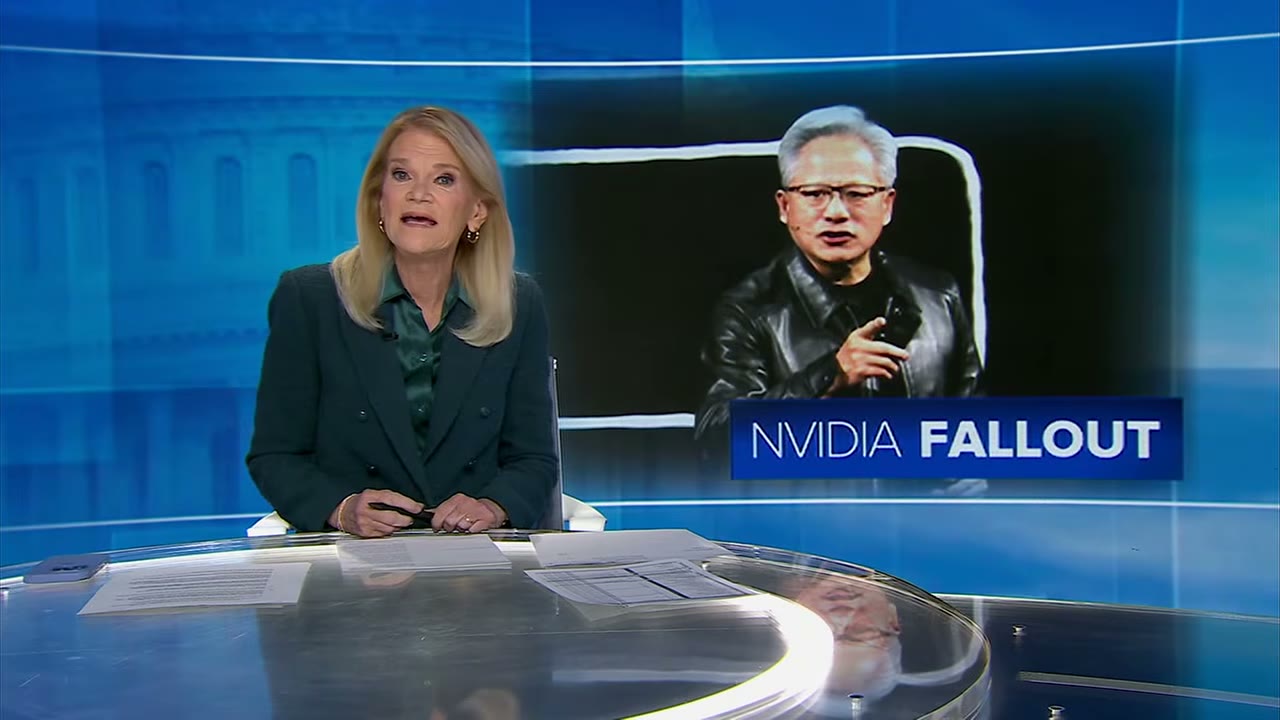
President Trump personally intervened to bring back Nvidia CEO Jensen Huang, overriding national security warnings and drawing bipartisan condemnation. Lawmakers allege a $19 billion chip diversion and spy ties, while female veterans head to Congress in record numbers.
1Jensen Huang Reinstated as NVIDIA CEO After Trump Intervention
Jensen Huang is back running NVIDIA less than two weeks after the board pushed him out — and President Trump is taking credit for the reversal.
Huang was reinstated Monday as leader of the chip giant, which drives the AI boom. His abrupt ouster followed reports of an affair with a woman U.S. intelligence believed was spying for China, plus reports of an affair with an NVIDIA executive.
Trump pressured the board directly, and the U-turn has drawn outrage across the political aisle. Huang testifies behind closed doors Tuesday to leaders of three House committees, then publicly before the Senate Banking Committee on Thursday.
2Trump Takes Credit for Huang's Return, Assures Board on Security
President Trump says NVIDIA's board would not have brought Jensen Huang back without him. "I believe my intervention was very important," he said.
Sources told ABC News that top administration officials gave the board critical assurances: Huang was not facing criminal charges and was not considered a national security risk over his reported affair with an alleged Chinese spy.
Trump initially insisted a Justice Department investigation had cleared Huang, saying officials "felt that he himself was exonerated." Attorney General Todd Blanche then muddied whether Huang had been investigated at all, saying the reporting and leaks didn't suggest Huang himself was under investigation.
3Trump Doubles Down on Backing Huang Despite Security Concerns
Asked how he could be sure Huang isn't a security threat, President Trump answered: "I think he's absolutely fine."
Pressed on what information that was based on, Trump said: "The information I have, which is a lot of information."
The backing marked a striking turn. Treasury Secretary Scott Bessent said earlier this month that NVIDIA needed new leadership and that the board should "go outside the company" — then reopened the door a week later, saying Huang "is on the outside now."
Huang's reinstatement came just 11 days after his downfall and briefly sent the stock soaring, though gains receded sharply. The New York Times reported NVIDIA is halting sales of some of its most advanced chips to four Southeast Asian countries that Chinese firms use to bypass export controls.
4Bipartisan Backlash and Schumer Vow to Investigate NVIDIA
Huang's return drew bipartisan condemnation on Capitol Hill, where lawmakers renewed concerns about national security risks.
"The risk remains that there could be information that a Chinese spy knows about a key individual in the supply chain," one lawmaker said.
Senate Democratic Leader Chuck Schumer vowed that come January, Democrats will use their full power to investigate any wrongdoing by the Trump administration, Huang, other NVIDIA executives, and "anyone selling out our national security for financial gain."
5Rep. McCaul: Huang Reinstatement Was a National Security Risk
Rep. Michael McCaul, a top Republican on the House Foreign Affairs Committee, says he would not have reinstated Jensen Huang.
"I think what he did was a national security risk," the Texas congressman said of President Trump's intervention, calling it unprecedented. He said he understands Trump was concerned about the economy and the stock market, with Huang a leader in advanced AI chips.
Three House committees — Foreign Affairs, the Select Committee on the Chinese Communist Party, and Intelligence — say they look forward to hearing from Huang and general counsel Tim Teeter on their roles in a potential national security breach.
6McCaul Details Alleged $19 Billion Chip Diversion Through Shell Company
Rep. Michael McCaul alleges NVIDIA diverted AI chips through a shell company whose CEO turned out to be an intelligence asset of the Chinese Communist Party.
The company, Megaspeed, "existed on paper only," McCaul said. He cited $12 billion in chips sold in 2024 and $7 billion in 2025, many of which would be illegal to sell in China and were diverted through the shell corporation.
McCaul, a former federal prosecutor, said he would make a case for willful blindness: "He should have known." He pointed to the Commerce Department's standard — know thy customer.
7McCaul: Alleged Spy Alice Huang Was a Chinese Intelligence Asset
Rep. Michael McCaul says Alice Huang, Jensen Huang's alleged affair partner, was operating on behalf of the Chinese Communist Party as an intelligence asset.
Asked whether Beijing sent her to meet the NVIDIA CEO, McCaul said he doesn't yet have all the facts in intelligence briefings. It's possible she was cultivated after the party saw she was having an affair with the top CEO of the top advanced chip company, he said.
He cited a memo by Secretary Rubio stating she was operating as an intelligence asset. He said he hopes the FBI has an open investigation, along with its foreign counterintelligence division.
8McCaul Criticizes Lack of Defensive Briefing for Jensen Huang
Rep. Michael McCaul says the Trump administration should have given Jensen Huang a defensive briefing warning him about a possible spy.
"I think they should have sat down with him," McCaul said, adding that Huang should have been briefed by the FBI and the intelligence community.
The Texas Republican said he finds it hard to believe Huang didn't know Megaspeed wasn't legitimate. "He denies over and over that this diversion of AI chips into China wasn't happening, when in fact, it was happening right under his nose," McCaul said.
9McCaul Calls Trump's Intervention Unprecedented, Seeks Export Control Fix
Rep. Michael McCaul called President Trump's intervention to reinstate Jensen Huang unprecedented — and said he doesn't think it was appropriate.
"I think that was a decision for the board to make," McCaul said, though he conceded Trump is entitled to act under his executive powers. He said Trump's motivation appeared to be the economy, since the AI industry drives it.
McCaul wants export control licensing moved, or jointly placed, under a national security regime rather than a department focused on profit and industry. He called the alleged diversion "borderline espionage."
10McCaul Predicts Bipartisan Legislation to Tighten Chip Export Controls
Rep. Michael McCaul predicts strong bipartisan support in the next Congress to fix the export control problem exposed by the NVIDIA scandal.
"It took an event as extreme as this one" to bring legislation he's promoted for years to the floor, McCaul said. He expects it to land in the National Defense Authorization Bill.
China hawks in the House and Senate will come together on it, he said — and he doesn't expect the effort to go against the president so much as to fix the problem.
11Professor Sonnenfeld Blasts NVIDIA Board as 'Weakest' and 'Shameful'
Yale's Jeffrey Sonnenfeld calls the NVIDIA board that reinstated Jensen Huang "the weakest board I've ever seen" — and "shameful."
The professor pointed to the celebrations as a "boys locker room," with a small number of tech CEOs rallying around Huang. He said no one from corporate America, from Dell and Amazon to Microsoft and Walmart, is rallying to his support.
Sonnenfeld said the stock is still down over 40% from its October high, and $2 trillion of shareholder wealth has been lost because of the misconduct.
12Sonnenfeld: NVIDIA Would Not Fail Without Huang, Cites Strong Interim CEO
NVIDIA would not have been at risk without Jensen Huang, according to Yale's Jeffrey Sonnenfeld. "Not whatsoever," he said.
He pointed to interim CEO Colette Kress, the CFO who stepped in after Huang was forced out. Five days later she ran the earnings call and "did a magnificent job," Sonnenfeld said. The company was up 25% on the quarter, and forecasts were up 75%, he said, with a strong report on the new Vera Rubin chip.
He contrasted this with bailouts of banks, General Motors and airlines during moments of national distress.
13Sonnenfeld: Trump's Intervention Is 'Assault on Free Enterprise'
Yale's Jeffrey Sonnenfeld says President Trump had no right to force a personnel change at NVIDIA — calling it "an assault on our free enterprise system."
Sonnenfeld said nothing in the wartime powers or national defense acts allows such a move on private enterprise. "This is much more Maoist," he said, arguing it isn't conservative economics.
He said it would lead Adam Smith, the 18th-century economist who wrote of the market's invisible hand, to roll over in his grave.
14Record Number of Female Veterans Elected to Congress
Thirteen female veterans will serve in the next Congress — a record. Three of them flipped Republican-held seats in this month's midterms, and all three are Democrats.
Army veteran Kate Conley, Marine Corps veteran Johanna Mendoza and Navy Vice Admiral Nancy Lacore are among the group. They met with ABC News ahead of taking office in January.
"Just when you meet each other, you feel this natural bonding, camaraderie," one said of the shared military background.
Conley said her district's high share of military families and veterans helped her win.
15Adm. Nancy Lacore Fired by Hegseth, Now Headed to Congress
A three-star admiral fired by Defense Secretary Pete Hegseth in August 2025 is headed to Congress — and will become the highest-ranking female military official ever to serve there.
Nancy Lacore spent 35 years in the Navy, rising to chief of the Navy Reserve. She won South Carolina's First District and takes office in January.
Hegseth fired her along with other senior military leaders. Lacore said she was not told exactly why. Asked what she thought it was, she said: "I don't really know."
16Kate Conley to Be First Female West Point Grad in Congress
Kate Conley will become the first female West Point graduate to serve in Congress.
The New York representative-elect spent 16 years in the Army, completing six tours in Iraq and Afghanistan. She enlisted after 9/11.
"It was the moment where I realized I felt the call to serve and went off to West Point," she said, adding she did four years there and 16 more on active duty, mostly in special operations.
She flipped a Republican-held seat in this month's midterms.
17Johanna Mendoza to Be First Female Marine Corps Veteran in Congress
Johanna Mendoza, known as Joe, will become the first female Marine Corps veteran to serve in Congress.
The Arizona representative-elect enlisted at 17 and became a drill instructor. She grew up in rural poverty and said military service was initially about pulling herself up by her bootstraps.
"My mom was not happy," she said. "I will tell you about that." But she stayed for "the love of country."
During her campaign, Mendoza started a group chat called the Hellcats with other female veterans running for Congress.
18Female Veterans Unite in 'Hellcats' Group Chat to Support Campaigns
A group chat called the Hellcats became a support network for female veteran candidates during the midterms.
Johanna Mendoza started it, naming it after the first female enlisted Marines. Kate Conley was part of it.
"It was really, I think, especially in the early days of the campaign, such a great just source of support and camaraderie," Conley said. "And then, yeah, we grew as more incredible badasses came in and said, 'I'm ready for this fight.'"
Thirteen female veterans will serve in the new Congress.
19Veterans Call for Diplomatic Solution to Iran War
The war in Iran and its economic fallout were central to these veterans' campaigns — and they say it's at a stalemate.
"We are at a stalemate, more or less right? With a blockade in place," Nancy Lacore said. "And I think at this point we need to call in the professional diplomats to start talking."
Johanna Mendoza said the U.S. cannot simply pull out of Iran and must develop a strategy, including diplomatic solutions. She said it won't happen overnight but believes it can in the next two years.
20Conley Questions Pentagon on War's Impact on Military Readiness
Kate Conley says the Pentagon won't answer how the war in Iran has affected the military's broader global readiness.
Conley supported U.S.-Israeli targeted strikes on Iran's nuclear program in summer 2025, but not the massive strikes President Trump and Israel launched this year.
"We can't get an answer from the Pentagon on how this war has impacted our broader global readiness and that of our military," she said. She also accused Pete Hegseth of purging the ranks of top military leaders, including one sitting next to her.
21Female Veterans Call for Hegseth's Impeachment and Accountability
Efforts to impeach Defense Secretary Pete Hegseth failed in the House earlier this month. Democrats may try again in the new year — but conviction would need Republican support in the Senate.
Asked if they want Hegseth impeached, the three veterans said yes. Johanna Mendoza said he should be "flat out removed" and also investigated for war crimes over what happened in Venezuela.
Hegseth has argued impeachment is an attack on service members themselves. Mendoza called that "not true," citing killed and injured service members.
22Trump intervenes to reinstate Nvidia CEO Jensen Huang, stock surges
President Trump personally intervened to reinstate Nvidia CEO Jensen Huang after the board ousted him — and the stock popped on the news.
Less than a week earlier, an interim CEO had told investors on an earnings call that Huang was out and would not be reinstated.
Trump has staked his economic legacy on the AI boom, and Nvidia has lost $2 trillion in value since the saga began a month and a half ago — about 6% of U.S. GDP. The stock came down a bit after its initial surge.
23Panel debates whether Trump administration is too close to AI industry elite
The Trump administration's move to reinstate Nvidia's CEO is playing well with AI executives — but not everyone else.
"This is not free markets," Donna Brazile said, calling it favoritism and pointing to questions about an affair with subordinates and possible export-control violations.
Ramesh said the administration has made a decision about what the economy needs and doesn't care about being isolated. He noted Stephen Miller as chief of staff and additional tariffs.
Congress returns tomorrow for briefings and testimony.
24National security concerns mount over Huang's alleged spy ties and Rubio warning
President Trump reportedly overrode his own national security adviser's written warnings about Nvidia CEO Jensen Huang.
Secretary of State Marco Rubio warned him in writing earlier this year about Huang and a security entanglement, according to the panel. Huang has reportedly said he had no idea about an alleged spy.
"What we're watching is a national security scandal unfold in real time," Susan said. She asked: "What did the president know, and when did he know it?"
Congress is set to change control, and investigations are expected.
25AI market jitters and new regulatory threats loom over Nvidia
Voters sent a clear message in the midterms: they don't want data centers in their communities. Nearly every ballot measure on the issue failed — except one.
They also elected governors in Texas and other states who want a pause on data centers, and the market took that seriously.
Lawmakers are now eyeing more AI restrictions, from export controls to broader regulation. Jensen Huang is set to testify before three House committees Tuesday and the Senate Banking Committee Thursday.
26Republicans split over China policy as Trump pivots toward Xi Jinping
Republicans who have long been hawks on China are raising questions about Trump's pivot toward Xi Jinping — and his Nvidia intervention.
Senator John Neely Kennedy of Louisiana has questions about Howard Lutnick, according to the panel.
Trump flew to Shenzhen, China, and met with the Chinese leader after the board ousted Jensen Huang — then came back and personally intervened to get him reinstated.
The question, one panelist said, is whether Republicans will join Democrats in the new Congress to put guardrails on Trump.
27Senate Democrats divided over Chuck Schumer's majority leader race
Chuck Schumer has just 16 public votes in his bid for Senate majority leader — 12 short of the 28 he needs. Thirty-three senators remain undecided, and rival Chris Van Hollen has seven, according to the latest public count.
The contest has split Democrats after a strong election showing. One analyst described it as "a much needed debate within the Democratic Party," framed around who sets the agenda and whether the leader will be aggressive.
The expanded coalition now includes senators from South Carolina, Mississippi and Alaska, and more progressive Democrats may push for a government shutdown over the Iran war — a stance one panelist doubted would play with those new senators.
Another called the infighting "divisive," saying it pulls focus from the agenda that won them office. The vote comes in a couple of weeks.
28The States Project helped Democrats win trifectas in 22 states
Democrats now control the governor's office and both legislative chambers in 22 states — the most trifectas the party has held since 1984. A little-known group called The States Project quietly laid the groundwork.
Co-founder Daniel Squadron said the win was hard to process. "It was hard to believe it was really happening," he said, describing the result as almost too shocking for euphoria.
Squadron traces the effort to 2010, when he served in the New York State Senate and Democrats lost the majority. He said the impact on his constituents and his own public service was "wildly dramatic," and he spent the next 15 to 16 years trying to change it.
The stakes are broad: statehouses control public school funding, the minimum wage and redistricting.
29Democrats crack 16 years of Republican dominance in state legislatures
For 16 years, since the 2010 Tea Party wave, Republicans dominated most state legislatures across the country. This year, Democrats broke that grip.
One analyst argued the biggest domestic policy shifts of the past decade — erasing the federal right to reproductive health care, gutting the Voting Rights Act and the Clean Water Act — came from the Supreme Court responding to state laws, not federal ones. The states, the analyst said, had driven it forward.
Actress Jay Smith Cameron, known as Jerri on HBO's Succession, joined The States Project as a top fundraiser. She said she had little interest in politics until Donald Trump was elected in 2016, then turned her focus to North Carolina, near where she grew up in South Carolina.
"It matters who we raise money for," she said.
30North Carolina flips as Democrats break Republican supermajority
Roy Cooper won his U.S. Senate race in North Carolina by 20 points — and that was enough to sweep Democrats back into power in the state House and break the Republicans' long-held supermajority in the state Senate.
Republicans had heavily gerrymandered state district lines after the 2010 Tea Party wave, holding the House and Senate for 16 years. This time, Democrats cracked it.
One Democrat called the result "a showing of the people power of North Carolina," saying voters threw out entrenched Republican majorities in every place that flipped because those majorities had disappointed them.
Asked whether Democrats were just surfing the blue wave, one speaker said the wave mattered — but for years conservatives had outperformed liberals at the state legislative level, and this year that didn't happen.