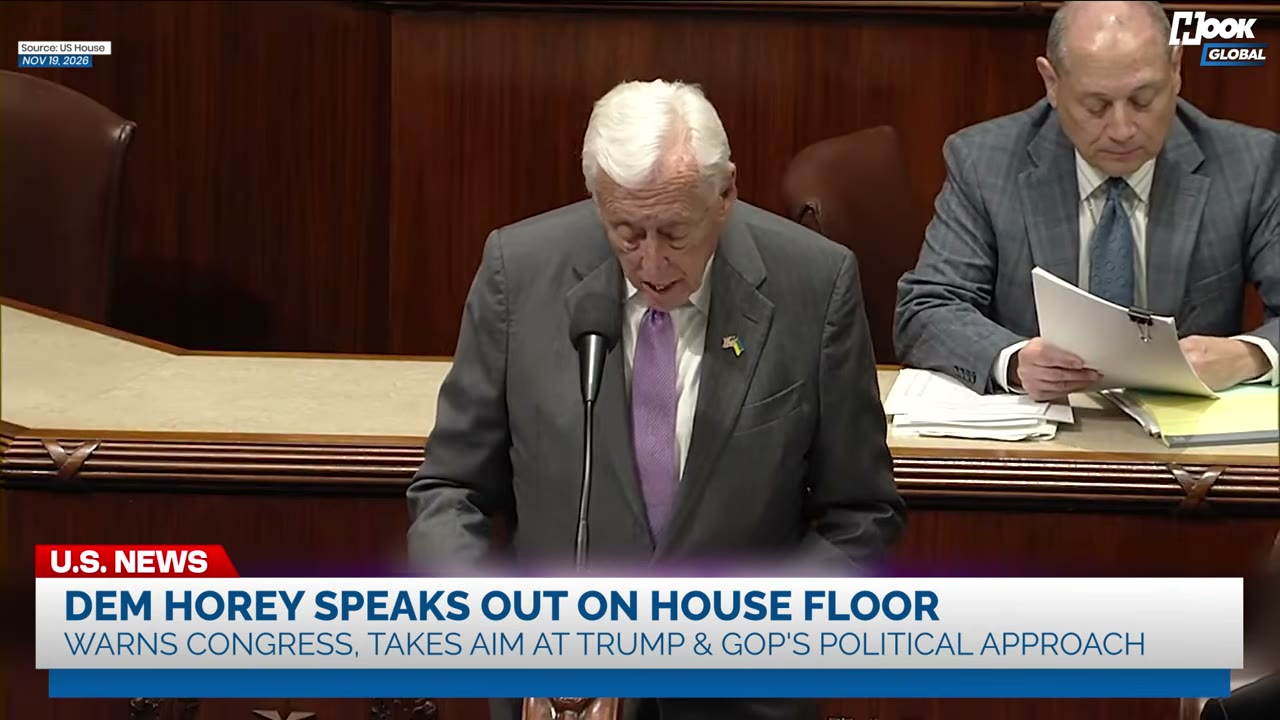
Steny Hoyer used his farewell speech to warn that American democracy is under threat, accusing Trump of defying sanctions law and blasting Congress for costly shutdowns and failed appropriations.
1Hoyer opens farewell speech questioning whether American democracy still works
A 45-year congressional veteran opened his farewell speech by asking whether American democracy still works. Steny Hoyer told the House that many Americans are now posing that question, and that Congress and its leaders must answer it.
Hoyer asked whether democracy remains the best way to protect rights, help communities prosper, give everyone an equal chance to be heard, and turn disagreement into consensus. His answer, after more than 60 years of work, was an unconditional "yes."
Yet he said voices at home and abroad increasingly call democracy too ineffective, too slow and too chaotic for modern problems.
2Hoyer says Trump and aides echo autocrats in demanding emergency powers
Hoyer said the view that democracy is too slow and chaotic is the worldview of Xi Jinping, Vladimir Putin and other autocrats. He then said it finds supporters among the current President of the United States and senior members of his administration.
Hoyer named Stephen Miller, Russell Vaught and Tom Homan as officials increasingly demanding emergency powers for the President.
He contrasted that with the Founding Fathers, who he said treated democracy as a big gamble.
3Hoyer explains the founders' theory of representative democracy
For the Founding Fathers, democracy was a big gamble — a leap of faith in ordinary people's wisdom and goodwill, Hoyer said. Voters would elect leaders capable of working together to solve problems and improve Americans' lives.
He described the working theory: empower elected representatives, then add checks, balances and accountability so power serves everyone, not personal enrichment.
Hoyer said House members serve two-year terms, and the only way in is to be elected, listen to your people and gain their trust.
4Hoyer reflects on three decades in House Democratic leadership
Hoyer said he was elected by his caucus to leadership positions for over three decades. The roles included caucus chair, co-chair of the steering committee, Democratic whip and majority leader.
That experience, he said, taught him how the institution should work — and what happens to democracy when it does not. He said the balance between success and failure almost always depends on leadership of both the majority and the minority.
Leaders rarely start with consensus, Hoyer said. Their job is to build enough for collective action by securing 218 votes.
5Hoyer recounts 2021 push to pass infrastructure and Build Back Better
Almost exactly five years ago, Democrats tried to pass two key economic bills: a bipartisan infrastructure bill and the Build Back Better Act. The Senate had already passed the infrastructure bill 69 to 30.
The only hurdle left was the House. One group of Democrats would vote for infrastructure only if it was linked to Build Back Better, then still in draft and not yet introduced. They feared infrastructure would become law and Build Back Better left in the dust.
Another group wanted a separate vote, believing the second bill was more divisive.
6House passes bipartisan infrastructure bill 228-206 after consensus deal
On November 5, 2021, the House passed the bipartisan infrastructure bill 228 to 206, with the support of all but one Democrat. Hoyer said the hard work paid off at the end of October as consensus began to emerge.
The two groups in the Democratic majority had taken firm, opposing positions. Hoyer said they managed not by dictate or threats.
Consensus, he said, requires patience, flexibility and a willingness to put yourself in the shoes of those you ask to go through a difficult path.
7Hoyer praises Speaker Jeffries as a master of consensus
Hoyer said the House has elected a person who understands the need for consensus almost perfectly: Speaker Hakeem Jeffries. He called Jeffries the first African American to serve as Speaker of the House.
Jeffries, Hoyer said, has worked diligently over the past four years of his leadership to bring people together.
Hoyer added that modern politics too often treats compromise as weakness and inflexibility as strength.
8Hoyer argues compromise is wrongly seen as weakness in modern politics
Saying no is easy, Hoyer said. Refusing compromise and being destructive are easy too. What takes skill is assembling a majority — 218 votes in the House or 51 to 60 in the Senate — while showing listening and humility.
He said his leadership experience taught him that compromise is not weakness, despite modern politics treating it that way.
In the 117th Congress, Hoyer said Democrats adopted what he called consensus psychology: stay together, but accept that principles or conscience may sometimes require going your own way.
9Hoyer credits 'consensus psychology' for the productive 117th Congress
Hoyer called the 117th Congress one of the most productive in modern American history, achieved by the slimmest of margins. He has served in 23 Congresses.
He listed the American Rescue Plan to get out of the pandemic, the bipartisan Chips and Science Act to revive manufacturing and secure supply chains, and bipartisan legislation expanding background checks for gun purchases.
With a margin of just four votes, he said, success required seeking consensus — listening to colleagues, understanding what they can support and adapting to reality.
10Hoyer cites 1990 Americans with Disabilities Act as bipartisan model
In 1990, as Democratic Caucus chairman, Hoyer worked across the aisle to pass the Americans with Disabilities Act. He named Republican Steve Bartlett, a former Dallas mayor, Republican presidential candidate Bob Dole, President George H.W. Bush and Democrat Tom Harkin among those who worked together.
Hoyer said tens of millions of Americans with disabilities have since experienced new opportunities, empowerment and restored dignity because of that consensus.
The negotiations were difficult and protracted, he said, but the bipartisan result was historic.
11Hoyer recalls bipartisan repeal of 'don't ask, don't tell' in 2010
As Majority Leader in 2010, Hoyer reached out to opponents to build consensus on repealing the discriminatory "don't ask, don't tell" policy.
He said many Republicans also understood how damaging it was to national security and democracy to bar Americans of color from serving openly in the military.
The bill passed with bipartisan support.
12Hoyer recounts 2013 bipartisan rescue of the Export-Import Bank
In 2013, Hoyer helped a group of Democrats and Republicans reopen the Export-Import Bank over the objections of the Republican chairman of the Financial Services Committee. Republicans held power at the time.
Hoyer said the bank plays a vital role in spurring American innovation, manufacturing and job growth. He worked with Oklahoma Republican Frank Lewis, then committee chairman, and many others to get the reauthorization bill out of committee and passed with votes from both parties.
He said it was considered critical to the country's economic growth.
13Hoyer tells voters Congress reflects the leaders they elect
Voters ask why lawmakers cannot agree, Hoyer said. His answer: we will do it as soon as you do. He said people react with bewilderment when told they are not ready.
As long as voters support people who come to the House for confrontation and opposition, he said, they should not be surprised to get a Congress of confrontation and opposition.
If they elect people on both sides who want to work together for the country, Hoyer said, they will get a Congress that will.
14Hoyer details bipartisan Ukraine support act and Russia sanctions
Sweeping sanctions on Russia won backing from about 86 percent of the Senate — 86 members — and 60 percent of the House. Steny Hoyer said he worked with Ranking Member Gregory Meeks, Representative Marcy Kaptur, Don Bacon, Brian Fitzpatrick, Bill Keating and Kevin Kiley to bring the Ukraine Support Act to a vote and pass it. Later, many worked with former Chairman McCaul, Chairman Mike Rogers, Representative Joe Wilson, Senators Graham and McConnell, and Senators Blumenthal and Shaheen to impose the most sweeping sanctions ever imposed on Russia. Hoyer called it consensus. President Trump signed the bill.
15Hoyer accuses Trump of betraying sanctions law he signed
President Trump signed the Russia sanctions bill — then, Hoyer says, he did the exact opposite of what the law required. A few days after signing, Trump refused to implement the sanctions it called for, according to Hoyer. Congress had reached consensus and the President had signed the law, but Hoyer said its purpose was not achieved. He called it "this act of betrayal" and said he remains proud of the bipartisan legislative victory, hoping it can still serve as the basis for strong American support for Ukraine, global democracy and international law.
16Hoyer says 2013 Senate immigration deal died under Hastert's rule
The Senate passed a bipartisan immigration bill 68 to 32 in 2013. Eight senators — four Republicans and four Democrats — crafted the deal: stricter border controls plus a path to legal status for those without a criminal record, expanded visas for professionals with in-demand skills, and stronger screening to ensure hired workers have legal status. Hoyer called it a convincing bipartisan victory. In the House, nothing happened. Speaker Boehner, facing a Freedom Caucus rebellion, decided not to try to get 218 votes with the Democrats because he couldn't get 218 on his own side.
17Hoyer blames Boehner for missing finest hour on immigration
Hastert's rule says if a majority of the majority doesn't support something, you don't put it to a vote. Hoyer said Speaker Boehner sometimes defied it in the country's interest, seeking consensus by bringing both sides together — as with an Export-Import Bank bill that passed with votes from both parties despite the committee chairman's opposition. But on immigration, Hoyer said what could have been Boehner's finest hour as Speaker was a missed opportunity because he and his team failed to display the same consensus psychology the Senate showed.
18Hoyer says appropriations failures and shutdowns betray the public
Congress fails its most fundamental test, Hoyer said: completing annual appropriations on time. He has served on the Appropriations Committee since 1983, with a brief break as Majority Leader and House Whip, and is its ranking Democrat. The cost of failure falls not on leadership but on the American people and those who deal with government every day, he said. Failures have brought too many shutdowns, forcing civil servants to go without salaries, lose the chance to work or work for free. He said failure shows up two ways: shutdowns and reliance on temporary resolutions.
19Hoyer compares Reagan-era brief shutdowns to modern lengthy ones
In Hoyer's 45 years in the House, the government was suspended 17 times. Nine came under Ronald Reagan and George H.W. Bush, lasting on average less than two days — usually weekend delays in reaching agreement. Since 1995, they've grown: Gingrich instigated a 21-day shutdown as a pressure tactic on the Clinton administration; 16 days in 2013 in an attempt to repeal the Affordable Care Act; 34 days in 2018 under Trump; and last year a record-breaking 43-day shutdown. Earlier this year, Homeland Security was partially closed for 76 days.
20Hoyer says four longest shutdowns cost the economy $40 billion
The four longest shutdowns of the last 20 years cost the economy $40 billion, Hoyer said. He pointed to Trump's Office of Management and Budget director, Russell Vought, saying the appropriations process should be less bipartisan — "The process needs to be less bipartisan," Hoyer quoted Vought as saying. Hoyer also said Trump told Republican leaders not to negotiate with Democrats: "Don't even try to deal with them." Hoyer called this the opposite of consensus psychology — the idea that Americans owe it to voters to come together across parties.
21Hoyer warns against governing by temporary budget resolutions
The last time Congress passed all its appropriations bills before a new fiscal year began was 1996 — 30 years ago. In 16 of the last 20 fiscal years, including 2027, Congress failed to pass a single appropriations bill on time, meaning before September 30. Hoyer said temporary resolution mode keeps lengthening: an average of 108 days a year from FY 2001 to FY 2010, then 142 days the next decade, 160 days in FY 2024, 165 days in FY 2025, and 211 days for the just-completed financial year.
22Hoyer blames the Senate for never debating appropriations bills
Not one appropriations bill reached the Senate floor for debate until the end of September this year, Hoyer said — though all 12 were supposed to be considered, adopted and signed by September 30. He blamed the Senate as the main reason, saying Republicans and Democrats there regularly feel they lack time in session to consider the bills. House leadership, he said, now expects the fiscal year to end without all legislation passed. Every failure to fund government on time, he said, is a vote of no confidence in Congress and democracy.
23Hoyer says fixing appropriations would restore trust in Congress
Fix appropriations and Congress takes a big step toward restoring trust, Hoyer said. When neither side can act alone, he said, the choice is consensus or failure. Leadership on both sides must count to 218 votes — half plus one in the House — regardless of which party supplies them, and plan for the Senate from the start rather than pass bills with no chance there. Hoyer said leadership's goal is always to make Congress work for the American people, whether on spending legislation or a policy program.
24Hoyer recalls razor-thin 117th majority that still legislated
Democrats held the House 222 to 212 in the 117th Congress — a margin that allowed losing only five votes, shrinking at times to three because of vacancies. The Senate was split 50-50, with Vice President Harris as the tie-breaking vote. Despite that razor-thin margin, Hoyer said, they consistently passed important legislation, delivering on promises and showing Congress can work for the people. He called it consensus building: not agreement on all points, but understanding that consensus is necessary to move forward in a democracy.
25Hoyer contrasts 118th Congress dysfunction with 117th success
The 118th Congress faced the same overwhelming odds but couldn't reach consensus, Hoyer said. He said management couldn't get agreement because many wanted to see it fail. Previous Republican speakers engaged with the opposition and paid the price, losing support in their own Congress, he said. The result: division instead of team spirit, threats instead of flexibility toward members from difficult constituencies, and compromise treated as weakness. Hoyer disagreed, comparing compromise to a marriage and to negotiating bedtime with children: 8:30, not 8:00.
26Hoyer rejects Speaker Johnson's claim this is the most productive Congress
Speaker Johnson declared on September 1 that the 119th Congress was "literally the most productive, successful, and active since '49" and put himself in the top five of all time. Hoyer said he exaggerated and was wrong. In many cases, Hoyer said, no consensus was reached on either side about what legislation should advance. "I think the speaker is confusing noise with music, and fuss with achievements," Hoyer said. The American people don't give Congress a medal for participation, he said — they are disappointed and right to be angry.
27Hoyer closes with warning that integrity without results breeds contempt
Forty-five years in Congress and 25 years in leadership taught Steny Hoyer one lesson he says the last election proved: integrity without results breeds contempt.
Speaking in the House, Hoyer said voters answered with fear and disappointment at the polls. Rigidity, he argued, is a weakness, not a strength, and refusing to work for compromise weakens democracy itself.
He pointed to the next leadership team, saying he is confident Speaker Jeffries will seek consensus — and hopes he will work with new Minority Leader Mr. Jordan to build it for the whole country, not one party.
His closing advice to colleagues: "Lead with a focus on consensus, collaboration, and success, not a 'my way or the highway' attitude." He urged Americans to seek harmony in their neighborhoods, communities, states and country, warning that a house divided cannot stand.