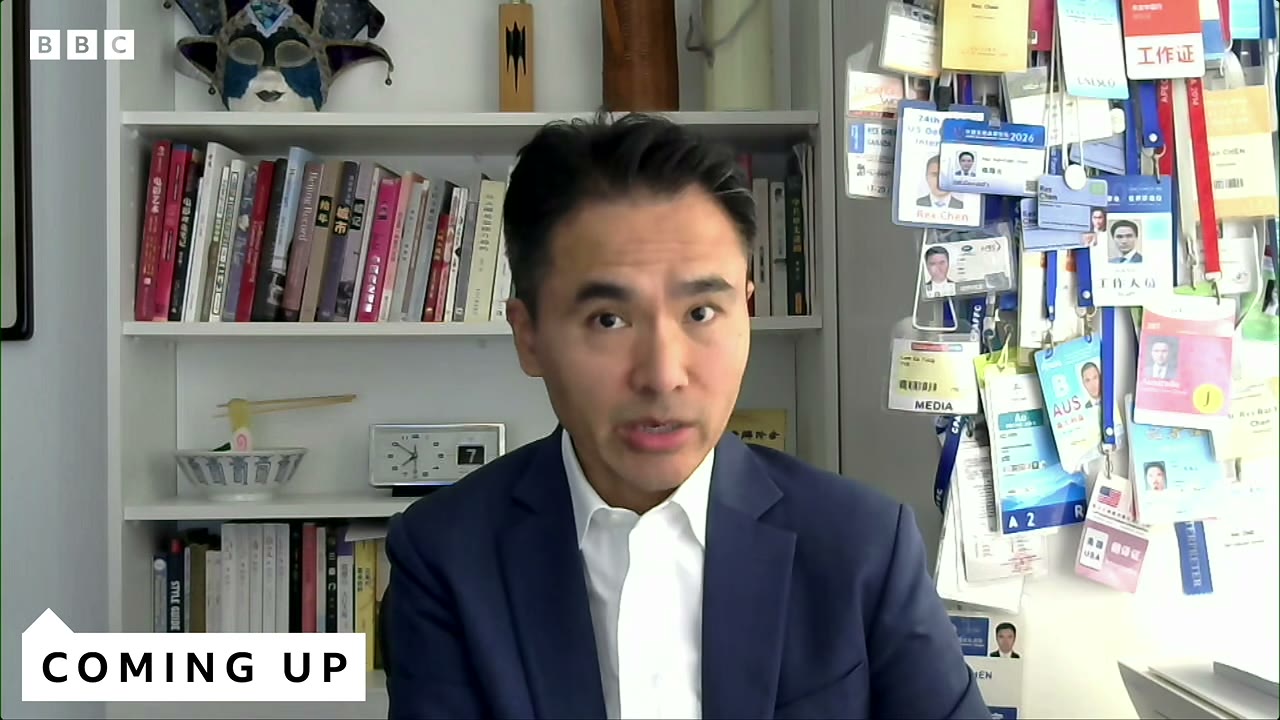
Interpreters Rex Chen and Handewi Pramesti discuss how AI translation is disrupting their profession, from lost gigs to machine errors. One predicts AI will wipe out general-purpose interpreters within five to ten years, while both defend human nuance and the value of learning languages.
1Interpreter Rex Chen predicts AI will replace general-purpose interpreters in 5-10 years
A veteran interpreter says AI will wipe out human interpreters within a decade. Rex Chen, an Australian interpreter based in Beijing, predicts the technology will replace general-purpose interpreting in five to ten years — even for serious business meetings.
Chen said AI interpretation currently faces three big challenges: accents, special terminology and a mix of language. But he believes machines will overcome these difficulties.
"Given time, AI will overcome these difficulties and they will wipe us out," he said.
He gave the timeline himself: five to ten years for general-purpose interpreting. The really high-stakes work, such as legal and high-level political meetings, may keep humans for a little longer, he said.
2Podcast asks whether AI translation makes learning a foreign language pointless
If AI keeps getting better at translating, is learning another language still worth it? That question sits at the heart of a new discussion on the future of interpreters.
Interpreters have long stood in the middle, breaking down language barriers. The question now is for how long.
For high-level meetings where every word counts, can technology really replace the human touch of the person in the middle? And what does the AI disruption mean for students trying to master a foreign tongue?
The discussion brings in voices from both sides of the language divide.
3Interpreters Rex Chen and Handewi Pramesti introduced with decades of high-stakes experience
Two interpreters with decades of high-stakes experience have joined the discussion. Rex Chen is an Australian interpreter based in Beijing, China.
He has been interpreting for more than 20 years, covering political, business and cultural work. He has also handled dozens of high-stakes international legal arbitration cases.
Handewi Pramesti has been interpreting for 24 years, working between English or French and Indonesian. Her work has taken her to business events, conferences and even simultaneous interpreting on ships.
Both now face the same question: what happens to their profession as AI improves?
4Interpreters explain the difference between translation and interpretation
Translation and interpretation are not the same job, and one interpreter wants to clear up the confusion. Translation means dealing with written text, while interpretation is the rendering of oral speech into oral speech.
Dewi said she doesn't mind when laypeople use "translation" loosely for any rendition of words from one language to another. But she prefers precision.
Technology is blurring the line, she said, because machine interpreting employs translation as one of the links in the process.
"When I introduce myself, I'm mainly an interpreter, but I also do translation," she said.
5Simultaneous interpretation began at the Nuremberg Trials in 1945-46
Simultaneous interpretation as a profession began at the Nuremberg Trials in 1945 to 1946. At the time, many former Nazi soldiers had to be tried, and proceedings had to be delivered in many languages.
Organizers innovated to get the job done in a shortened time. That is when simultaneous interpretation began.
The profession is relatively new, one interpreter noted — a young trade born out of one of history's most closely watched legal proceedings.
Before that, colonial powers arriving in new countries likely had no interpreter to converse with locals.
6Speak CTO Andrew Hsu says AI language tools will make fluency cheaper, not kill demand
AI is often named among the technologies that could replace translators and interpreters. Andrew Hsu uses it to teach languages instead.
Hsu co-founded and is chief technology officer of Speak, an app that teaches languages using AI voice recognition. He is based in California.
"Our main business is teaching English in APAC, but we also teach a bunch of other languages in the US, Europe," he said.
The app uses a speaking-first, functional-first curriculum. It builds custom speech recognition models and uses frontier AI models to understand learners, even those with heavy accents, and give feedback on sounding more native.
7Andrew Hsu argues real-time translation won't replace human need for connection
Real-time audio translation models are already pretty good and will become extremely good, according to one AI language app founder. He doesn't think they will replace why people learn languages.
Andrew Hsu, co-founder and CTO of the app Speak, said users in South Korea, Taiwan and Japan describe learning English as a story about self-improvement, career advancement and human connection.
He argued that as AI makes fluency easier and cheaper, more people will become interested in learning.
"I don't think that is going to replace this fundamental human need for connection," he said.
8Interpreter Dewi lost a job after client chose AI translation instead
Interpreter Dewi was ready with her quotation and set to leave Indonesia, possibly for Vietnam, when the agency that recruited her called it off. The end user had decided not to use an interpreter and would use AI or machine translation instead.
"I lost my gig at that time," she said. It was a sign she had to do something.
Her response: continuous learning and sharper expertise, such as medical or law enforcement interpretation. She said there is a politeness and protocol that AI cannot access.
She believes the market for human interpreters may become very niche in the future.
9Rex Chen says AI is squeezing out whispered interpreting at Chinese conferences
In China, conferences are putting machine translation results on screens as subtitles, and human interpreters are feeling the squeeze. Rex Chen, who mostly works in China, said organizers there are very happy to test new technologies.
He has not knowingly lost a gig to AI, but said it is entirely possible it has happened.
He described a common scenario: a Chinese-language corporate event with a non-Chinese-speaking European boss. Normally the company might hire someone like him to whisper interpretations to that one person.
Now, he said, they hand the boss a device that puts text in front of him instead.
10Chen calls AI translation unstable and unpredictable despite good quality
AI can produce very good translation and interpretation, but Rex Chen says it is unstable and unpredictable. He compares it to a prodigy with really good abilities but unstable behavior.
"You never know what they're going to do," he said.
In one ChatGPT chat, he set the instruction to always interpret between Japanese and English. The model sometimes forgot, repeating his English or answering his questions instead of interpreting them. A simple statement could turn into a long essay.
He also saw a screenshot of complete gibberish, supposedly Chinese, at the bottom of a presentation at a business school. It came from a world-leading technology company, but the application was based on five-year-old technology.
11Dewi says AI misses Indonesian politeness nuances, calling officials 'kamu'
In Indonesian, there are two words for "you": "kamu," which is informal, and "anda," which is polite. Dewi said she watched a video where a head of countries used AI as an interpreter, and the machine addressed a high officer with "kamu."
"It is quite annoying," she said.
She compared it to the French "tu" and "vous," or the Indonesian "aku" and "saya" — the same meaning, a different level of politeness. English has only "you."
She said such nuances cannot be replaced by AI, at least for now. In the future, she believes the market for human interpreters may become very niche.
12Chen lists accents, terminology and mixed languages as AI's three biggest challenges
Accents, special terminology and a mix of language are the three biggest challenges facing AI interpretation today, according to Rex Chen. He is not dumping on the technology — he says it is becoming very good.
He compares it to a prodigy who doesn't know how to properly do the job: you need to teach it the techniques and ethics.
"Given time, AI will overcome these difficulties and they will wipe us out," he said.
He gives it five to ten years for general-purpose interpreting, even for serious business meetings. Really high-stakes scenarios like legal and high-level political work might retain humans for a little longer.
13Interpreters debate whether AI can handle tone in presidential-level meetings
Can a machine catch the tone when the US and Chinese presidents meet? One interpreter says no. "I can't possibly imagine like the American and the Chinese presidents meeting without a human interpreters using just a translating machine," they said.
Most language models work in two steps: automatic speech recognition turns speech into text, then the computer translates that text. The tone gets separated from the words, and may be lost.
Some teams are working on spoken-to-spoken rendering, but the vast majority of models still do dictation first. That gap, the interpreter said, can be tricky for today's AI.
14Dewi disagrees with Chen, says humans and AI can be friends and complement each other
One interpreter says humans and AI can be friends. Dewi said people can learn how the machine works and improve what it cannot do — especially nuances, jokes and rhymes that Indonesians like to make in meetings.
She pushed back on Rex's view. "I disagree with what Rex said," she said, arguing that because AI is developed by humans, it has weaknesses humans can still address.
She did not put a date on it. Asked how long the human edge lasts, she said: "I don't know, or how long it ten years."
15Interpreters urge young language learners to continue despite AI
You won't fall in love using an AI translation. That was the message to young language learners weighing whether the effort is still worth it.
Rex compared learning a foreign language to learning to sing: you won't match streamed songs, but it's enjoyable and a fascinating skill. It helps you see things from a different perspective, he said, and nothing compares to communicating with people from another culture in their language.
He added that speaking someone's language earns more respect from native speakers, and a sense of appreciation for another culture.