A countdown of the French army's ten most modern combat vehicles, from the 1976-era VAB to the digital Leclerc XLR tank. The video details armor, firepower, sensors and combat records, highlighting France's shift toward networked Scorpion-program warfare.
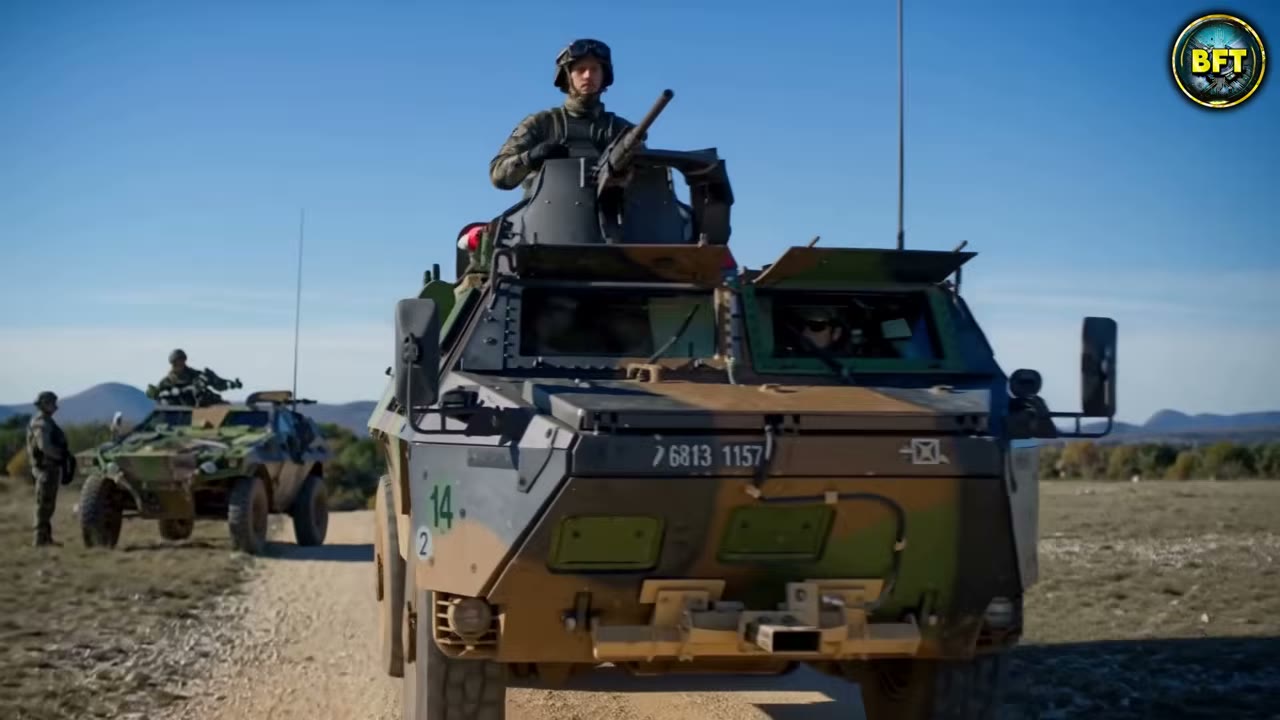
1VAB: France's 1976 'combat taxi' nears retirement after 5,000 units
France's VAB armored personnel carrier has served since 1976 — older than most soldiers who ride it today — and is now being retired after more than 5,000 were built. The all-wheel-drive "combat taxi" carried up to 10 fully equipped soldiers at speeds of up to 110 km/h, and could swim rivers at 8 km/h using water cannons. Weighing about 13 tons, it saw combat from African deserts to European swamps. A 12.7mm machine gun or anti-tank missile launchers could be mounted on the roof. France is replacing it with high-tech digital vehicles.
The VAB earned its reputation on simplicity and endurance, setting the standard for what came after it.
2VBMR-L Serval: digital scout vehicle with gunshot detection
The VBMR-L Serval carries an acoustic gunshot detector that instantly tells its crew the direction of fire — the machine determines a shooter's exact location before the shooter has time to pull the trigger. The all-wheel-drive vehicle, weighing 15 to 17 tons, is one of the high-tech replacements for the old VAB under France's Scorpion program. It carries up to eight fully equipped soldiers with a 375 hp engine, reaching 100 km/h with a range of 600 km.
Inside, it has 360° cameras, laser warning sensors and electronic suppression equipment to neutralize improvised explosive devices. Its remotely controlled module — a 12.7mm heavy machine gun or 40mm automatic grenade launcher — is fired by joystick from inside. C-130 or A400M aircraft can deploy it anywhere at short notice.
3VBMR Griffon: 24.5-ton six-wheeled carrier with Scorpion network
The VBMR Griffon weighs 24.5 tons and shares battlefield targets in real time. The six-wheeled armored personnel carrier links every unit through the Scorpion combat information system: if a drone or other vehicle spots a target, the Griffon instantly receives precise coordinates on its command screens. It carries two crew and up to eight infantrymen, with a 400 hp engine reaching 90 km/h and a range of 800 km.
Its sensors detect gunshots and laser radiation, and its combat module mounts a 12.7mm or 7.62mm machine gun. Armor protects soldiers from heavy machine gun bullets, artillery fragments and mine explosions. France has created more than 10 variants, including command posts, ambulances and artillery observation posts.
4AMX-10RC: 105mm wheeled gun with adjustable hydropneumatic suspension
The AMX-10RC puts a 105mm gun on a fast six-wheeled chassis — and its hydropneumatic suspension lets the driver adjust the vehicle's height on the go, tilting it forward, backward or sideways. It can hide behind low hills, bring its cannon out to fire, then hide again like a sniper. The 16-ton reconnaissance vehicle, introduced in the late 1970s and upgraded over the years, hits targets beyond 2,000 meters.
A 280 horsepower diesel engine gives it 85 km/h on roads and 40 km/h off-road. It turns on the spot using a side-turning system like a tracked tank. It proved its worth in desert combat during the Gulf War.
5VBCI: 28-ton eight-wheeled infantry fighting vehicle
The VBCI, France's eight-wheeled infantry fighting vehicle, gained a reputation for saving soldiers' lives after being hit by multiple grenade launcher rounds and landmine explosions in Afghanistan and Mali. Weighing 28 tons, it carries 11 soldiers — a two-man crew and nine infantrymen — into dense fire. A 550 horsepower diesel engine pushes it to 100 km/h with a range of 750 km.
Its 25mm NATO-standard automatic cannon fires 300 rounds per minute, backed by a coaxial 7.62mm machine gun and thermal sights for day and night. The aluminum-titanium armor hull protects against large-caliber machine gun bullets, artillery fragments and mines.
6Caesar: truck-mounted 155mm howitzer fires six shells then escapes
France's Caesar artillery system can stop, deploy its cannon, fire six heavy shells in less than 60 seconds, and be gone before the first shell hits its target. When enemy counter-battery radar detects the fire and opens fire in return, Caesar is already 2 km away. The 155mm 52-caliber howitzer sits on a six- or eight-wheeled truck weighing around 18 tonnes, traveling over 80 km/h with a range of 600 km.
It hits targets up to 40 km away, or 55 km with active-reactive projectiles. A crew of five operates it, though three can fire it in emergencies. It has seen fierce battles from Iraq to Ukraine.
7Leclerc: 57-ton tank with three-man crew and 12 rounds-per-minute autoloader
France's Leclerc main battle tank fires 12 rounds per minute with a crew of just three — commander, gunner and driver — thanks to an automatic loader inside the turret. Most Western tanks such as the American Abrams or German Leopard 2 need four. The 57-ton tank, named after General Philippe Leclerc, loads its 120mm smoothbore gun even while moving at full speed over rough terrain.
A 1,500-horsepower Hyperbar V8 diesel combined with a gas turbine pushes it to 71 km/h on roads and 50 km/h off-road. Its hunter-killer fire control lets the commander track one target while the gunner engages another, destroying enemy tanks beyond 4,000 meters day and night.
8EBRC Jaguar: 40mm gun and Akeron missiles for digital reconnaissance
The EBRC Jaguar packs a 40mm gun firing 200 rounds per minute plus two Akeron MP anti-tank missiles that strike beyond 4,000 meters — even beyond direct visibility. The 25-ton six-wheeled reconnaissance vehicle succeeds the AMX-10RC, with a 500 horsepower engine reaching 90 km/h and a range of 800 km.
Its hydraulic suspension adjusts ground clearance to hide behind cover, and it carries active protection systems and missile suppression. The three-man crew shares target data with nearby tanks and drones through the Scorpion digital network, while touch screens and thermal imaging give full situational awareness.
9Caesar NG: armored cabin and 460-horsepower upgrade for artillery
The Caesar NG — "new generation" — gives the battle-proven artillery system a heavily armored cabin with second-level ballistic and mine protection, shielding its crew from small arms, shell fragments and improvised explosive devices while moving or firing. It keeps the 155mm 52-caliber gun, which fires up to six rounds per minute beyond 40 km, or over 55 km with rocket-propelled grenades.
A 460-horsepower engine and new automatic transmission move the heavier chassis over extreme off-road ground. Automated loading lets the crew deploy, fire a salvo and collapse in under 60 seconds without leaving the armored cockpit. It is built to survive battlefields saturated with enemy drones and counter-battery radars.
10Leclerc XLR: fully digitalized networked main battle tank tops the list
France's top combat vehicle is a 60-tonne tank rebuilt to swap battlefield data with drones. The Leclerc XLR takes first place among the French army's most advanced armored vehicles, an upgrade of the classic Leclerc that appeared fourth on the same list.
Its biggest change is full integration into the Scorpion network through the SICS combat control system. That lets the XLR instantly exchange tactical data, target coordinates and battlefield imagery with Griffin armored personnel carriers, Jaguar reconnaissance vehicles and friendly drones.
Protection got a major boost for urban combat: reinforced side screens, mesh anti-cumulative screens over the engine compartment and mine protection under the hull. A new remotely controlled roof module with a 7.62 mm machine gun lets the commander engage infantry and enemy drones while staying inside.
The 120 mm smoothbore gun, 52 calibers long, and its automatic loader remain, now firing modern programmable smart ammunition. Its 1,500 horsepower engine still pushes it to 71 km/h.