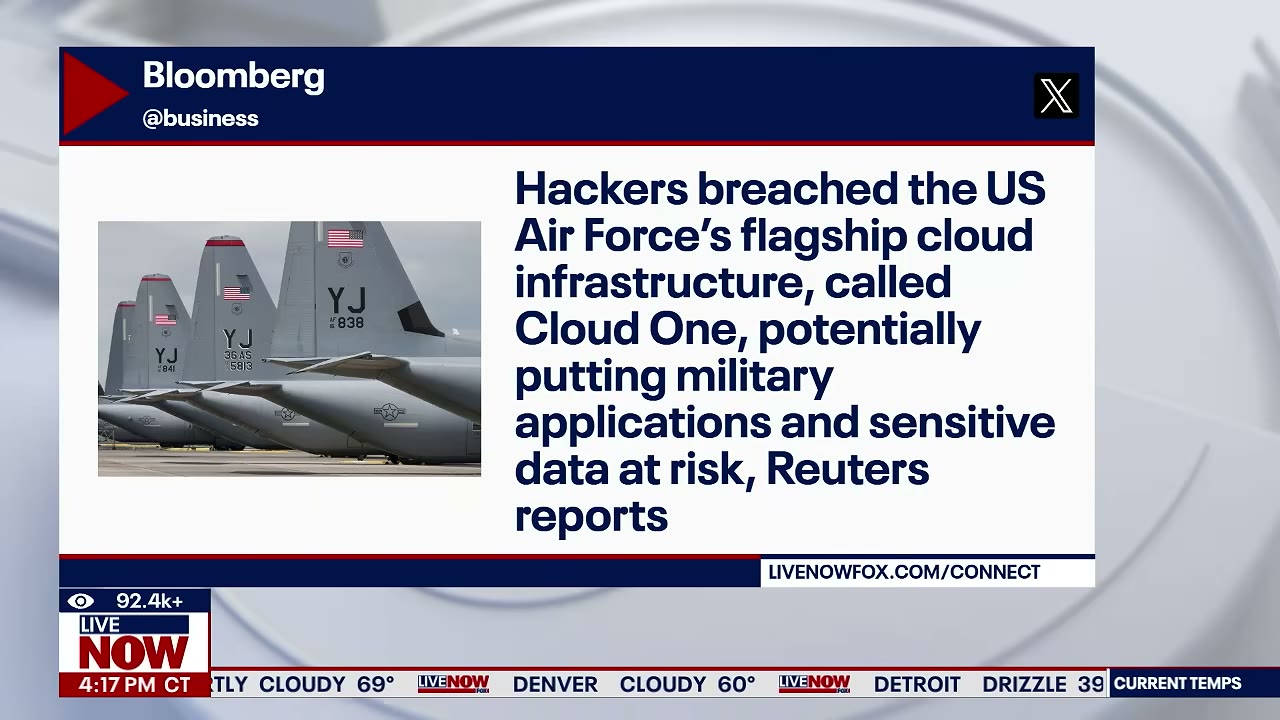
Reuters reports hackers breached the Air Force's main cloud platform, Cloud One, potentially exposing logistics and personal data. A national security analyst says the platform supports air defense facilities at about 200 locations worldwide and warns of broader cyber threats.
1Hackers breach US Air Force Cloud One platform, Reuters reports
Hackers have breached Cloud One, the US Air Force's main cloud platform, according to a Reuters report. The report, cited by many news outlets and their sources, says the breach potentially compromised a large amount of logistical and personal data.
The vulnerability was reportedly discovered during a system update last month.
Asked about it, an Air Force spokesperson told Fox News Digital that the Department of the Air Force does not comment on the security status, vulnerabilities, or operational status of specific networks and systems. The spokesperson said the department continually takes reasonable steps to protect its information systems and mission capabilities, and that ensuring the security, resilience, and availability of its most critical military assets remains a top priority.
2Analyst explains Cloud One's role across Air Force and Space Force
Cloud One is used across both the Air Force and the Space Force, and it reportedly served as a basis for maintaining air defense facilities at about 200 locations worldwide, according to Gal Kaempfer of the STRAT podcast.
Kaempfer described it as a ubiquitous cloud platform that is very widely used in both services. Early talk focused on compromised administrative details and personal data, he said, but information is now emerging about its role in air defense — the roughly 200 locations, missiles and everything else.
He said it is unclear how large the breach is, but that the platform is large, calling into question not only what was lost but also the security situation on some of these cloud platforms.
3Analyst questions reliance on cloud after breach and AI risks
The move to the cloud was actively promoted on the promise that encryption would keep data safe, but the rise of AI raises new questions about that dependence, analyst Gal Kaempfer said.
"I think there are a lot of questions about whether we should reconsider this dependence on the cloud, because it's obviously a huge problem," he said.
His comment came after many other events, he added.
4Analyst lists prior hacks of NSA, FBI, CIA and intelligence systems
The reported Air Force breach lands after a string of hacks on US intelligence and law enforcement systems, according to analyst Gal Kaempfer.
He said the NSA network was hacked, FBI databases were hacked, and the National Crime Information Center database was hacked. The CIA had a system that was hacked, and the Office of the Director of National Intelligence had a system that was hacked.
Kaempfer said many things could have been written off as some kind of update, and that it may be worth going back to see if anything was actually done. Much remains unknown about what exactly could have been stolen and what, if anything, could have been targeted.
5Analyst warns attackers could manipulate air defense data
If attackers can manipulate the data inside Cloud One, they could disrupt US situational awareness of air and missile defense, analyst Gal Kaempfer warned.
He said the threat runs in stages: first, stealing information; then going in and starting to manipulate data, perhaps causing mistakes and disrupting awareness of what is going on in the world. Many subtle changes can be made, he said, and it all depends on how serious the break is.
"If they can go in there and start manipulating the database, that's very scary, especially when it comes to maintaining awareness for air and missile defense," he said. He said this can lead to potentially very bad consequences, and there are also all the personal matters.
6Analyst warns stolen Pentagon personnel data could enable crime
What the Pentagon keeps on its military and civilian employees goes far beyond a date of birth or a Social Security number, analyst Gal Kaempfer said.
He said personal identification data is constantly discussed as something that must be protected, and that the Pentagon's records are much more extensive than basic details.
He said there is a serious possibility that stolen data could be used for other purposes, "even criminal ones."
7Analyst says string of agency hacks is unlikely coincidence
Treating the recent hacks on US agencies as a coincidence now puts you in the minority, analyst Gal Kaempfer said.
Asked about the attacks coming relatively close together in time, he said everyone is starting to see this is not just a coincidence, and that statistically it defies any idea that it is all just chance.
He said he is not claiming everything that happened was someone's deliberate plan, but that many of these events are clearly related to attackers interfering with US systems. That, he said, raises a lot of questions about cybersecurity protocols.
8Analyst says AI fuels cybersecurity race with adversaries
Artificial intelligence is very good at detecting vulnerabilities — and that skill can be used for protection or for offense, analyst Gal Kaempfer warned.
The question, he said, is whether the US can keep up as quickly as opponents and enemies who are discovering these things, and whether it can implement fixes and stop the violations.
"This will be a real race," he said. He cited a comment from about a week ago that there is a very difficult road ahead over the next two years in trying to overcome the threat.
9Analyst points to Iran and Russia as likely culprits behind hacks
Analyst Gal Kaempfer said he immediately looks at Iran and Russia as likely participants in the hacks.
He noted that back in September, the FBI appeared to report on a group called Shiny Hunters that it was studying, but said there are others. Many of these events coincide with what is happening in Iran and what Russia is doing in the area of hybrid warfare, he said.
"Many of these hacker groups are directly linked to Russia," he said.
10Analyst links cyberattacks to vulnerabilities in maritime shipping
Iran boasted that it damaged about 50 ships in the Strait of Hormuz, analyst Gal Kaempfer said, pointing to the vulnerability of maritime transport to cyberattacks.
Kaempfer, who works in maritime security, said the risk has been discussed for years. He said four ships in the Caribbean heading to US ports had to be boarded by the Coast Guard because their systems had also been hit by cyberattacks. A few weeks ago, a ship heading to the port of Houston that had been broken into had to be stopped, he said.
He recalled a whole series of such cases, including an incident in Mississippi involving a cruise ship in a collision. Many questions remain about whether these things are random, coincidences, or the actions of the enemy, he said.
11Analyst discusses podcast on electromagnetic pulse and Russian space threat
A nuclear blast in space could knock out up to 98% of all satellites in orbit, an analyst warned while discussing electromagnetic pulse. The analyst, Gel, said the new "Strat" release focuses on EMP and what it would do to objects on Earth as well as in orbit.
He pointed to reports from a few days earlier that the Russians are allegedly preparing to launch nuclear weapons into space soon, which he said would violate the 1967 treaty. He called that a huge escalation.
Gel said the timing is a coincidence: the material was prepared before that news broke.
What happens next is unclear from his remarks, which covered the threat and its potential scale rather than any response.