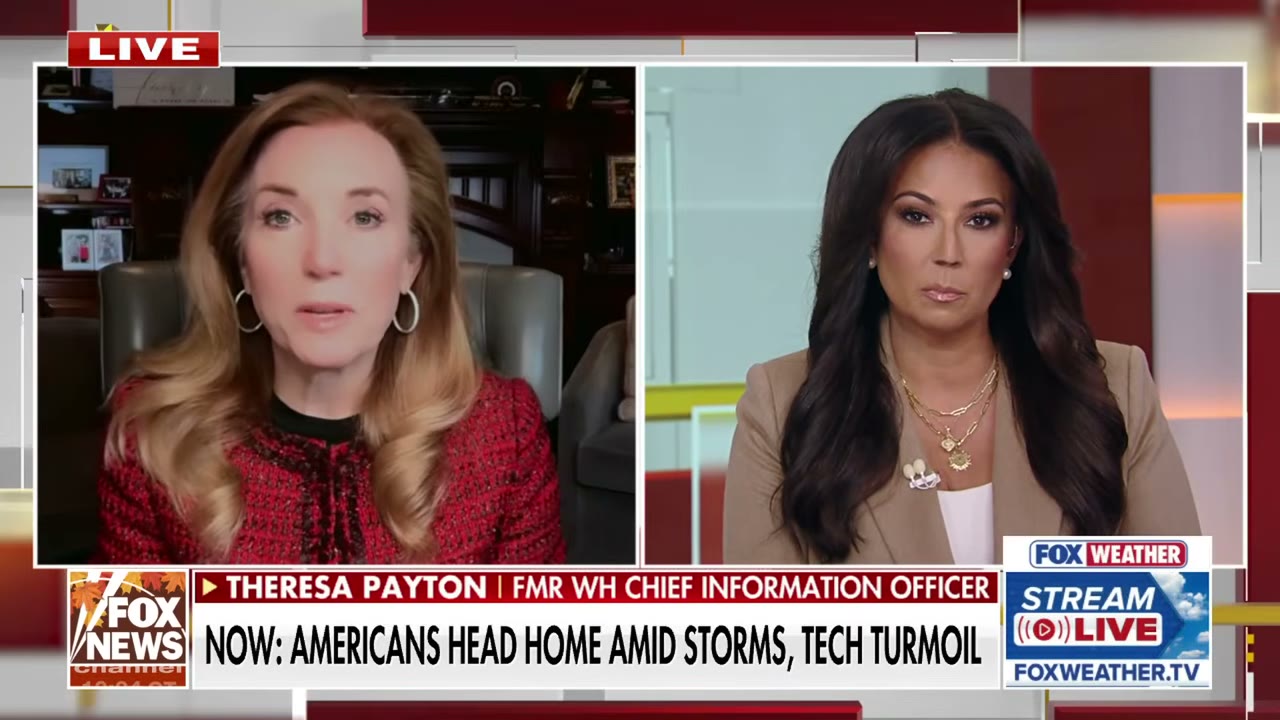
A former White House chief information officer warns that businesses rushing AI-driven security patches risk causing new outages. The interview follows a wave of tech failures at Microsoft, Apple and the FAA, with officials warning of more disruptions at banks and airports.
1Expert says AI-weaponized criminals force firms into patch-or-outage dilemma
Companies now face two bad options: skip a patch and risk an AI-powered cyberattack, or rush the fix and risk causing an outage themselves. That's the warning from Theresa Peyton, a former White House chief information officer and CEO of a cybersecurity firm, after a wave of tech failures hit Microsoft, Apple and internet services across the country, plus an FAA ground stop.
Peyton pointed to a major announcement earlier in 2026 about the Mythos model at Anthropic. That, she said, started the chain of events now showing up as outages.
Her core concern: criminals have weaponized AI. Businesses trying to stay ahead of them are hurriedly patching systems — and that haste can itself take services down.
"Criminals have weaponized A.I.," she said, describing the pressure firms are under.
The takeaway for ordinary users is that the same race to fix software can produce the disruptions they experience.
2Intelligence director warns of more tech outages at banks and airports
Americans should brace for more tech outages at banks and airports, the director of national intelligence warned. Jay Clayton said the country faces a step change in technology across both computing and applications — and that will bring bumps in the road.
He said the public should be prepared for a great deal of investment in upgrading systems, and for investment in cybersecurity.
His warning came as travelers were said to be doing better this week after recent disruptions.
Clayton did not say which banks or airports might be affected, or when. He framed the disruptions as an expected side effect of major technology upgrades rather than a one-off.
What comes next, in his account: more spending on systems and security, and more bumps along the way.
3Bank of America CEO says AI models let bad actors act faster
New AI models let people "do bad things faster than they ever did," Bank of America's CEO said, as the fallout from recent tech outages spread. The attacks are automated and don't require humans, he said.
His answer: patch in real time, very quickly. The bank and others are running those models against their own software, including third-party systems, to find what is causing the activity.
The comments tie the outages to the speed of artificial intelligence — bad actors move faster, so defenders must patch faster.
He did not name specific threats or say how many systems were affected. The focus was on the pace of patching and on checking third-party software.
What comes next is a continued push to patch quickly in real time.
4FAA ground stop blamed on fiber cable swap during peak time
The FAA ground stop happened because cyber optic cables were being swapped out and the old system didn't go with them, according to an account given on air. The timing — maintenance during a peak period — is what drew disbelief.
"I just can't understand how in the world this happens in this day in age," the speaker said, calling it confusing to all Americans.
The complaint was not just about the cable change but about intelligence and updates not being up to speed with the changes being made.
The account did not specify the date, the airports affected or how long the ground stop lasted. It focused on the decision to change out cables and the failure to keep the old system working alongside.
What comes next is scrutiny of how and when such maintenance is scheduled.
5Expert urges off-peak maintenance, machine-speed testing and rollback plans
Pick less busy times to do maintenance, test at machine speed and always keep a rollback plan. That's the advice from Theresa Peyton, a former White House chief information officer, after a run of outages.
She said everyone should ask what window of time maintenance is being done in, and suggested choosing less peak times. Rushing maintenance to beat attackers, she warned, can itself cause an outage.
Her other rules: test, test, test; test at machine speed; and have a rollback plan for when old and new systems are connected and something breaks.
She also pointed to missing redundancy. Systems should be able to go offline and fall back to an unaffected one, she said.
"A lot of investment needs to be made," she said. She expects things to get stronger in the next couple of months, but called it a bumpy ride.