A countdown of the Bundeswehr's most modern infantry weapons, from the compact MP7A1 submachine gun to the EuroSpike MELLS guided missile. The video details each system's range, caliber and combat role, including the G36 scandal and the army's new G95A1 rifle.
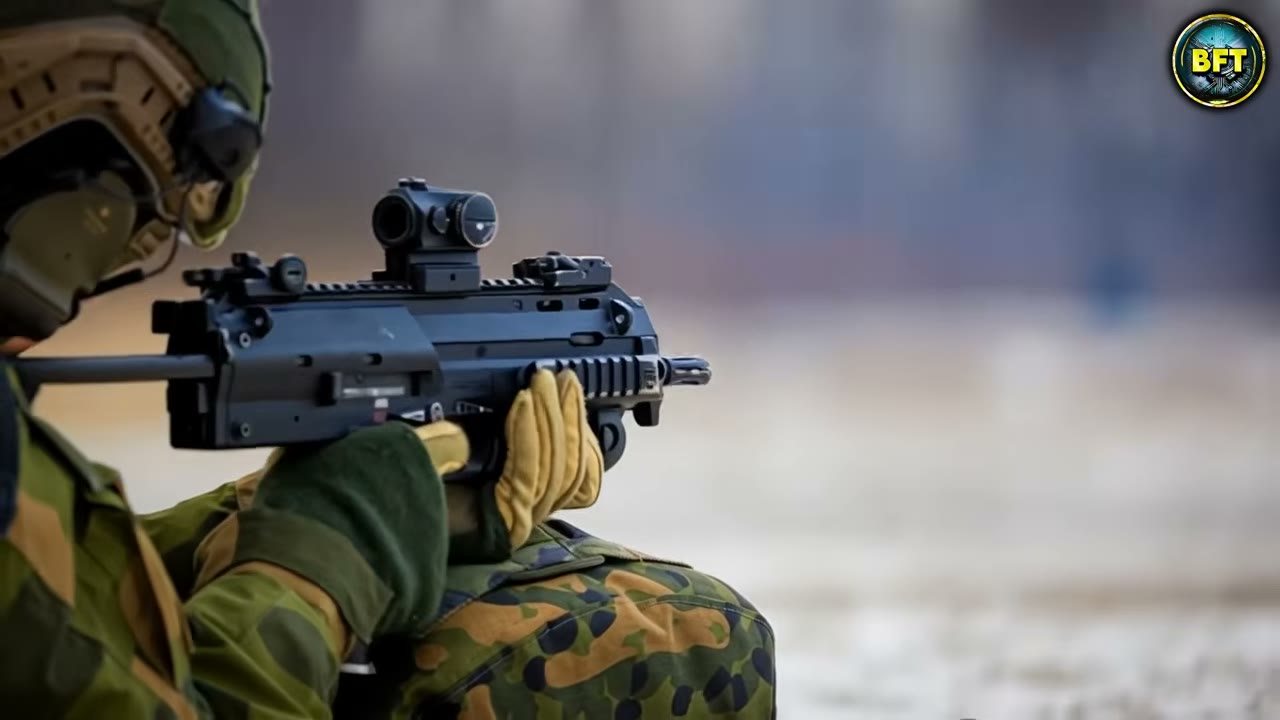
1Heckler & Koch MP7A1: Compact SMG That Pierces Body Armor
A gun small enough to fit in a large holster can punch through body armor at 200 meters. Heckler & Koch built the MP7A1 around a 4.6x30mm round that looks like a tiny rifle bullet, and that round is the whole secret — conventional 9mm submachine guns struggle to do the same job at that distance.
The weapon weighs about 1.9 kg without ammunition and fires roughly 950 rounds per minute, so a 40-round magazine empties fast. The Bundeswehr issues it to truck crews, military police and special forces — troops who need real firepower but have no room for a full-sized rifle.
With the stock folded, it still fits into a large holster.
2Heckler & Koch G36A3: Germany's Standard Rifle and Its 2015 Accuracy Scandal
Germany's defense minister said the G36 rifle had no future in the army. The weapon had been the standard rifle of every German soldier for almost 20 years, entering service in 1997, firing 5.56x45mm NATO rounds and weighing about 3.6 kg, much of it carbon fiber reinforced plastic.
Then 2015 came. Reports indicated that when the rifle got very hot after long bursts or in desert heat, hits began to deviate from the target. The minister stated the G36 in its current form had no future in the army. Heckler & Koch fought back, and later tests showed the problem was smaller than the headlines portrayed — but the damage was done.
The A3 version is the last major update: a new forend with strips for lights and lasers, an adjustable stock, modern optics. It can hit a man-sized target at 400 meters, and thousands of soldiers still carry it. Its days are numbered.
3Heckler & Koch G27P: Short Battle Rifle for Special Forces
A rifle short enough to climb into a helicopter with can still hit targets at 600 meters. The Heckler & Koch G27P is built on the HK417 and fires the more powerful 7.62x51mm cartridge, which hits harder than 5.56 and keeps its energy longer.
The P stands for "patrol." Its barrel is only about 33 cm long, so it moves easily inside buildings. With the right scope it reaches 600 m. It is sand-colored, takes 10- or 20-round magazines, and works with silencers, night sights and almost any equipment special forces want to install.
German troops use it as a middle ground: more powerful than an assault rifle, lighter than a sniper rifle. Recoil is stronger than its size suggests.
4Heckler & Koch MG4: Light Machine Gun With Downward Ejection
The MG4 light machine gun ejects its spent cartridges straight down, so left- and right-handed soldiers can fire it equally comfortably. The Bundeswehr adopted it in 2005, and it uses the same 5.56 round as a standard rifle, so an entire unit shares common ammunition.
It weighs around 8 kg — heavy until you remember the old MG3 weighed around 11.5 kg. It is belt-fed, often from a 200-round magazine under the weapon, fires up to 880 rounds per minute and has an effective range of about 800 m. The barrel is replaced in seconds when it overheats.
The stock folds for carrying through forest or jumping out of a vehicle. Soldiers who used it in Afghanistan loved it for performing flawlessly in dust and sand.
5Accuracy International G22A2: British Sniper Rifle in German Service
A British rifle serves in the German army. Accuracy International builds sniper rifles in a small town in Hampshire, and dozens of armies buy them. The first G22 entered the Bundeswehr in 2009; the A2 is a new version based on the AXMC, firing .338 Lapua Magnum cartridges.
That round was originally created for hunting big game, but soldiers liked it so much they borrowed it. It flies faster, descends less and overcomes wind better than the old 7.62. The rifle is modular: a sniper can change the barrel and switch caliber in the field in a few minutes without a workshop.
The stock folds, the cheekpiece adjusts, and the rifle weighs about 7 kg before the sight is installed. It is extremely accurate and costs a fortune.
6Heckler & Koch G28: Squad Marksman Rifle With 20x Scope
At 800 meters, the target hears the sound of the shot only after the bullet hits. That is the working range of the Heckler & Koch G28, the marksman rifle one soldier in a squad carries to engage targets farther out than the rest can reach.
It fires 7.62x51mm rounds from a barrel about 42 cm long. The Bundeswehr began using it in 2011, mainly in Afghanistan. A large Schmidt & Bender scope on top provides 20x magnification. Heckler & Koch built it from a civilian sporting rifle, then made it more robust for the military.
The result is very high accuracy for a semi-automatic, letting the shooter fire rapid repeated shots, which a bolt-action sniper rifle cannot. The downside is weight: about 6 kg with scope, bipod and full magazine. Some shooters complain it is heavy.
7Heckler & Koch MG5A2: Replacing the Legendary MG3 Machine Gun
For decades, German soldiers fought with the MG3, a descendant of the World War II MG42 that fired so fast the sound was like fabric tearing. Its replacement, the Heckler & Koch MG5, entered service in 2015 — and it is deliberately slower.
It fires 7.62x51mm rounds, which travel significantly further than the 5.56 in the MG4. The shooter chooses between about 640 or 800 rounds per minute. Less wasted ammunition, less vibration, more hits. Effective range from the bipod is about 1,000 m, and from a mount even further.
The weapon weighs about 11 kg, and the A2 version adds rails for optics and night sights. The barrel changes in seconds, and it can be mounted on vehicles like the Boxer or Dingo.
8Barrett M82: American Anti-Materiel Rifle in Bundeswehr Hands
What if the target is a truck and not a person? The Barrett M82 fires a 12.7x99mm round — the same .50 caliber bullet used in heavy machine guns — and hits objects at about 1,800 meters.
Its job is called "anti-material": radars, parked aircraft, engine blocks, light equipment, even roadside explosives. The rifle weighs about 14 kg and is almost 1.5 m long, so usually two soldiers share the weight along with heavy ammunition. It is semi-automatic, letting the shooter fire 10 rounds as fast as he can pull the trigger and control the recoil. A muzzle brake absorbs much of the kick and directs it sideways in a cloud of dust.
Ronnie Barrett developed the first version in his garage in Tennessee in the early 1980s. Today it serves in dozens of armies, and the Bundeswehr issues it to its troops.
9Haenel G29: German Sniper Rifle From a Historic Suhl Factory
A factory in Suhl, Thuringia, that has made rifles since 1840 built the StG44 — one of the first true assault rifles in history — and now supplies German snipers. The Haenel G29 is the RS9 sniper rifle the Bundeswehr selected in 2016.
It fires .338 Lapua Magnum rounds, the same as the G22A2, and hits targets at 1,500 meters. So why field both? Armies like to have choices, and the G29 was developed with a lot of advice from German snipers.
The butt folds sideways, the cheekpiece and buttstock adjust in all directions, and the barrel can be swapped for a smaller .308 caliber for training or closer ranges.
10Heckler & Koch G95A1: New Standard Rifle After Patent Fight
Heckler & Koch got its order back. The G95A1 — known outside Germany as the HK416A8 — is the army's new rifle and the successor the G36 finally got. The deal covers more than 100,000 rifles, and they are already arriving at the troops.
It fires the same 5.56x45mm cartridge, but a gas piston drives the mechanism, so less dirt and heat reach the moving parts. It stays cleaner and works longer. The barrel is about 37 cm long and stays accurate after prolonged firing — a major requirement after 2015. The rifle weighs about 3.6 kg, with an adjustable stock and a top rail for optics, lasers and night sights.
Many soldiers will get a shortened version, the G95KA1, for close combat. American Special Forces used the HK416 in some very famous missions.
11Heckler & Koch GMW A1: Automatic 40mm Grenade Launcher
A weapon that fires 40mm grenades in automatic mode at about 340 per minute is often aimed with a joystick. The Heckler & Koch GMW A1 — Granatmaschinenwaffe, German for grenade launcher system — scatters fragments over a large area, with a maximum range of about 2,200 m.
Soldiers use it against groups of enemies, light equipment or positions behind cover. The cannon weighs about 29 kg and the tripod adds about 11 kg, so nobody carries it far on foot. It is most often mounted on vehicle roofs like the Dingo or Boxer, often in a remotely controlled module the crew operates from inside using a screen and joystick.
The belt can feed from the left or right for different mounts. In Afghanistan, German troops used it to keep attackers far from their convoys. Its weak point: it is almost powerless against a modern tank.
12Dynamit Nobel Panzerfaust 3: Tandem Warhead Against Tanks
A tandem warhead pierces over 700 mm of steel behind a tank's reactive armor. The Panzerfaust 3's name echoes World War II — the first Panzerfaust was a German anti-tank weapon from 1943 — but the modern version entered service in 1992 and is a completely different thing.
A soldier attaches a disposable tube with a 110mm warhead to a reusable launcher holding the sight and trigger. The newer tandem warhead has two charges: the first undermines the tank's dynamic protection, the second pierces over 700 mm of steel behind it. Effective range is about 400 m against moving targets, and more with the newer scope.
When fired, it throws back a mass of plastic pellets that compensates for recoil and cuts gas outflow, so soldiers can fire it indoors. In 2022, Germany transferred thousands to Ukraine, where they were used against Russian armored vehicles.
13Dynamit Nobel Wirkmittel 90: Disposable Launcher That Breaches Walls
A 9 kg launcher an infantryman carries on his back, fires once, and throws away. The Dynamit Nobel Wirkmittel 90 — known in other armies as RGW 90 and sold in some as Matador — is a 90mm disposable grenade launcher.
Like the Panzerfaust 3, it uses a counterweight so it can be fired indoors, which matters in urban combat: older launchers needed open space behind the shooter or the exhaust could harm his own. Against armored vehicles it acts like a classic anti-tank shell.
Against a wall, it punches a hole large enough for soldiers to pass through, so they don't have to go through a door where the enemy is likely waiting. It hits targets from 15 to 500 meters. German soldiers call it the WM90 and love it for its simplicity — no batteries or electronics that can break.
14MBDA Enforcer: Fire-and-Forget Missile for the Squad
A 16 kg guided missile now lets German soldiers fire at a target and run for cover while the weapon finishes the job itself. The MBDA Enforcer, one of the newest systems in the German army, fills a gap that has troubled the military for years.
Unguided grenade launchers such as the Wirkmittel 90 are light but miss at long ranges. Large guided missiles hit accurately but are heavy and expensive. The Enforcer sits between the two.
The full system weighs about 16 kg, and the missile itself weighs almost 12. An infrared camera in the nose lets the soldier capture the target, shoot and leave. Its range is about 2 km — four times that of the Wirkmittel 90.
It is designed for light vehicles, machine gun nests or soldiers outside a window, with a warhead built for precise damage without destroying the entire street. It can also chase a moving target.
The Bundeswehr ordered it several years ago, and the first missiles are already arriving in the troops.
15EuroSpike MELLS: Fiber-Optic Missile With 4 km Range
A missile that can be redirected in mid-flight — or called off if civilians appear — now leads Germany's infantry weapons. The EuroSpike MELLS, known worldwide as Spike LR, replaced the old Milan complex.
It is made by Eurospike, a company owned by Germany's Diehl and Rheinmetall together with Israel's Rafael. The missile weighs about 13 kg and can hit targets up to 4 km away — 10 times the firing range of the Panzerfaust 3.
A camera in the nose and a thin fiber-optic cable that unwinds behind it during flight give the operator a real-time view of everything the missile sees. He can use the "fire and forget" principle, guide it until it hits, redirect it, or cancel the shot if civilians appear.
It can also climb high and dive onto a tank from above, where the armor is thinnest. Its tandem warhead penetrates over 700 mm of steel behind dynamic protection. The same missile is installed on the Puma infantry fighting vehicle.