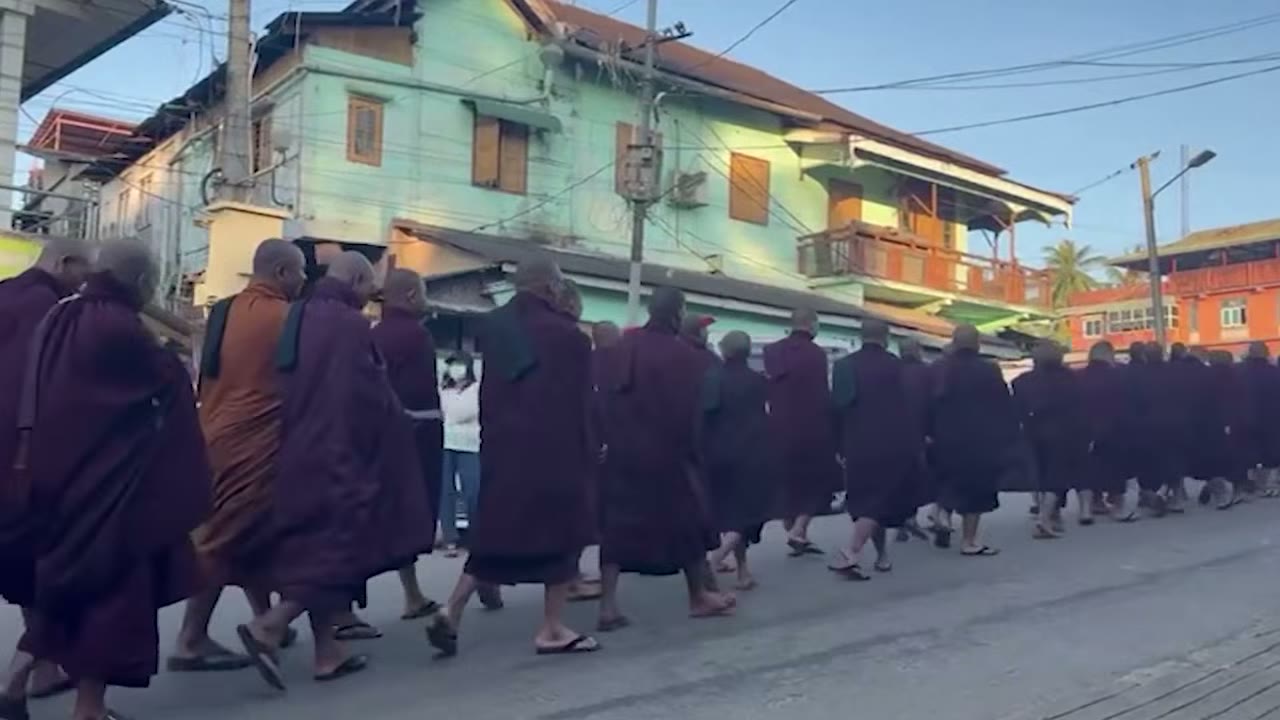
Myanmar's ICJ genocide judgment over the Rohingya has sparked nationalist protests in Bago and defiance from President Min Aung Hlaing. The video examines the ruling, the obligations it imposes, and whether over a million displaced Rohingya can ever return home safely.
1Myanmar Nationalists Protest ICJ Genocide Verdict in Bago
Hundreds of nationalist demonstrators rallied in Bago on November 29 against the International Court of Justice's genocide ruling, accusing the court of interfering in Myanmar's internal affairs.
Buddhist monks, nationalist activists and supporters carried national flags, religious flags and placards opposing the verdict near the historic Shwemawdaw Pagoda.
The protest came 10 days after the UN's highest court delivered one of its most significant judgments on Myanmar, and follows objections from military-backed President Min Aung Hlaing, who has indicated his administration will not fully comply with the court's requirements.
2Nationalist Monk Wirathu Rejects ICJ Authority at Bago Rally
Controversial nationalist monk Wirathu questioned the court's authority at the Bago rally, asking: "Are we the ICJ slaves or something?"
Wirathu, who has previously faced accusations of promoting religious hostility, accused the court of interfering with Myanmar's sovereignty. His remarks reflected nationalist groups' position that the judgment is an unacceptable intervention by an international institution.
The ICJ ruling concerns Myanmar's legal responsibilities as a state under the 1948 genocide convention. It does not hold Buddhism or Myanmar's entire population responsible for genocide.
3ICJ Finds Myanmar Committed Genocide Against Rohingya
In a 9-to-6 decision, the International Court of Justice concluded that Myanmar committed genocide against the Rohingya in northern Rakhine state during military operations in 2017.
The November 19 judgment at The Hague followed seven years of proceedings in a case brought by The Gambia, with extensive submissions from both countries and examination of evidence on the treatment of the Rohingya.
The court found Myanmar's security forces committed acts prohibited under the 1948 genocide convention, accompanied by the specific intention required to establish genocide — a finding that requires evidence of intent to destroy a protected group, in whole or in part.
4Myanmar Says 2017 Operations Targeted ARSA Insurgency, Not Civilians
Myanmar's government has consistently rejected accusations that its military deliberately targeted the Rohingya with genocidal intent, saying operations responded to security threats from the Arakan Rohingya Salvation Army.
In August 2017, the group carried out assaults on Myanmar security installations, prompting a major military response across northern Rakhine state. Myanmar argued its forces were responding to an insurgency and trying to restore security.
International investigators documented widespread harm to civilians, destruction of residential communities, sexual violence and forced displacement. More than 700,000 Rohingya fled to neighbouring Bangladesh after the 2017 campaign.
5Over 700,000 Rohingya Fled to Bangladesh in 2017
More than 700,000 Rohingya fled into neighbouring Bangladesh after the 2017 military campaign, creating one of Southeast Asia's largest refugee emergencies.
Many of the displaced have now spent more than nine years outside Myanmar. According to the UN Refugee Agency, Bangladesh currently hosts more than 1.2 million Rohingya refugees, including those displaced in earlier periods and later waves of instability.
For many of these families, the ICJ judgment represents recognition of suffering that has continued for years without an adequate resolution.
6Myanmar Nationalists Seize on Divided 9-6 Court Vote
Six judges disagreed with the majority's genocide finding — a split Myanmar's authorities have highlighted in questioning the judgment.
Nationalist groups inside Myanmar have responded to the ruling with strong opposition, arguing the country's reputation and sovereignty are being undermined by international pressure. The Bago demonstration illustrated how differently the judgment is being interpreted across Myanmar's population.
Disagreement among judges does not invalidate an ICJ ruling; the majority decision remains legally binding on the parties. Myanmar's Ministry of Foreign Affairs expressed disappointment with the verdict.
7Min Aung Hlaing Says Myanmar Will Not Comply With 'Inappropriate' ICJ Demands
Myanmar's president has said the country will take measures befitting a responsible state but will not comply with ICJ requirements it considers inappropriate.
Min Aung Hlaing addressed the issue at a government meeting on November 25, with his remarks reported the following day. He did not clearly identify which specific requirements his government intended to reject.
The position has raised concerns about the judgment's practical implementation. Myanmar's Foreign Ministry had earlier expressed disappointment with the verdict, saying allegations of genocide required particularly careful consideration of evidence and legal standards.
8ICJ Orders Myanmar to Prevent Genocide, Prosecute and Compensate
The court ordered Myanmar to prevent further violations of the genocide convention, strengthen domestic legislation and investigate individuals reasonably suspected of committing genocidal acts.
Authorities must also take steps toward prosecuting and punishing those responsible, and provide remedies to the Rohingya, including compensation and measures to facilitate the return of displaced families.
The return process must be voluntary, safe and respectful of the rights and dignity of affected communities. The judgment also addresses protecting Rakhine residents from persecution and discrimination, including access to citizenship.
9Rohingya Statelessness Under Myanmar's 1982 Citizenship Law
Myanmar's 1982 citizenship framework has contributed to widespread statelessness among the Rohingya, many of whom have faced restrictions on citizenship, movement, education, employment and access to essential services.
Without recognised citizenship or adequate legal protection, many Rohingya families have struggled to participate fully in the country's social and economic life.
These long-standing challenges remain central to international discussions concerning the refugee crisis and to the conditions the ICJ says must be addressed for any safe return.
10Myanmar Given Until November 2028 to Report on Compliance
The International Court of Justice has required Myanmar to submit a report within two years detailing the steps taken to implement its obligations — setting a November 2028 reporting deadline.
That creates an additional opportunity for the court to examine Myanmar's response to the genocide judgment.
The amount and arrangements for compensation have not yet been finalised and are expected to be addressed through further proceedings.
11Min Aung Hlaing's Role in 2017 Operations and 2021 Coup
Min Aung Hlaing commanded Myanmar's armed forces during the 2017 military operations that formed the central focus of the genocide case.
In February 2021, he seized power from the elected government led by Aung San Suu Kyi, triggering nationwide political instability and armed resistance. Aung San Suu Kyi remains detained.
Min Aung Hlaing became president in 2026 following elections widely criticised for restrictions on political participation, as Myanmar continues to experience a devastating internal conflict.
12Arakan Army Control Complicates Rohingya Refugee Return
Large parts of Rakhine state are now under the control of the Arakan Army, an ethnic armed organisation fighting Myanmar's military — complicating any large-scale refugee return.
Implementing a repatriation programme would require addressing security conditions involving multiple actors, not just decisions by the central government.
The continuing instability raises questions about whether Myanmar has the administrative and security capacity to guarantee a safe return. Even if authorities formally agreed, refugees would need assurances that their homes, livelihoods and fundamental rights would be protected.
13Bangladesh Bears Strain of Hosting Rohingya Refugees
Bangladesh has sheltered enormous numbers of displaced Rohingya, particularly in the Cox's Bazar region, where refugee settlements face overcrowding, limited employment and education, and strained health care.
Thousands of children have grown up without experiencing life in their ancestral homeland, and the settlements depend heavily on humanitarian assistance.
International organisations have repeatedly stressed that aid alone cannot resolve the crisis. For Bangladesh, the ICJ judgment represents a potentially important development in a humanitarian emergency that has placed considerable pressure on its resources.
14UN Refugee Agency Welcomes Ruling, Stresses Voluntary Returns
The UN Refugee Agency welcomed the ICJ judgment as "an important opportunity to address the underlying causes of displacement" — but stressed that returns must be genuinely voluntary.
UNHCR said a lasting solution requires political progress, human rights protection and conditions that make voluntary repatriation possible. It also emphasized protecting refugees.
The Gambia, which brought the case, celebrated the ruling as a significant victory for accountability. What happens next depends on whether conditions inside Myanmar allow refugees to return safely.
15Gambia's Genocide Case Sets Global Accountability Precedent
A West African nation with no shared border with Myanmar sued it under the Genocide Convention — and the court ruled in its favor.
The Gambia launched proceedings in November 2019 with support from the Organization of Islamic Cooperation. It argued that countries share responsibility to prevent and punish genocide.
Eleven countries intervened, contributing legal arguments on how the convention should be interpreted. The judgment could influence how governments and courts handle future genocide allegations far beyond Myanmar and the Rohingya.
16ICJ Has No Enforcement Power as Compliance Hinges on Security Council
The court's judgment is legally binding — but the ICJ has no enforcement authority to make Myanmar comply.
Under the UN Charter, non-compliance can potentially be brought before the Security Council. Diplomatic negotiations and international political pressure may also sway a government's response.
But those processes can be complicated by disagreements among major international powers. The ruling therefore does not automatically guarantee immediate improvements in living conditions for Rohingya refugees.
17ICJ Ruling Does Not Establish Individual Criminal Liability
The ruling does not automatically establish criminal liability against individual Myanmar military commanders.
The ICJ settles legal disputes between states. Individual criminal responsibility is a separate matter that may be examined through domestic or international criminal proceedings.
That distinction is essential to understanding what the November 19 ruling accomplished — and what remains unresolved.
18Rights Groups Warn Inflammatory Rhetoric Threatens Rohingya
Human rights organizations have warned about growing hostility toward the Rohingya around the time of the court's judgment.
Criticizing an international court is not inherently unlawful, but portraying an entire ethnic or religious community as a threat can deepen social divisions and undermine reconciliation, the groups warned.
Myanmar is home to numerous ethnic and religious communities, many scarred by decades of political instability and armed conflict. The views of nationalist demonstrators in Bago should not be read as representing every Buddhist monk or every Myanmar citizen.
19Myanmar's Opposition NUG Backs ICJ Ruling, Exposing Split
Myanmar's opposition National Unity Government welcomed the international court's ruling — a sign that political responses inside the country remain divided.
Supporters of the military-backed administration have challenged the judgment, while other Myanmar political organizations have expressed support for international accountability.
The competing responses highlight a broader debate about Myanmar's future. One approach emphasizes national sovereignty and resistance to external pressure; another argues accountability and minority protection are foundations for lasting peace.
20Rohingya Survivors Say Legal Win Falls Short of Justice
For Rohingya survivors, a legal victory cannot rebuild destroyed homes, reunite separated families or erase years of displacement.
Their most urgent concerns remain practical: security, recognition, access to fundamental rights and the chance to rebuild their lives.
The demonstration in Bago highlighted the distance between an international judgment and its implementation on the ground. Min Aung Hlaing's administration now faces growing scrutiny over how it intends to respond to the court.
21Min Aung Hlaing Faces Scrutiny Over Compliance With ICJ Orders
International organizations will be watching for concrete measures from Myanmar, not political assurances alone.
Questions remain over investigations, compensation, citizenship protections and whether refugees can return under genuinely safe conditions. The coming months could determine whether Myanmar cooperates with international institutions or keeps resisting significant parts of the judgment.
The ruling stands as legally binding despite government objections and nationalist protests in Bago. For more than a million displaced people, the question is whether that recognition finally changes anything.