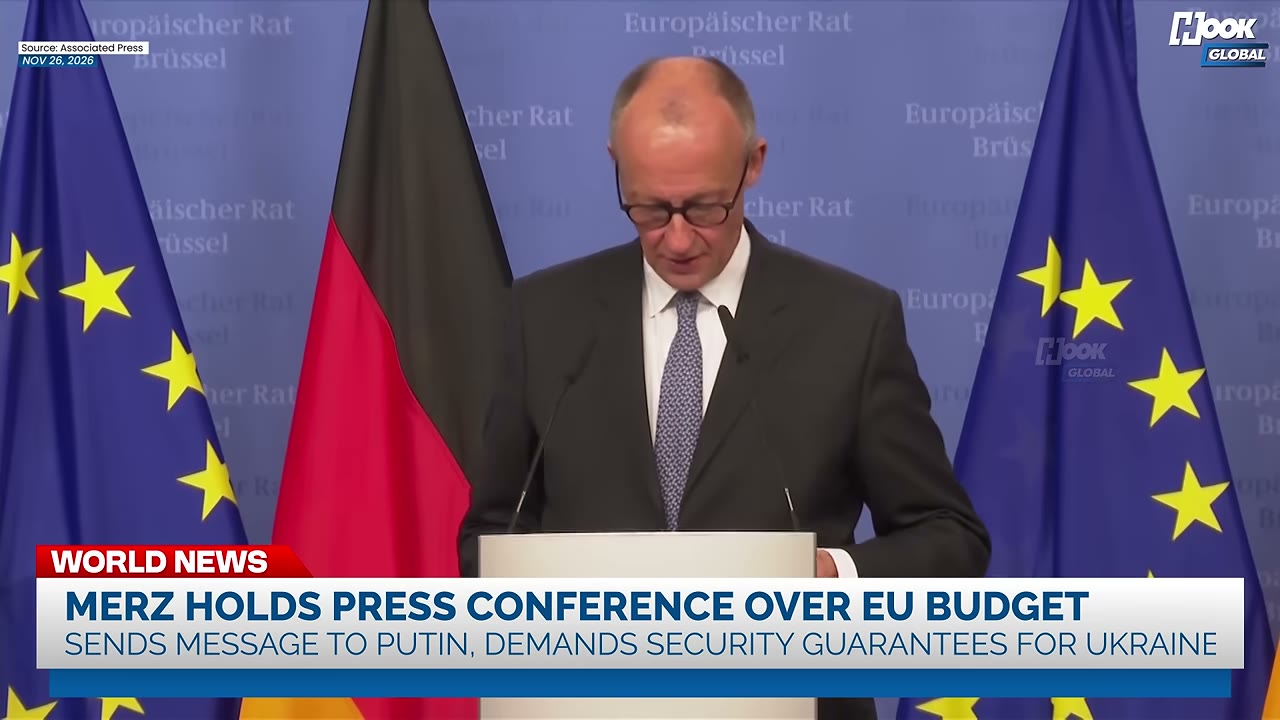
German Chancellor Merz says EU talks on the 2028-2034 budget ended without agreement and will resume December 17. He demands a long-term Ukraine financing reserve and welcomes Trump's call to Putin to halt hostilities, stressing Kyiv needs lasting security guarantees.
1EU Leaders Open Talks on Post-2028 Multiannual Financial Framework
EU leaders have started haggling over the bloc's next seven-year budget, which begins in 2028. They met, as agreed in November, to open discussions on the future Multiannual Financial Framework.
It was also the first and last time the group received the president of the European Central Bank in this format.
No figures or deadlines were set out in the opening remarks.
2Lagarde Attends Final ECB Meeting as Leaders Thank Her Seven-Year Tenure
Christine Lagarde has attended her final European Central Bank meeting in this format, with leaders lining up to thank her after almost seven years in the job. She spoke to them about the situation in the eurozone.
The chancellor said Lagarde led the bank through times that were not always easy, and that its mandate to keep interest rates low was achieved more successfully than at many other central banks.
Her mandate ends in February. Leaders thanked her personally and said the talks then turned in detail to the future budget.
3Merz Says EU Budget Positions Remain Far Apart After Marathon Talks
Twelve hours of talks ended with EU leaders still far apart on how the bloc's future budget should be shaped. The chancellor said the gap was not really surprising, and that convergence takes time and goodwill.
Two principles guided the negotiations: public finances are not in the best condition in any member state, so Europe should not make promises it cannot keep. Excessive debt, he said, is a danger to Europe and a threat to its sovereignty.
The talks are also happening in a new era, with Europe needing to strengthen its economy and its ability to defend itself against the war in Ukraine. No agreement was reached.
4Merz Sets Four Conditions for Germany Backing the EU Budget
Germany pays about a quarter of the EU budget but gets back only about 8% of pre-allocated funds, the chancellor said, calling the contributions question one of justice.
He set out his conditions after talks ended without a deal. The total volume should not grow disproportionately, and the burden must be fairly distributed. Contributions must be adjusted, with cohesion funds giving Germany even less back.
He also said Europe must get its priorities right: strengthening its economy and ensuring its security. On the numbers, he said leaders are still far from agreement.
5Merz Demands Long-Term Ukraine Financing Reserve in EU Budget
Germany is demanding a dedicated reserve in the EU budget for long-term financing for Ukraine, with everyone participating and decisions taken by qualified majority.
The chancellor also rejected the idea that new own resources solve the problem, saying they cannot generate enough new money and will only be a very small part of the future budget.
He warned against piling on more debt. Next Generation EU and aid to Ukraine have already built up huge liabilities, and interest of over 150 billion euros will burden the new budget framework. "We must not continue to accumulate debt," he said.
6Merz Hopes for EU Budget Deal by End of Year Despite Election Risks
The chancellor is confident EU leaders can reach a budget agreement by the end of the year, and says he will do everything he can to help.
Elections next year may not make passing a deal any easier, which is why leaders are working hard to close one this year. They meet again on December 17th for what he expects to be a very intense council meeting.
"I'm not sure if we will succeed, but I continue to hope," he said.
7Merz Denies Undermining Costa by Announcing Talks Failed
The chancellor denied he was undermining European Council President Antonio Costa by telling reporters the budget talks had failed.
He said leaders agreed at the start of the night not to continue the session tomorrow, but to hold a final plenary session around midnight, knowing no deal would be reached. The next session is set for December 17th, at Costa's suggestion.
Asked whether it is normally the president's privilege to report to the press, he replied: "No, no, really." He said leaders did not want to keep reporters waiting.
8Merz Backs Macron on Sealing EU Budget Deal Before French Elections
President Macron considers it extremely important to reach an EU budget agreement this year, because otherwise negotiations would have to wait for French elections. The chancellor said he agrees.
Leaders meet again on December 17th and have allocated two days, with everyone wanting to be home by Christmas.
Asked whether 12 hours of talks brought progress, he said both yes and no. He pointed to movement toward cutting the negotiating framework by 204 billion euros compared with the Commission's proposal, and said he has always wanted several hundred billion less.
9Merz Calls All 27 Leaders Bridge Builders After Macron Remark
Asked about Macron calling himself a bridge builder, the chancellor said the French president, like every other head of state and government, represents his country's interests — just as he does.
"We are 27 bridge builders who want to achieve a solution for Europe," he said.
He said he agrees with that framing. The press conference then moved to Ukraine.
10Merz Welcomes Trump's Call to Putin and Presses for Ukraine Security Guarantees
President Trump called President Putin today and urged him to cease hostilities, a move the chancellor said he was pleased to note.
After speaking with Americans and Europeans, he said they agreed that once a ceasefire is established and a peace agreement reached, Ukraine needs long-term security guarantees. Last week he invited the Coalition of the Willing to Berlin, where they described security guarantee articles along the lines of Article 5, and he said they agree with the Americans on that.
He said the details are too early to determine. The remarks followed questions about US troops and Jared Kushner's suggestion that Article 5 can be defined broadly, which he said Zelenskyy appears unhappy with.
11Merz Says EU Should Share Ukraine Support Burden Despite Reluctance
Germany's chancellor says some EU countries are reluctant to share the cost of backing Ukraine — and he wants all of them to carry it anyway.
Speaking after talks that have not yet produced an agreement, he said there are signs that "one or another group of those who were there was hesitant about how we could share this burden, given the internal difficulties of individual countries."
His position: support for Ukraine should be undertaken by the European Union, by all member states. He conceded the details still need to be worked through, and said he would discuss them with colleagues that evening.
No deal has been reached. The question of who pays — and how much — remains open.