A countdown of the ten most advanced transport aircraft in the Russian Air Force, from the 1959 Antonov An-12 to the giant An-124 Ruslan. The video details payloads, ranges, engines and short-runway capabilities of each plane.
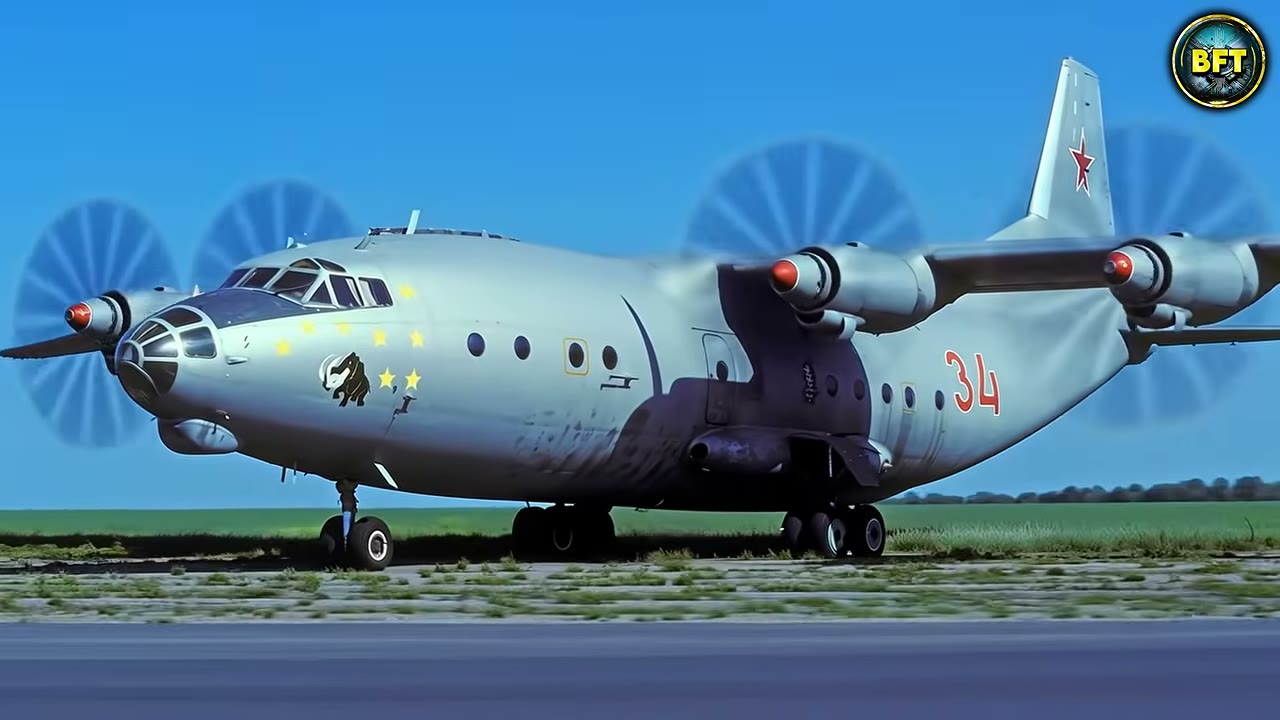
1Antonov An-12 ranks 10th among Russian transport aircraft
A four-engine turboprop introduced in 1959 still ranks among Russia's ten most advanced military transport aircraft. The Antonov An-12 takes tenth place on the list, with more than 1,200 built during its production run and still serving as a workhorse for transport in challenging conditions.
Four Ivchenko AI-20 turboprop engines give it a maximum cruising speed of 670 km/h and a range of 3,600 km with a full load. It can carry up to 20,000 kg of military cargo or more than 90 fully equipped paratroopers directly into a combat zone.
A built-in rear ramp allows quick loading and unloading on dirt runways, and the aircraft retains its classic rear gun turret. Its upper-wing design raises the engines high above the ground, keeping dirt out of the propellers during takeoff — useful for icy Arctic conditions or muddy runways.
2Antonov An-26 takes ninth place for tactical short-runway transport
A twin-engine turboprop built to reach places where larger aircraft cannot land takes ninth place among Russia's military transports. The Antonov An-26, developed in the late 1960s as an upgrade of the An-24 airliner, is designed to deliver troops and light equipment to hard-to-reach locations.
Two Ivchenko AI-24VT turboprop engines plus an auxiliary jet engine hidden in the right engine nacelle to accelerate takeoff give it a maximum speed of 540 km/h and a range of 2,550 km. It carries up to 5,500 kg of cargo or 40 fully equipped fighters.
Its rear cargo ramp can slide under the fuselage for quick loading from a truck or drop to the ground as a gangway. Conveyor belts built into the cabin floor roll heavy boxes out through the rear hatch, and the aircraft can land on snow, ice or thick mud.
3Ilyushin Il-18 ranks eighth as converted command and recon plane
A four-engine turboprop that first flew in 1957 started life as a passenger airliner — then the Russian military turned it into flying command posts. The Ilyushin Il-18 ranks eighth, converted for specialized command, VIP transport and electronic reconnaissance roles.
Some of these aircraft have flown tens of thousands of hours over several decades without serious structural damage, according to the account. Four AI-20M turboprop engines give it a top speed of 675 km/h and a range of over 6,500 km.
That range lets it stay airborne for hours monitoring radar networks or coordinating fleet operations from high altitude. It operates at altitudes up to 10,000 meters, above areas of bad weather, and its cabin noise is described as surprisingly low for a turboprop of that era.
4An-22 Antaeus is seventh, still world's largest turboprop
Aircraft number seven generates over 60,000 horsepower — enough to lift a maximum take-off weight of more than 250,000 kg. The An-22 "Antaeus" first flew in 1965 and earned the title of the world's largest turboprop aircraft, a title it holds to this day.
Four Kuznetsov NK-12MA turboprop engines, each with twin coaxial propellers, push it to speeds of up to 740 km/h and a range of 5,000 km with a full load. It carries a payload of 80,000 kg, enough for heavy battle tanks, rocket launchers or hundreds of soldiers.
A 14-wheel landing gear system lets the giant land on soft dirt airfields where conventional cargo planes would fail, according to the account. It was designed to move massive military equipment to remote Siberian outposts with no paved runways.
5An-72 takes sixth with over-wing engines and Coanda effect
Its engines sit above the wings instead of below — and that unusual layout lets the An-72 take off from runways just 600 meters long. The aircraft ranks sixth, nicknamed "Cheburashka" after a famous eared cartoon character.
Two D-36 turbofan engines above the leading edge of the wings direct exhaust over the upper wing surface, creating a physical phenomenon known as the Coanda effect that generates extra lift at low speeds. The design allows short takeoff and landing on extremely short runways.
The jet reaches a maximum speed of 700 km/h with a range of 4,300 km, carrying up to 10,000 kg of cargo or 52 fully equipped fighters. Engines high above the wings also keep dirt, rocks and debris out of the intakes on gravel strips or frozen tundra.
6Ilyushin Il-62 ranks fifth as strategic VIP command jet
All four engines sit in pairs at the rear of the fuselage — and a retractable tailplane lowers when parked to stop the nose tipping over during loading. The Il-62 ranks fifth, a long-range jet that entered service in the 1960s as the country's flagship transcontinental airliner before the military adopted it for senior commanders and VIP units.
Four Solovyov D-30KU turbofans give it a maximum cruising speed of 900 km/h and a range of over 10,000 km without refueling — enough for non-stop flights across vast continents or oceans. Rear-mounted engines keep the wings clean and minimize cabin noise.
Military VIP versions carry encrypted satellite communication systems, secure briefing rooms and comfortable quarters for officers directing strategic air operations, making it a strategic aerial command post.
7Antonov An-148 is fourth, a modern digital tactical jet
A regional jet with a digital "glass" cockpit doubles as a flying intensive care unit. The Antonov An-148 ranks fourth, introduced in the mid-2000s as a modern step in tactical transport, VIP mobility and fleet emergency response.
Two Motor Sich D-436 turbojet engines under a high-mounted wing give it a maximum speed of 870 km/h and a range of up to 3,500 km. Its electric remote control system reduces pilot load and increases flight safety in all weather, according to the account.
In its medical configuration, the cabin can be quickly fitted with life support modules to rush seriously injured people from remote bases to specialized hospitals. The high wing position allows safe operation on dirt or ice-covered runways without risking engine damage.
8Il-76MD-90A takes third with 70% modernized systems
More than 70% of its systems have been completely modernized — and new engines plus composite wings let it carry 20% more payload. The Il-76MD-90A ranks third, an update of the classic Il-76 that the account calls a true icon of military transport aviation.
The redesign includes a wing made of lighter, stronger composite materials and a new digital cockpit with multi-function color displays. Four new PS-90A-76 turbojet engines are described as significantly more powerful, quieter and more economical than the old Soviet engines.
It carries a maximum payload of 60,000 kg, cruises at 850 km/h and has a range of 5,000 km with 52,000 kg on board. It is the main landing vehicle of Russian airborne troops, able to drop armored vehicles, paratroopers and artillery, and its multi-wheel chassis still handles dirt and snowy tracks.
9Tupolev Tu-154M is second, the fastest three-engine transport
A retired airliner still flies military VIPs at a cruising speed of 950 km/h. The Tupolev Tu-154M ranks second, a three-engine jet designed as a high-speed medium-haul passenger airliner that became legendary for its speed and ability to use unprepared airfields.
Three Solovyov D-30KU-154 turbofan engines in the tail section give it a range of 6,600 km and altitudes of up to 12,100 m. Its six-wheel main landing gear was designed for gravel strips and frozen runways in harsh northern conditions.
The military uses the platform for VIP transport, strategic command post operations and specialized electronic reconnaissance, with secure communications systems letting leaders stay in touch with ground forces in flight. Many commercial airlines have retired it, but it remains in active military service.
10An-124 Ruslan tops the list as world's largest cargo plane
Its nose drops onto the front landing gear and lifts up, letting battle tanks and entire attack helicopters drive straight into the cargo bay. The Antonov An-124 "Ruslan" tops the list as the world's largest production military cargo plane, over 20 m tall with a wingspan of over 73 m.
Four Progress D-18T turbofan engines push it to speeds of up to 865 km/h. It can carry 150,000 kg of heavy military equipment over 3,700 km, or fly 14,000 km during a race, according to the account.
A rear loading ramp allows double loading operations, and 24 heavy-duty wheels on the main chassis let the giant land on unprepared, snow-covered airfields despite its weight. An upper passenger cabin above the main cargo space accommodates 88 soldiers.