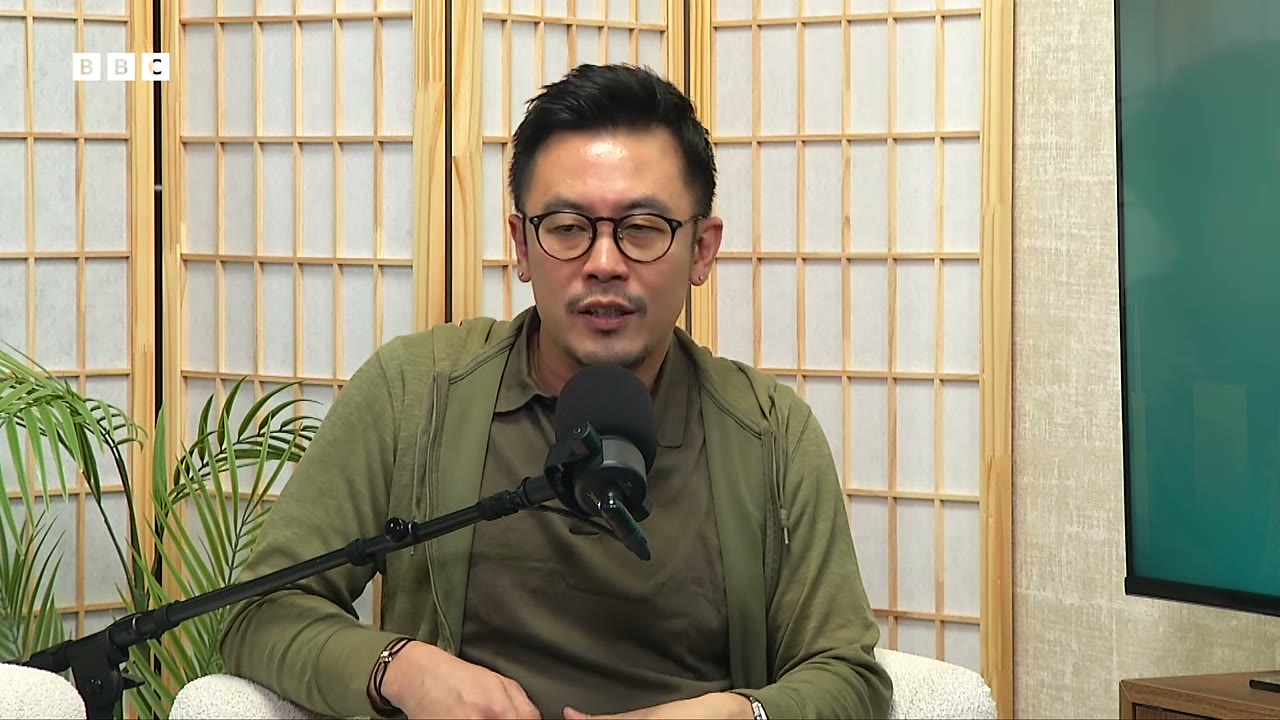
A BBC Asia Pacific podcast examines whether China merely copies Western technology or genuinely invents. A Singapore professor and a BBC journalist discuss patents, TikTok's algorithm, DeepSeek and state-led innovation, weighing China's strengths in scaling against America's edge in breakthroughs.
1Podcast sets out to test the claim that China only copies Western tech
A persistent online narrative claims China doesn't really invent anything — it steals from the US or the West, mass-produces it at scale and makes it cheaper for everyone. One journalist decided to find out whether that was true.
They went down a rabbit hole online and spoke to a bunch of people. The result is a discussion of what they found.
The question at the centre: is China a tech copycat, or a genuine inventor?
2Professor Kenneth Huang introduces his research on Chinese innovation
Professor Kenneth Huang from the National University of Singapore joined the show, bringing extensive writing on exactly this topic.
He introduced himself as a professor of management of technology and innovation who works on technology innovation strategy.
Most recently, he said, he has written a lot about China's transitional economy — how Chinese innovation can take off, how it compares to US innovation, and what strategies firms should take in China.
3Panel debates favorite inventions and defines invention versus innovation
The smartphone is one panelist's favourite invention of their lifetime — because they use it so much and find it super convenient.
They put invention in three broad categories: empirical discovery, like a scientist discovering a new element; prototype invention, like the Wright brothers inventing a plane; and commercial invention — innovation.
The Wright brothers invented the plane, but the first commercial flight didn't take off until ten or 12 years later. One panelist argued innovation could be more important, because an invention is only useful to humanity if it's mass-produced and you can buy it.
4David Hsu argues China innovates by driving down costs, not inventing
China is not necessarily the originator of technologies like batteries, solar panels and electric vehicles, but it has made substantial innovation, Professor David Hsu said.
"That innovation of driving down costs, more efficiency. That's just as hard in many cases as the initial invention itself," he said.
He argued we have to separate invention from innovation. US consumers and consumers around the world benefit when manufacturers in China scale up inventions and produce things more efficiently and accessibly.
5Why China excels at scaling and iterating others' inventions
China is very good at taking an invention — often a breakthrough from the West, maybe the US or Europe — iterating it, building on it and redefining it for the local market.
It does this at scale and with a lot of speed, according to Professor Kenneth Huang.
Why? He pointed to a very strong ecosystem of manufacturing, supply chains and great inventors, plus very well trained students, scientists and engineers. China did it with EVs and many other things.
6Did China steal IP? Professor Huang says early abuses but stronger system now
China's intellectual property system only really started in the mid-1980s, and in the early days there could be some infringement upon IP or patents from the West or the US, Professor Kenneth Huang said.
Since then, he said, China has strengthened its IP system substantially through at least four major reforms.
He was responding to the widely held view that China doesn't invent but copies or steals and then scales up.
7Debate over forced tech transfer through joint ventures
One accusation against China is forced tech transfer: a US company wanting to set up shop there must form a joint venture and teach Chinese engineers or workers what they do.
One panelist disagreed with the accusation because a lot of other countries do it — citing Singapore, which did it with the Japanese. When you're a developing country, that's how you grow, they said.
Another noted China is no longer developing and still does it. Professor Huang said some companies could be legally asked to share technology in very early days, and that the US took some IP from Europe in the 1800s. He said it is probably not as rampant as popular media suggests.
8TikTok's algorithm cited as a genuinely original Chinese invention
TikTok or Bytedance's algorithm is an original invention, one panelist argued — social media itself is not, since it has been around a long time.
The algorithm that feeds users what it thinks they want, and possibly gets them addicted, is something they called proprietary China.
That's why companies like Meta, Instagram, Facebook and YouTube are all trying to copy that algorithm now, they said. The panelist added China is very good at iterations and making things adaptable to local conditions.
9DeepSeek's open-source AI model shocked the US despite chip limits
DeepSeek was one of the earlier open-source large language models for AI chatbot search, Professor Kenneth Huang said, when most others like ChatGPT relied on closed-source models.
It sent shock waves in the US, he said — partly because of the chips.
People asked how it was done if they weren't allowed to have the best chips from the US. He called DeepSeek probably controversial but noted it was among the first open models out there.
10China's state-led innovation model and patent-filing incentives
In China the state exerts a major influence and provides a lot of incentive for companies and organizations to invent — for example, incentivizing companies to get patents, Professor Kenneth Huang said.
Once incentivized to file for patents, they do. But it is not clear the quality is substantial, because they can potentially break a substantial patent into two or three more incremental patents to fulfil the state's mandate.
Companies can be told: to be known as an innovative company, you need to produce a certain number of patents within one year, and there are policy benefits attached.
11How global patent systems compare in China and the US
Patent systems are essentially global now, and both China and the US have harmonized with them after several rounds of reforms, Professor Kenneth Huang said.
A patent is protected for 20 years from the date of filing. The US once had its own more eccentric system but has also largely aligned.
But enforcement and approval examination remain territorial, he said.
12Does authoritarian rule stifle or enable creativity?
The Soviet Union beat the US to space twice — a fact one panelist raised against the idea that authoritarian, state-led regimes naturally stifle creativity.
Professor Kenneth Huang said China is unique: when the state is led and can pull resources together, it can target specific areas like AI, semiconductor material sciences and other emerging strategic fields. That could propel an area further, faster.
In the US, he said, it is a lot more decentralized, with a policy guideline but much left to private companies. It cuts both ways: incentivized patenting can mean churning out patents for policy benefits, but some companies are serious and understand the resources in areas like semiconductors.
13China's slowing economy despite heavy innovation spending
China spends about 2% of its GDP on innovation — yet its economy is struggling. Critics argue the state-led model isn't sustainable and doesn't benefit the mass population.
Technology and innovation "drive the economy," but they are "necessary, but not sufficient," one expert said. Thriving economies also need new talent to flow in, exchange of ideas, and freedom to think outside the box.
China may not have all those ingredients, the expert added — though neither does the US. Innovation moving forward doesn't necessarily propel the economy.
China enjoyed a long period of high growth, but recently there has been much more emphasis on security and national interest — sometimes above innovation or regional economic growth.
14Why hasn't China produced more breakthrough inventions?
China looks like the perfect petri dish for inventions: a country of engineers, deep talent, and state-led funding that can direct money where it wants. So why hasn't it produced more breakthroughs?
One expert says the US still attracts many of the very top scientists, because it is open to people coming in, using its system and thriving — incentivized by strong private property protection.
China runs a different model, the expert said. Its innovation caters to the market itself, and can be localized or regionalized — not the breakthrough things like the US inventing the internet.
Instead, China is "very strong at iterations," making things faster and cheaper, and scaling up products that cater to local markets and communities.
15Should the US and China cooperate on AI and climate change?
Knowledge isn't a zero-sum game: if I have more, yours doesn't decrease. That was the takeaway after a conversation about the world's two biggest economies.
Everyone sees China and the US as locked in zero-sum competition, one expert said. But knowledge is different — if one wins, the other doesn't lose.
Competition can drive creativity, but on issues like climate change, technology and AI, the question is whether the two superpowers should work together instead.
The conclusion: "if the tide rises, all our boats will rise."