The video traces the origins of the U.S. Army's Air Cavalry Combat Brigade, from the 1962 Howze Board through its 1970s test and permanent formation. It explains the brigade's organization, its hunter-killer helicopter teams and how it was meant to destroy enemy armor.
1Howze Board Proposes Ambitious Air Assault and Air Cavalry Forces
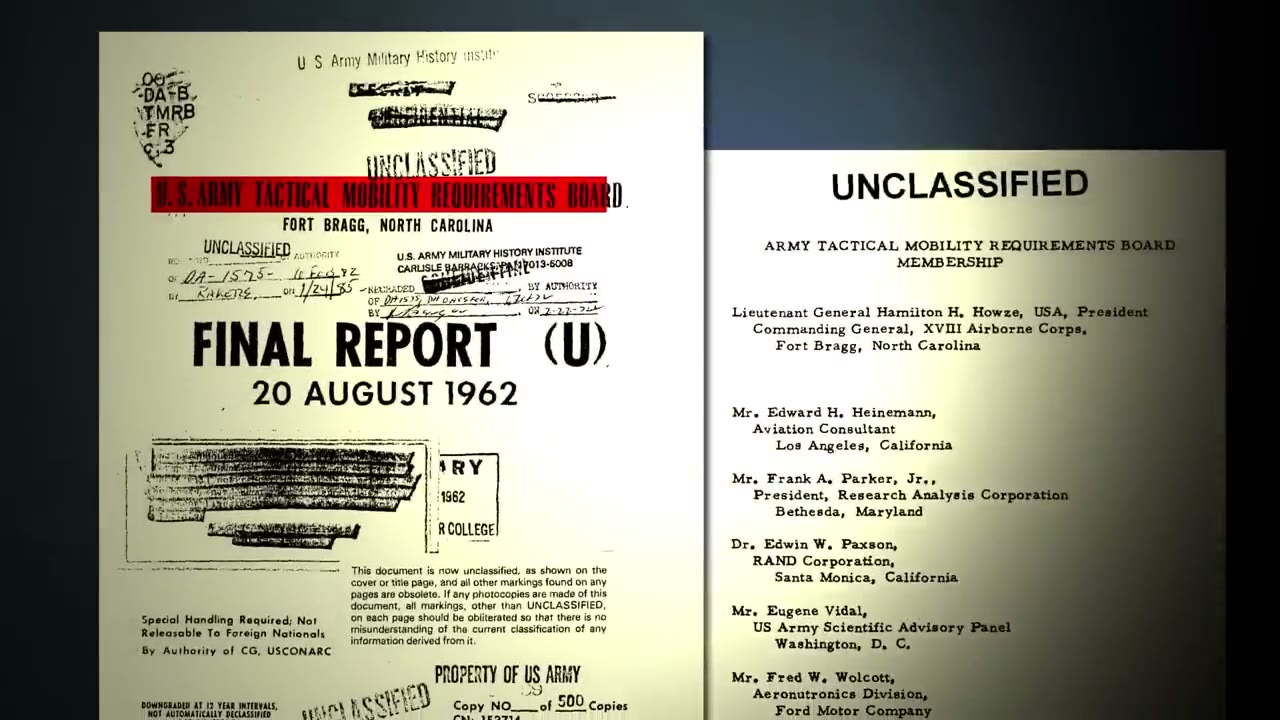
A 1962 Army report called for five air assault divisions with more than 450 aircraft. The Howze Board released its report that year on how the U.S. Army should integrate aviation into its force, and it was very ambitious.
Among its proposals: those five air assault divisions, each with over 450 aircraft. The Army never got close. It briefly had two airmobile divisions from 1969 to 1971, and just one for the rest of its history.
2Air Cavalry Combat Brigade's Role: Destroying Enemy Armor by Aerial Firepower
The Howze Board wanted three air cavalry combat brigades — flying anti-tank units that war games suggested could cut the time to bring up a mobile anti-tank reserve by 25%.
The board described the brigade as "an air fighting unit which destroys or punishes the enemy by aerial maneuver, surprise and heavy application of firepower delivered from rotary wing, light attack helicopters, and by air delivered riflemen and tank killer teams."
Its focus was destroying or neutralizing enemy armor and mechanized forces, with less emphasis on soft targets when armed with anti-personnel weapons. Reconnaissance elements let it find the enemy and conduct reconnaissance and defensive security missions like a screen.
3Air Cavalry Brigade Compared to World War II Tank Destroyer Units
The air cavalry brigade's broad doctrinal role resembled U.S. Tank Destroyer units of World War II. Observation helicopters found the enemy for attack helicopters to kill, just as Tank Destroyer units had organic jeep and armored car scouts.
Superior mobility was a selling point for tank destroyers too, and pursuit by fire was a prescribed method of employment — similar to the attack helicopter's attack by fire, delay by fire and defend by fire, rather than seizing and holding terrain.
One difference: the brigade's reconnaissance and security roles in support of a higher headquarters would be out of scope for a Tank Destroyer Battalion.
4Attack Helicopter Icon Shift Signals Move from Fire Support to Operational Fires
In the 1970s and 80s, the Army's unit icon for attack helicopters was aviation plus armor. Today it is just the letter A — a sign of a shift in how the Army thought about them.
The change went from units mainly delivering rocket fire in close support of ground troops or other helicopters, to units that could maneuver independently and deliver anti-tank fire for a higher-level objective. Fire support versus operational fires.
In Vietnam, the largest concentration of attack helicopters and Huey gunships was in Aerial Rocket Artillery battalions under the airmobile division artillery, led by artillery professionals and dedicated to rocket fire as artillery. Attack helicopter battalions in airmobile divisions mainly provided security to air assaults. Post-Vietnam mission statements were more oriented on the enemy and on being decisive units that conduct fire and maneuver.
5Armor School Influence and Limits of Calling the Brigade a Flying Tank Unit
Attack helicopters needed to react independently and penetrate and maneuver through the attacking army to find tank reserves, according to Simmons' paper on attack helicopter doctrine, which references the Armor School's influence on post-Vietnam aviation doctrine.
But helicopters can't do certain things tanks can, like close with the enemy and seize ground. That is why the Air Cav Combat Brigade should not be called a flying tank brigade.
6Triple Capability Test Spawns Independent 6th Cavalry Brigade
The air cavalry combat concept was tested with the 1st Cavalry from 1971 to 1975 in the "triple capability" experiment, where the division had airmobile infantry, armor and the air cav combat brigade.
The division concept went nowhere, but the brigade succeeded and spun off into its own independent formation — the 6th Cavalry Brigade — under corps command.
It included a Headquarters and Headquarters Troop, 2 Attack Helicopter Battalions, 1 Air Cavalry Squadron, 1 Support Battalion, a Signal Company, an attached Medical Company to be OPCON'd to the Support Battalion, and an attached Admin Company. The Air Cav Squadron was the hunter in the hunter-killer team.
7Air Cavalry Squadron's Hunter Organization and Scout-Weapons Troops
In 1977, the air cavalry squadron included an HQ and HQ Troop and 3 Air Cav Troops. Each troop packed Cobras, Kiowa scouts and rifle teams.
A troop had a Troop HQ with a UH-1 Huey, a Flight Operations Section, an Aeroweapons Platoon with 5 AH-1G and 4 AH-1S attack helicopters split into two sections (the Sierra could use the wire-guided TOW missile), an Aeroscout Platoon with 10 OH-58A Kiowa observation helicopters, an Aerorifle Platoon with 4 dismounted reconnaissance squads and 5 Huey utility helicopters, and a Service Platoon.
8Attack Helicopter Battalions as the Brigade's Anti-Tank Killers
The attack helicopter battalions were the killers. Each had an HQ and HQ Company and 3 Attack Helicopter Companies, with an HQ, Flight Operations Section, 3 Attack Helicopter Platoons, a Scout Helicopter Platoon and a Service Platoon.
Unlike the air cav troop's Aeroweapons Platoons, the Attack Helicopter Platoons had 7 AH-1S helicopters split into two unequal sections, all capable of using the TOW missile.
Historically, dedicated attack helicopter formations have gotten first dibs on new attack helicopters over air cavalry squadrons. That also applied to AH-64 Apaches in the 1980s.
9Massing and Mixed Scout-Attack Teams for Continuous Fire
The Scout Platoon had 3 sections of 4 Kiowa scout helicopters. Doctrine encouraged massing all 9 platoons of a battalion at a single point against one enemy, ideally the enemy's main effort.
A company commander could form mixed teams of one scout section and one attack platoon, keeping one-third of the company on station, one-third en route and one-third being refueled and rearmed. That rotation allowed continuous fire on the enemy and prevented the whole company from getting decisively engaged and stuck.
Two or three teams forward were possible if maximum destruction in a short time was needed, but that provided less sustainable coverage.
10Scout Employment: Separate Screening Versus Paired Target Acquisition
Scout sections could be employed separately from the attack helicopters, letting scouts stay in constant contact with the enemy while Cobras cycled — the Cobras often expended their ammunition quickly.
The big difference: the Air Cav Squadron's scouts fulfilled a dedicated reconnaissance and security mission for the corps commander and could screen well in front. Scouts in the attack helicopter battalions did specific recon and target acquisition for their paired Cobras. Those battalions could do reconnaissance too, but as a secondary role.
11Covering Force Versus Screen: Decisive Engagement Explained
A covering force often seeks to become decisively engaged — a battle that has to be fought to its final conclusion. A decisively engaged force has generally been fully committed and lacks the freedom of maneuver to withdraw or reposition, so it either has to win, lose or be extricated by an outside friendly force.
That differs from a screen, which destroys or repels enemy forces when possible but is more about providing early warning in a defensive manner. A screening force generally seeks to remain in contact with the enemy but retains freedom of maneuver and does not become decisively engaged.
Certain security missions were inherent to the Cobras, like acting as a covering force to disrupt or destroy the enemy.
12Air Cavalry Cobras Support Recon While Attack Companies Sustain Attacks
Two attack helicopter battalions could keep six platoon-sized attacks running continuously, according to Battle Order's breakdown of how U.S. helicopter tank destroyers were organized.
The key was rotation. Each Attack Helicopter Company could sustain a platoon-sized attack indefinitely by cycling crews and aircraft, the analysis found.
Cobras in the Air Cavalry Troops worked differently. They were built to support reconnaissance and security first, and while a troop could attack, it could not sustain a sizeable one.
By the rule of three, a whole squadron — roughly a battalion in size — could probably keep only a platoon's worth of Cobras in the field continuously, and normal scout-weapons teams would be smaller and more spread out.
Do the math across a brigade's two Attack Helicopter Battalions, and the result is six platoon-sized attacks sustained at once — more if gaps between attacks were acceptable.